
Who Can Register Under the Startup India Scheme?
First Startup
Feb 17, 2026
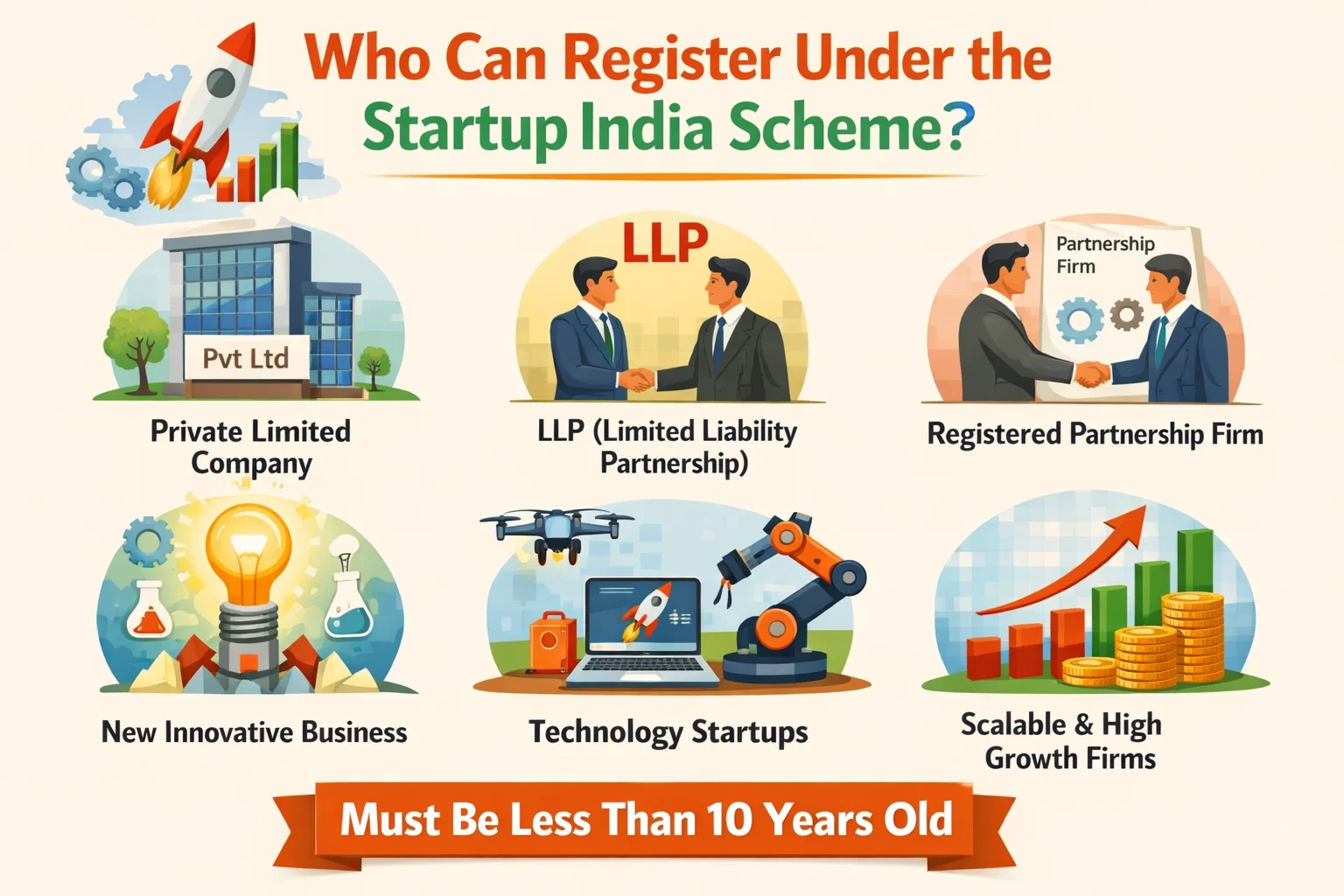
Startup India Scheme is a flagship initiative by the Government of India to support innovation-driven entrepreneurship. The Startup India scheme for new businesses provides legal recognition, tax benefits, funding support, and compliance relaxations to startups that meet prescribed criteria.
Understanding Startup India recognition eligibility is essential before applying, as only startups eligible for Startup India can access these benefits.
What Is Startup India Recognition?
Startup India recognition is granted by the Department for Promotion of Industry and Internal Trade (DPIIT). DPIIT evaluates whether a business meets the DPIIT startup eligibility guidelines based on age, turnover, innovation, and structure.
Once approved, the startup receives a DPIIT Recognition Certificate, which is mandatory to claim benefits under the Startup India scheme.
Eligible Startups for Startup India Registration
To qualify as eligible startups for Startup India, a business must meet all Startup India registration requirements listed below.
1. Type of Business Entity Allowed
As per official guidelines, the following entities are eligible:
Private Limited Company
Limited Liability Partnership (LLP)
Registered Partnership Firm
❌ Sole proprietorships are not eligible under the Startup India scheme.
This condition is a core part of Startup India registration requirements.
2. Age Limit for Startup India Recognition (Explained in Detail)
Age is one of the most critical factors in Startup India recognition eligibility.
The startup must be less than 10 years old from the date of incorporation or registration.
The age is calculated from the date mentioned on the Certificate of Incorporation.
Once a startup crosses 10 years, it automatically loses its DPIIT startup eligibility, even if it was previously recognized.
👉 This age condition applies equally to all business structures—Private Limited, LLP, and Partnership Firms.
3. Annual Turnover LimitThe startup’s turnover must not exceed ₹100 crore in any financial year since incorporation.
If turnover exceeds ₹100 crore in a particular year, the startup becomes ineligible from that year onward.
The startup’s turnover must not exceed ₹100 crore in any financial year since incorporation.
If turnover exceeds ₹100 crore in a particular year, the startup becomes ineligible from that year onward.
Maintaining this limit is mandatory for being counted among eligible startups for Startup India.
4. Innovation and Scalability Requirement
One of the most important Startup India registration requirements is innovation. The startup must:
Work towards innovation, development, or improvement of products or services
Use technology, intellectual property, or unique processes
Have a scalable business model with high growth potential
Pure trading businesses or routine services without innovation usually do not meet Startup India recognition eligibility.
5. Original Business (No Reconstruction)The startup must not be formed by splitting up or reconstructing an existing business.
Only new and original entities qualify under DPIIT startup eligibility rules.
6. Mandatory DPIIT RecognitionApplication must be submitted on the Startup India portal
DPIIT approval is compulsory
Recognition Certificate is required to claim tax and funding benefits
The startup must not be formed by splitting up or reconstructing an existing business.
Only new and original entities qualify under DPIIT startup eligibility rules.
Application must be submitted on the Startup India portal
DPIIT approval is compulsory
Recognition Certificate is required to claim tax and funding benefits
Without DPIIT approval, a business cannot avail benefits under the Startup India scheme for new businesses.
7. Indian Incorporation RequirementThe startup must be incorporated in India
Foreign companies, branches, or liaison offices are not eligible startups for Startup India
Who Is NOT Eligible Under Startup India?
The startup must be incorporated in India
Foreign companies, branches, or liaison offices are not eligible startups for Startup India
The following do not meet Startup India recognition eligibility:
Sole proprietorship firms
Businesses older than 10 years
Companies with turnover above ₹100 crore
Non-innovative traditional businesses
Reconstructed or split entities
Benefits for Eligible Startups Under Startup India
Once a business qualifies under DPIIT startup eligibility, it can access:
3-year income tax exemption under Section 80-IAC
Angel tax exemption (subject to approval)
80% rebate on patent filing fees
Fast-track patent and trademark examination
Self-certification under labor and environmental laws
Easier participation in government tenders
These benefits make the Startup India scheme for new businesses highly valuable.
Documents Required as per Startup India Registration Requirements
To apply successfully, startups must submit:
Certificate of Incorporation/Partnership Deed
PAN of the entity
Details of directors or partners
Description of innovation or scalability
Authorized representative details
Proper documentation improves chances of approval under Startup India recognition eligibility.
Frequently Asked Questions (FAQs)1. Who are eligible startups for Startup India?
Eligible startups for Startup India include Private Limited Companies, LLPs, and Partnership Firms that are less than 10 years old, have turnover below ₹100 crore, and focus on innovation or scalable business models.
2. What is the age limit under Startup India recognition eligibility?
The startup must be incorporated within the last 10 years. Any entity older than 10 years does not qualify under DPIIT startup eligibility.
3. Is Startup India scheme for new businesses only?
Yes. The Startup India scheme for new businesses is specifically designed for early-stage and growth-oriented startups that meet age, turnover, and innovation criteria.
4. What are the Startup India registration requirements?
Startup India registration requirements include:
Eligible business structure
Age below 10 years
Turnover below ₹100 crore
Innovation or scalability
DPIIT recognition
5. Can service-based startups apply for Startup India?
Yes. Service-based startups are eligible if they demonstrate innovation, technology usage, or scalability and meet Startup India recognition eligibility norms.
6. Is DPIIT recognition mandatory for Startup India benefits?
Yes. DPIIT recognition is compulsory. Without it, a startup cannot claim tax exemptions or benefits under the Startup India scheme for new businesses.
7. Can an existing business apply for Startup India?
Only if it is not older than 10 years, not reconstructed, and meets DPIIT startup eligibility criteria.
Final Words
Understanding eligible startups for Startup India, Startup India registration requirements, and DPIIT startup eligibility is crucial before applying. If your startup is innovative, within the age limit, and properly registered in India, Startup India recognition can significantly boost your growth journey.
Startup Registration Support Number for India
Our Startup Registration Support Number, +91 63956 22281, is available to help you register your startup smoothly and legally.