
Trust vs Section 8 Company vs Society: Which One to Choose in India?
First Startup
Oct 27, 2026
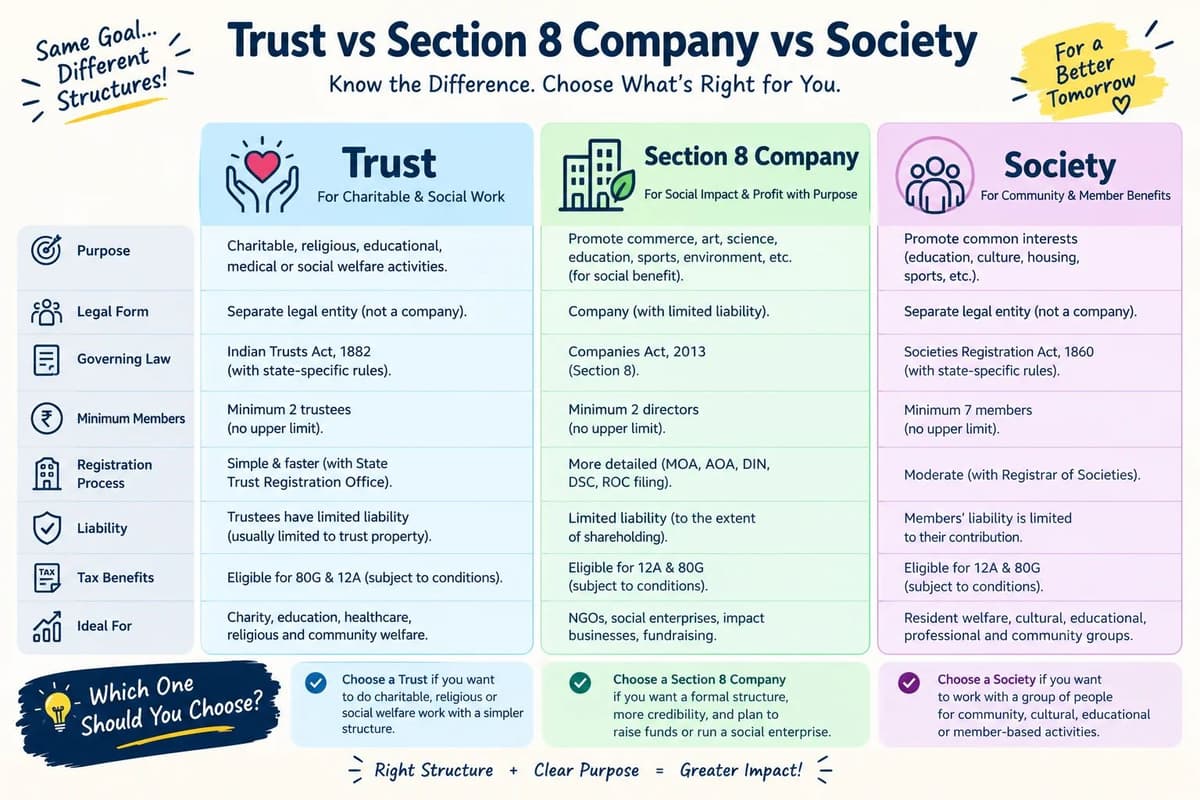
If you are planning to start an NGO, charitable organisation, educational institution, or social welfare initiative in India, one of your first decisions is choosing the right legal structure. The three common options are a Trust, a Society, and a Section 8 Company.
Each structure has a different registration process, governance model, legal framework, and compliance burden. Choosing the right one can help you manage donations, organise your activities, build credibility, and plan for long-term growth.
In this guide, we explain Trust vs Section 8 Company vs Society: Which One to Choose? We compare their features, registration requirements, advantages, limitations, tax-related approvals, and suitability for different types of NGOs.
What Is the Difference Between a Trust, Section 8 Company, and Society?
A Trust is generally suitable for charitable activities managed by trustees. A Society is designed for a group of members working towards a common objective. A Section 8 Company is a nonprofit company incorporated under the Companies Act, 2013, for eligible charitable or other specified objectives.
All three structures can be used for eligible nonprofit activities, but their governance and compliance requirements differ.
Trust vs Section 8 Company vs Society: Comparison Table
| Basis of comparison | Trust | Society | Section 8 Company |
|---|---|---|---|
| Governing framework | Applicable trust law and state public-trust laws, where relevant | Societies Registration Act, 1860, or applicable state legislation | Companies Act, 2013 |
| Registration authority | Depends on the state and type of trust | Registrar of Societies or relevant state authority | Registrar of Companies through the MCA |
| Founding requirements | Depend on applicable law and the trust structure | Generally seven persons under the central Act; check state law | At least two members and two directors for a private Section 8 company |
| Management | Trustees | Governing body or managing committee | Board of directors |
| Decision-making | As provided in the trust deed | According to membership rules and governing documents | According to the Companies Act, memorandum, articles, and board procedures |
| Main documents | Trust deed and applicable supporting documents | Memorandum of Association and rules and regulations | Memorandum of Association and Articles of Association |
| Compliance burden | Varies by state and trust type | Varies by state and governing requirements | Generally higher because company-law compliance applies |
| Suitable for | Founder-led charitable activities and philanthropy | Member-led associations and community organisations | Professionally governed nonprofit organisations and planned institutional growth |
| Tax benefits | Separate eligibility and approvals apply | Separate eligibility and approvals apply | Separate eligibility and approvals apply |
| CSR funding | Possible if applicable legal conditions are met | Possible if applicable legal conditions are met | Possible if applicable legal conditions are met |
Important: The exact requirements for Trusts and Societies vary by state. Registration as any one of these structures does not automatically grant income-tax exemption, donor deductions, CSR funding eligibility, or permission to receive foreign contributions.
1. What Is a Trust?
A charitable Trust is an arrangement in which property or assets are held and managed by trustees for specified charitable or other lawful purposes.
Trusts are commonly used for education, healthcare, poverty relief, religious activities, community welfare, and other charitable initiatives.
The governing document is generally the trust deed, which sets out the objectives, powers of trustees, management arrangements, and rules for using the Trust's assets.
Key Features of a Trust
Managed by trustees according to the trust deed.
Often suitable for founder-led or family-led philanthropic activities.
Registration procedures depend on the type of Trust and applicable state laws.
Assets must be used according to the Trust's lawful purposes and governing documents.
Tax registrations and other approvals may be needed to obtain specific benefits.
Advantages of a Trust
1. Suitable for charitable activities
A Trust can be an appropriate structure for supporting education, healthcare, relief programmes, and other charitable initiatives.
2. Deed-based management
The trust deed can establish the trustees' responsibilities, appointment procedures, and decision-making arrangements, subject to applicable law.
3. Useful for asset-based philanthropy
A Trust may suit founders who intend to dedicate property or other assets to a continuing charitable purpose.
Limitations of a Trust
Registration and reporting requirements vary by state.
The structure may be less suitable for organisations requiring a broad membership system.
Changes to the deed or trustees may require prescribed procedures or approvals.
The organisation must maintain appropriate financial records and comply with applicable tax requirements.
Who Should Choose a Trust?
A Trust may be suitable if you want to establish a charitable organisation with trustee-based management, particularly for local philanthropy, educational support, or long-term charitable activities.
2. What Is a Society?
A Society is a membership-based organisation established for eligible purposes such as education, science, literature, culture, charitable activities, and social welfare.
Societies are generally registered under the Societies Registration Act, 1860, or the applicable state legislation. State laws may change membership requirements and registration procedures.
Under the central Act, a Society is generally formed by at least seven persons. You should verify the rules applicable in the state where you intend to register.
Key Features of a Society
Operates through members and a governing body.
Uses a memorandum and rules or regulations to define its objectives and management.
Supports collective decision-making through membership procedures.
Can undertake eligible charitable, educational, cultural, and community activities.
Must comply with applicable state filing and governance requirements.
Advantages of a Society
1. Membership-based management
A Society can be appropriate when several people want to participate in decisions and elect or appoint a governing body.
2. Suitable for community organisations
Educational associations, cultural groups, welfare organisations, and membership-based initiatives may benefit from this structure.
3. Shared responsibility
The organisation's rules can define the responsibilities of members and governing-body officeholders.
Limitations of a Society
A larger founding group may be required than for a private Section 8 Company.
Disputes can arise over elections, membership, or governing-body decisions.
Filing and renewal-related requirements depend on applicable state law.
Changes to the constitution and management must follow prescribed procedures.
Who Should Choose a Society?
A Society may be the right choice if your organisation is based on collective participation, elected leadership, and a membership community—for example, a cultural association, educational group, or community welfare organisation.
3. What Is a Section 8 Company?
A Section 8 Company is a nonprofit company incorporated under Section 8 of the Companies Act, 2013.
It must pursue eligible objectives such as promoting education, art, science, sports, social welfare, charity, research, religion, environmental protection, or other permitted purposes. Its profits and income must be applied towards its objectives, and it cannot distribute dividends to its members.
A Section 8 Company follows a formal corporate governance structure and is registered through the Ministry of Corporate Affairs (MCA) process.
Key Features of a Section 8 Company
Incorporated under the Companies Act, 2013.
Governed by a board of directors and its constitutional documents.
Subject to company-law accounting, audit, and filing requirements.
Profits must be applied towards permitted objectives.
Members cannot receive dividends from the company's profits.
Advantages of a Section 8 Company
1. Formal governance structure
Board procedures and statutory records can help establish clear accountability and decision-making processes.
2. Suitable for planned growth
A Section 8 Company can be appropriate for organisations intending to work with institutional partners, develop professional teams, or expand their operations.
3. Corporate documentation
MCA records and formal reporting may help institutional partners conduct due diligence, although funding decisions depend on the funder's own criteria.
4. Clear nonprofit purpose
The legal framework requires the organisation to apply its income towards its permitted objectives and restricts dividend distribution.
Limitations of a Section 8 Company
Incorporation requires prescribed documents and regulatory approval.
Annual compliance is generally more extensive than for many small Trusts.
Accounting, audit, board governance, and statutory filing costs should be budgeted for.
Changes to company records and governance must follow company-law procedures.
Who Should Choose a Section 8 Company?
A Section 8 Company may be suitable if you plan to build a professionally managed nonprofit, seek institutional partnerships, or develop a structured organisation with formal governance and long-term expansion plans.
Trust vs Section 8 Company vs Society: Which Is Better for an NGO?
There is no single structure that is best for every NGO. Your choice should depend on how the organisation will be managed, who will participate in decisions, the funding you expect, and the compliance you can maintain.
Choose a Trust If:
You prefer trustee-based management.
Your charitable work is founder-led or family-led.
You want to dedicate assets to a continuing charitable purpose.
The Trust structure is suitable under the relevant state law.
Choose a Society If:
You have a group of people working towards a shared objective.
Members should participate in elections and governance.
Your organisation is community-based or membership-driven.
You can comply with the applicable state requirements.
Choose a Section 8 Company If:
You prefer a formal board-based governance structure.
You intend to build a professionally managed nonprofit.
You expect to work with institutional donors or corporate partners.
You can manage the additional corporate compliance requirements.
These are general guidelines, not legal rules that restrict each structure to a particular activity. All three may undertake eligible charitable work if their objects, registration, and operations comply with applicable law.
Registration Process: Trust vs Society vs Section 8 Company
The registration process differs according to the legal structure and applicable jurisdiction.
Trust Registration Process
Decide the charitable objectives and proposed name.
Identify the settlor and trustees.
Prepare the trust deed.
Arrange the applicable stamp duty and supporting documents.
Execute and register the deed through the appropriate authority, where required.
Complete any additional state-specific public-trust registration or formalities.
The exact process depends on the type of Trust and the state in which it is established.
Society Registration Process
Finalise the Society's objectives and name.
Identify the required founding members.
Prepare the Memorandum of Association.
Draft the rules and regulations.
Collect the required identity, address, and supporting documents.
Submit the application to the relevant Registrar.
Respond to any queries and obtain the registration certificate.
Check the applicable state law because membership and filing requirements may differ.
Section 8 Company Registration Process
Decide the proposed name and nonprofit objectives.
Identify the proposed members and directors.
Obtain the required digital signatures and director identification, where applicable.
Prepare the Memorandum of Association and Articles of Association.
Submit the applicable incorporation forms and Section 8 application through the MCA process.
Provide the required declarations, identity documents, and registered-office information.
Respond to any regulatory queries and obtain the incorporation documents once approved.
The documents and forms depend on the proposed structure and current MCA requirements.
Tax Benefits: 12A/12AB and 80G for NGOs
Founders often assume that registering a Trust, Society, or Section 8 Company automatically provides tax exemptions. This is not correct.
The organisation must separately satisfy the relevant conditions and obtain the applicable tax registration or approval.
Commonly used terms include:
12A/12AB: Terms historically associated with registration for eligible charitable institutions under the Income-tax Act framework.
80G: Terms historically associated with approval that may allow eligible donors to claim deductions for qualifying donations.
PAN: A tax identification number needed for the organisation's financial and tax-related activities.
India's Income-tax Act framework changed from 1 April 2026, so organisations registering or applying for approvals should verify the applicable current provisions, forms, and transitional rules rather than relying only on older section numbers.
Tax benefits depend on eligibility, the applicable law, and the organisation's continuing compliance. Registration alone does not guarantee exemption or donor deductions.
Can a Trust, Society, or Section 8 Company Receive CSR Funding?
Eligible nonprofit entities may receive Corporate Social Responsibility (CSR) funding if they meet the applicable requirements under the Companies Act, 2013, and the CSR Rules.
Depending on the entity and its circumstances, requirements can include:
Appropriate registration and charitable objects.
Compliance with the conditions for implementing CSR activities.
Registration with the MCA through the prescribed CSR-1 process, where required.
Relevant income-tax registrations or approvals.
Experience or track-record requirements where applicable.
A Section 8 Company is not automatically eligible for CSR funding merely because it has been incorporated. Trusts and Societies may also qualify if they meet the relevant requirements.
If CSR funding is an important part of your plan, review the current CSR Rules before choosing a structure.
Can These Organisations Receive Foreign Donations?
Trusts, Societies, and Section 8 Companies may be able to receive foreign contributions, but they must comply with the Foreign Contribution (Regulation) Act, 2010 (FCRA) and the applicable rules.
Depending on the circumstances, an organisation may need FCRA registration or prior permission before accepting foreign contributions. Additional eligibility conditions, documentation, and banking requirements apply.
Do not accept foreign contributions until you have verified that the organisation is legally permitted to receive them. The legal structure alone does not provide FCRA permission.
Common Mistakes to Avoid When Choosing an NGO Structure
Before registering, avoid these common mistakes:
Choosing a structure only because its initial registration appears cheaper.
Assuming tax exemption is automatic.
Assuming registration guarantees CSR or foreign funding.
Ignoring state-specific Trust or Society requirements.
Underestimating annual compliance costs.
Drafting vague charitable objectives.
Failing to define how trustees, members, or directors will be appointed.
Selecting a structure without considering long-term governance and fundraising plans.
A well-planned structure can help prevent administrative difficulties later.
How FirstStartup.in Can Help with NGO Registration
Choosing the right structure is an important step when establishing an NGO or charitable organisation. You may need assistance with documentation, registration procedures, tax-related approvals, and ongoing compliance.
FirstStartup.in provides assistance with:
Trust Registration
Society Registration
Section 8 Company Registration
NGO Registration Assistance
PAN and related registration guidance
GST Registration, where applicable
Accounting and compliance support
Assistance with relevant tax-registration processes
Our team can help you understand the registration options and documentation requirements for your proposed organisation.
Visit www.firststartup.in or contact +91 63956 22281 to discuss your registration requirements.
Frequently Asked Questions (FAQs)
1. Which is better: Trust, Society, or Section 8 Company?
It depends on your goals. A Trust may suit trustee-led charitable work, a Society may suit a membership-based organisation, and a Section 8 Company may suit an organisation that prefers formal corporate governance.
2. Which NGO structure is easiest to register?
The process depends on the state, the entity type, the documents, and the relevant authorities. Trust registration may be relatively straightforward in some jurisdictions, while a Section 8 Company requires compliance with the MCA incorporation process.
3. How many people are required to start a Section 8 Company?
A private Section 8 Company generally requires at least two members and two directors, subject to applicable company-law requirements. A public company structure has different minimum requirements.
4. How many members are required to register a Society?
Under the central Societies Registration Act, 1860, seven or more persons are generally required. State-specific legislation may provide different requirements, so confirm the rules in your state.
5. Does a Trust need 12AB and 80G approval?
A Trust seeking the relevant income-tax benefits must satisfy the applicable legal conditions and obtain the required registrations or approvals. These benefits are not automatically granted by Trust registration.
6. Can a Section 8 Company earn a profit?
A Section 8 Company may generate income through activities consistent with its permitted objectives and legal requirements. Its income must be applied towards those objectives, and dividends cannot be distributed to members.
7. Which structure is better for CSR funding?
There is no automatic winner. A Section 8 Company may provide a familiar corporate governance framework, but eligible Trusts and Societies can also receive CSR funding if they meet the applicable requirements.
8. Can an NGO receive foreign donations after registration?
Not automatically. The organisation must comply with FCRA requirements and obtain registration or prior permission, as applicable, before receiving foreign contributions.
9. Can I convert a Trust into a Section 8 Company?
Changing from one legal structure to another is not always a simple conversion. The available options depend on the original entity, applicable laws, assets, liabilities, contracts, tax status, and regulatory requirements. Obtain professional advice before attempting a restructuring.
10. Does NGO registration provide tax exemption automatically?
No. Registration establishes the legal entity under the relevant framework. Tax exemptions and donor-related benefits require separate eligibility checks and applicable approvals.
Conclusion
Choosing between a Trust, Section 8 Company, and Society depends on your nonprofit's purpose, governance preferences, funding plans, and ability to manage compliance.
A Trust may be appropriate for trustee-led philanthropy, a Society may work well for a member-driven organisation, and a Section 8 Company may be suitable for a nonprofit seeking a formal corporate governance structure.
Before registering, compare the legal requirements, documentation, costs, tax-related approvals, and long-term plans. For assistance with NGO registration and business compliance in India, contact First Startup.