
Section 151 of Income Tax Act – Sanction for Reassessment Notice in India
First Startup
Nov 12, 2026
Receiving an income tax reassessment notice can create confusion for taxpayers, especially when they believe their income tax return has already been properly filed or their assessment has been completed. However, under certain circumstances, the Income Tax Department can initiate reassessment proceedings if it has information suggesting that taxable income has escaped assessment.
One important legal requirement in this process is Section 151 of the Income-tax Act, 1961, which deals with the sanction or approval required for issuing reassessment notices.
Understanding Section 151 is important for taxpayers, businesses, professionals, and tax consultants because the approval of the specified authority is an important part of the reassessment procedure.
Important legal update: The Income-tax Act, 1961 was replaced by the Income-tax Act, 2025 with effect from 1 April 2026. Section 151 remains relevant for earlier tax years under the transition provisions. Its corresponding provision for the new Act is Section 284. The applicable law depends on the tax year and the proceedings involved.
What Is Section 151 of the Income-tax Act?
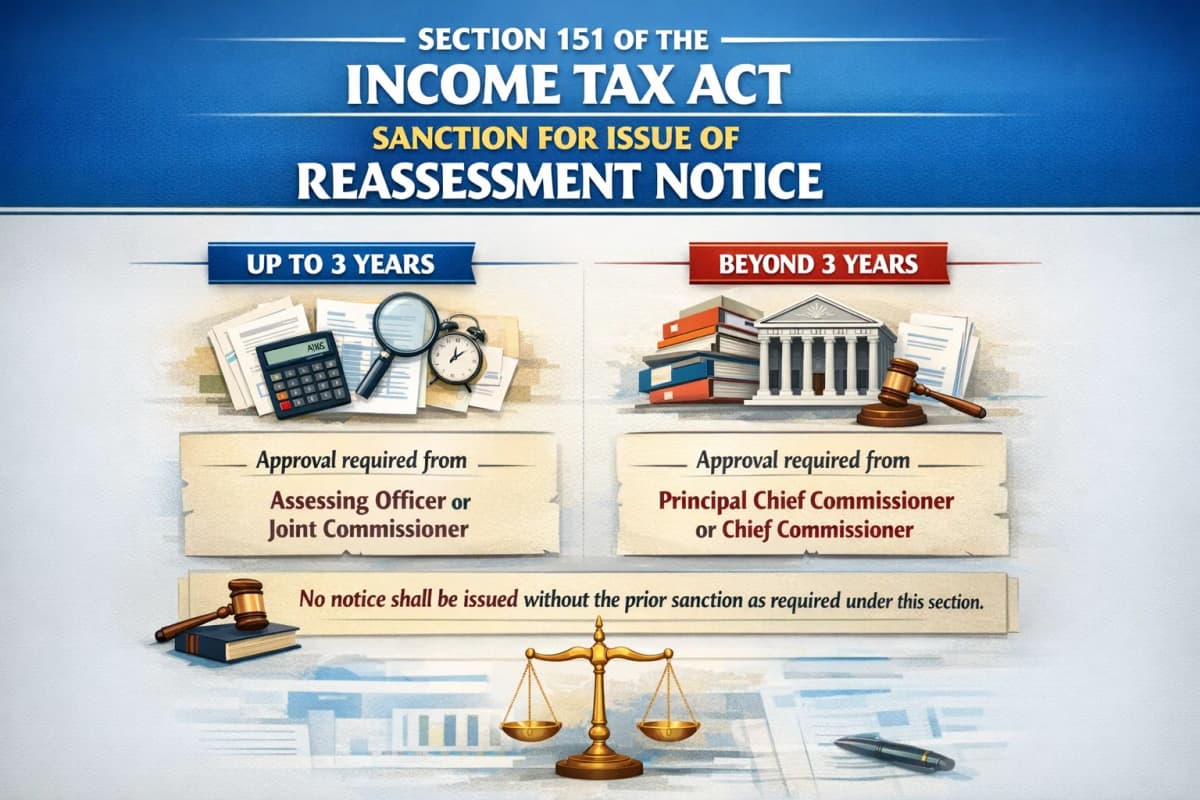
Section 151 of the Income-tax Act, 1961 deals with the specified authority whose sanction is required for issuing notices under Sections 148 and 148A.
In simple terms, it establishes the approval requirement associated with initiating income tax reassessment proceedings.
The purpose of this provision is to ensure that reassessment notices are issued through the prescribed legal process and with the approval of the appropriate authority.
Section 151 should be read along with:
Section 147: Income escaping assessment.
Section 148: Issue of notice for reassessment.
Section 148A: Procedure before issuing a reassessment notice.
Section 149: Time limits for issuing reassessment notices.
Section 151: Specified authority and sanction for issuing notices.
These provisions work together to regulate the reassessment process.
Who Can Give Sanction Under Section 151?
Under the version of Section 151 applicable from 1 September 2024, the specified authority for the purposes of Sections 148 and 148A is:
Additional Commissioner of Income Tax.
Additional Director of Income Tax.
Joint Commissioner of Income Tax.
Joint Director of Income Tax.
The applicable authority must be determined according to the relevant statutory provisions and the nature of the reassessment proceeding.
Important: The version of Section 151 applicable to a particular notice depends on the date of the relevant action and the law governing that proceeding. Earlier versions contained different approval arrangements. Therefore, taxpayers should not apply the current wording retrospectively without checking the applicable law.
Why Is Sanction Required for Reassessment Notices?
Sanction under Section 151 is an important procedural safeguard in reassessment proceedings.
It helps ensure that the Assessing Officer follows the prescribed approval process before issuing the relevant notice.
Some important purposes include:
1. Legal Compliance
The Assessing Officer must follow the applicable statutory requirements before initiating reassessment proceedings.
2. Authority Verification
The approval must come from the authority prescribed under the applicable version of the law.
3. Procedural Safeguard
The approval requirement forms part of the statutory safeguards applicable to reopening an assessment.
4. Protection of Taxpayers
The prescribed procedure helps prevent reassessment notices from being issued without satisfying the applicable legal requirements.
5. Proper Administration of Tax Proceedings
The sanction mechanism establishes an approval framework for reassessment-related actions.
Relationship Between Section 151 and Sections 148 and 148A
To understand Section 151 properly, it is important to understand how reassessment proceedings generally operate under the Income-tax Act, 1961.
Section 147 – Income Escaping Assessment
Section 147 provides the legal framework for assessing or reassessing income that has escaped assessment, subject to the applicable conditions.
Section 148 – Issue of Reassessment Notice
Section 148 deals with issuing a notice requiring the taxpayer to furnish a return in cases where reassessment proceedings are initiated.
Section 148A – Procedure Before Issuing Notice
Section 148A generally provides a preliminary procedure before issuing a notice under Section 148.
This may involve:
Information suggesting that income has escaped assessment.
Issuing a show-cause notice to the taxpayer.
Providing an opportunity to submit an explanation.
Considering the taxpayer's response.
Passing an order deciding whether it is a fit case for issuing a reassessment notice.
The procedure is subject to statutory exceptions and the applicable version of the law.
Section 151 – Sanction for Issue of Notice
Section 151 identifies the specified authority for the purposes of Sections 148 and 148A.
Therefore, Section 151 is closely connected with the legal validity of the reassessment procedure.
Step-by-Step Process of Reassessment Under the Old Income-tax Act
The following is a general outline of the reassessment procedure under Sections 147, 148, 148A and 151 of the Income-tax Act, 1961.
Step 1: Information About Escaped Income
The Assessing Officer must have information suggesting that income chargeable to tax has escaped assessment, as required under the applicable provisions.
Step 2: Examination of Information
The Assessing Officer examines the available information and determines whether the statutory conditions for initiating reassessment proceedings are satisfied.
Step 3: Show-Cause Notice Under Section 148A
Where the preliminary procedure applies, the taxpayer is provided an opportunity to explain why a notice under Section 148 should not be issued.
Step 4: Consideration of Taxpayer's Reply
The taxpayer can submit relevant explanations, documents, financial records, and supporting evidence.
The Assessing Officer must consider the response in accordance with the applicable legal requirements.
Step 5: Approval of the Specified Authority
The required approval must be obtained from the authority prescribed under Section 151, as applicable to the relevant proceeding.
Step 6: Issue of Reassessment Notice
After satisfying the applicable statutory requirements, the Assessing Officer may issue a notice under Section 148.
Step 7: Reassessment Proceedings
The taxpayer must respond to the notice and participate in the reassessment proceedings within the prescribed timelines.
What Happens If Sanction Under Section 151 Is Not Obtained?
Sanction is an important statutory requirement. If approval is required but has not been obtained, or if approval is obtained from an authority that is not competent under the applicable law, the reassessment proceedings may be legally challenged.
However, the legal consequences depend on the facts, the applicable statutory version, and the nature of the procedural defect.
Some issues that may require examination include:
Whether approval was legally required.
Whether approval was obtained before the relevant notice was issued.
Whether the approving authority was competent.
Whether the correct statutory procedure was followed.
Whether the applicable time limit was satisfied.
Whether the required preliminary procedure was completed.
A procedural defect should be examined in the context of the entire reassessment record. It should not automatically be assumed that every error makes a notice invalid.
How Can a Taxpayer Challenge a Reassessment Notice?
If a taxpayer receives a reassessment notice, it is important to examine the notice and related proceedings carefully.
The following points may help:
1. Check the Notice Details
Verify the taxpayer's PAN, assessment year, notice date, issuing authority, and statutory provision mentioned in the notice.
2. Verify the Reassessment Procedure
Check whether the applicable procedure under Section 148A was followed or whether a statutory exception applies.
3. Examine the Approval Requirement
Verify whether the required sanction under Section 151 was obtained from the competent specified authority.
4. Check the Limitation Period
Review the applicable time limits under Section 149 and other relevant provisions.
5. Review the Information and Reasons
Examine the information relied upon by the Assessing Officer and the order passed during the preliminary reassessment process, where applicable.
6. Submit an Appropriate Response
Prepare a factual and legally supported response within the prescribed deadline.
7. Seek Professional Advice
A tax professional can examine the notice, approval records, applicable provisions, and relevant judicial decisions before recommending further action.
Important Supreme Court Judgment on Reassessment: Union of India v. Rajeev Bansal
The Supreme Court judgment in Union of India v. Rajeev Bansal, decided on 3 October 2024, is an important decision concerning reassessment notices and the transition between the old and amended reassessment frameworks.
The judgment examined the application of the Taxation and Other Laws (Relaxation and Amendment of Certain Provisions) Act, 2020 (TOLA), and the time limits applicable to reassessment notices.
The decision is relevant when examining reassessment notices issued during the transition period around 1 April 2021.
Taxpayers and professionals should read the complete judgment and consider the relevant assessment year, notice date, statutory amendments, and facts before relying on it in a particular case.
Section 151 of the Income-tax Act, 1961 vs Section 284 of the Income-tax Act, 2025
The Income-tax Act, 2025 replaced the Income-tax Act, 1961 with effect from 1 April 2026.
The corresponding provision dealing with sanction for issuing reassessment notices is Section 284 of the new Act.
| Particulars | Income-tax Act, 1961 | Income-tax Act, 2025 |
|---|---|---|
| Sanction provision | Section 151 | Section 284 |
| Reassessment framework | Sections 147–153 | Sections 279–286 |
| Reassessment notice | Section 148 | Section 280 |
| Preliminary procedure | Section 148A | Section 281 |
| Time limit for notices | Section 149 | Section 282 |
Which Section Applies After 1 April 2026?
The applicable law depends on the tax year concerned.
For tax years beginning before 1 April 2026: The relevant reassessment proceedings continue under the Income-tax Act, 1961, including its Section 151 approval framework, subject to the savings and transition provisions.
For Tax Year 2026–27 onwards: The reassessment framework under the Income-tax Act, 2025 applies, including Section 284 for sanction.
This distinction is important because a reassessment notice issued after 1 April 2026 may still be governed by the old Act if it relates to an earlier tax year.
Common Mistakes Taxpayers Should Avoid
Taxpayers receiving reassessment notices should avoid the following mistakes:
Ignoring an income tax notice.
Missing the response deadline.
Failing to check the assessment year.
Not examining the approval requirement.
Confusing Sections 148 and 151.
Ignoring the applicable limitation period.
Submitting an incomplete response.
Failing to preserve supporting documents.
Assuming every reassessment notice is invalid.
Applying provisions of the new Income-tax Act to proceedings governed by the old Act.
A careful examination of the notice and supporting records can help taxpayers understand their legal position.
How First Startup Can Help with Income Tax Compliance
Income tax notices and reassessment proceedings can involve detailed legal and procedural requirements. Understanding the applicable law, reviewing documents, and preparing an appropriate response are important steps.
First Startup provides professional assistance with business and tax-related compliance services, including:
Income Tax Return Filing
ITR Filing for Individuals and Businesses
Tax Compliance Assistance
Accounting and Bookkeeping
GST Registration and Return Filing
TDS Return Filing
Business Registration
Financial Compliance Support
For assistance with income tax compliance and related services, contact First Startup.
Contact First Startup
Website: https://www.firststartup.in/
Phone: +91 63956 22281
Email: [email protected]
Frequently Asked Questions (FAQs)
1. What is Section 151 of the Income-tax Act?
Section 151 of the Income-tax Act, 1961 deals with the specified authority whose sanction is required for issuing notices under Sections 148 and 148A.
2. What is the purpose of Section 151?
The purpose of Section 151 is to establish the prescribed approval requirement for reassessment notices and provide a statutory safeguard in the reassessment process.
3. Who can give sanction under Section 151?
Under the version effective from 1 September 2024, the specified authority is the Additional Commissioner, Additional Director, Joint Commissioner, or Joint Director, as applicable.
4. Is approval under Section 151 required before issuing a reassessment notice?
Where the applicable statutory provisions require approval, the prescribed sanction must be obtained as part of the reassessment process. The exact requirement depends on the relevant version of the law and the nature of the proceedings.
5. What is the difference between Section 148 and Section 151?
Section 148 deals with issuing a reassessment notice, while Section 151 identifies the specified authority whose sanction is required for notices under Sections 148 and 148A.
6. What is the relationship between Section 148A and Section 151?
Section 148A provides the preliminary procedure before issuing a reassessment notice, where applicable. Section 151 identifies the specified authority for the purposes of Sections 148 and 148A.
7. Can a reassessment notice be challenged if proper sanction is not obtained?
Yes. Where sanction is legally required but has not been obtained, or has been obtained from an incompetent authority, the proceedings may be challenged. The outcome depends on the applicable law and facts.
8. Is Section 151 still applicable after 1 April 2026?
Yes, for relevant proceedings concerning tax years beginning before 1 April 2026, under the transition and savings provisions of the Income-tax Act, 2025. For Tax Year 2026–27 onwards, the corresponding provision is Section 284 of the new Act.
9. What is Section 284 of the Income-tax Act, 2025?
Section 284 is the corresponding provision dealing with sanction for issuing reassessment notices under the Income-tax Act, 2025.
10. Which sections should be read along with Section 151?
Sections 147, 148, 148A and 149 of the Income-tax Act, 1961 should be read along with Section 151 to understand the reassessment framework.
Conclusion
Section 151 of the Income-tax Act, 1961 plays an important role in the reassessment process by identifying the authority responsible for granting the required sanction for notices under Sections 148 and 148A.
Taxpayers should carefully examine the reassessment notice, applicable assessment year, approval requirement, limitation period, and procedural compliance before responding.
Since the Income-tax Act, 2025 came into effect on 1 April 2026, it is also important to distinguish between Section 151 of the old Act and Section 284 of the new Act. Understanding this transition helps taxpayers and professionals apply the correct legal provisions to reassessment proceedings.