
How to Start a Mushroom Farming Startup in India?
First Startup
Jan 30, 2026
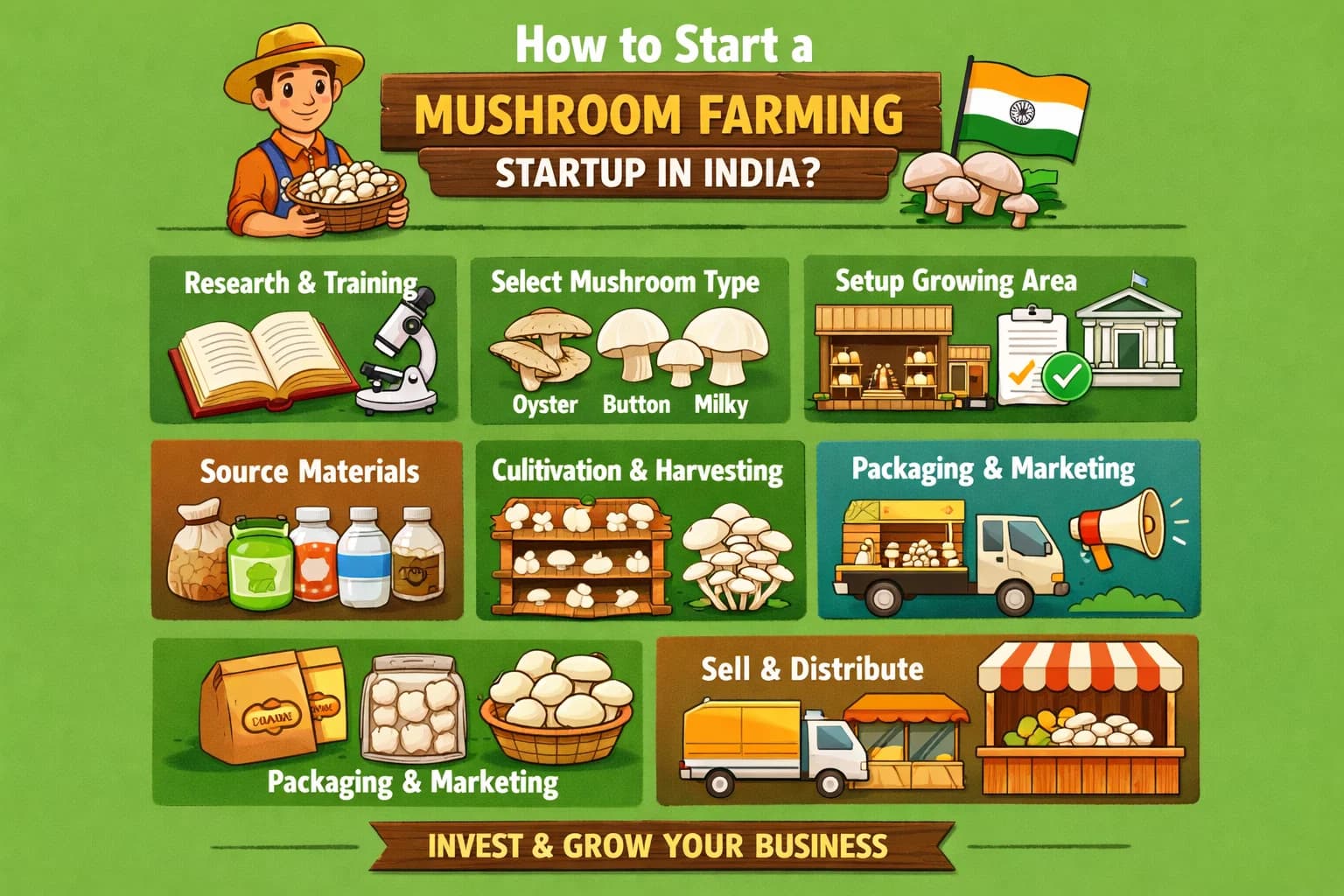
Starting a mushroom farming startup in India is one of the most profitable and sustainable agribusiness ideas today. With rising demand for healthy, protein-rich foods and low land requirements, mushroom farming is ideal for farmers, entrepreneurs, and even urban startups. Mushrooms like button, oyster, and milky mushrooms are widely consumed in hotels, restaurants, supermarkets, and households.
This detailed guide explains how to start mushroom farming in India step by step, covering types of mushrooms, investment, registration, production process, profits, and marketing.
Why Start a Mushroom Farming Business in India?
Mushroom farming offers several advantages compared to traditional agriculture:
High demand due to health awareness and vegetarian protein sources
Requires very little land and water
Can be started indoors or at home
Short crop cycle (30–45 days)
High profit margins with low initial investment
Suitable for rural and urban entrepreneurs
With government support, subsidies, and training programs, mushroom farming has become a fast-growing sector in India.
Types of Mushrooms Grown in India
Choosing the right mushroom variety is the first step toward success.
1. Button MushroomMost popular and widely consumed
Requires controlled temperature (12–18°C)
High demand in hotels and restaurants
Most popular and widely consumed
Requires controlled temperature (12–18°C)
High demand in hotels and restaurants
2. Oyster MushroomEasy to grow and beginner-friendly
Grows well in Indian climate
Low investment and fast growth
Easy to grow and beginner-friendly
Grows well in Indian climate
Low investment and fast growth
3. Milky MushroomSuitable for tropical regions
Attractive appearance and good shelf life
High demand in South India
Suitable for tropical regions
Attractive appearance and good shelf life
High demand in South India
4. Shiitake & Exotic MushroomsPremium pricing and export demand
Requires technical knowledge and climate control
Premium pricing and export demand
Requires technical knowledge and climate control
Step 1: Learn Mushroom Farming Techniques
Before starting commercially, proper training is essential. You can learn mushroom farming from:
Krishi Vigyan Kendras (KVKs)
Agricultural universities
Government training centers
Online courses and workshops
Understanding sterilization, spawning, incubation, and harvesting will reduce losses and improve yield.
Step 2: Choose the Location & Setup
Mushroom farming does not require farmland. You can start in:
A small room or shed
Basement or unused building
Polyhouse or controlled environment unit
Basic Infrastructure Required:Clean and ventilated room
Temperature and humidity control
Shelves or hanging racks
Water spraying system
Lighting (minimal requirement)
Clean and ventilated room
Temperature and humidity control
Shelves or hanging racks
Water spraying system
Lighting (minimal requirement)
Hygiene and cleanliness are critical to prevent contamination.
Step 3: Mushroom Farming Registration & Licenses
To legally start a mushroom farming startup in India, the following registrations are recommended:
Mandatory / Recommended RegistrationsBusiness Registration (Sole Proprietorship or Partnership)
FSSAI Registration (Mandatory if selling packaged mushrooms)
GST Registration (Required for branded or online sales)
Shop & Establishment License (If operating commercially)
Business Registration (Sole Proprietorship or Partnership)
FSSAI Registration (Mandatory if selling packaged mushrooms)
GST Registration (Required for branded or online sales)
Shop & Establishment License (If operating commercially)
Additional BenefitsMSME (Udyam) Registration
Bank loan and government subsidy eligibility
MSME (Udyam) Registration
Bank loan and government subsidy eligibility
Step 4: Investment & Cost Breakdown
The investment for mushroom farming depends on scale and mushroom type.
Small-Scale Setup (Home-Based)Initial setup: ₹50,000 – ₹1,00,000
Monthly operating cost: ₹10,000 – ₹20,000
Initial setup: ₹50,000 – ₹1,00,000
Monthly operating cost: ₹10,000 – ₹20,000
Medium-Scale Commercial UnitSetup cost: ₹3 lakh – ₹6 lakh
Includes racks, humidity control, spawn, and raw material
Setup cost: ₹3 lakh – ₹6 lakh
Includes racks, humidity control, spawn, and raw material
Large-Scale UnitInvestment: ₹10 lakh+
Requires cold storage and advanced climate control
Investment: ₹10 lakh+
Requires cold storage and advanced climate control
Mushroom farming is eligible for government subsidies under horticulture schemes.
Step 5: Raw Materials Required
Key raw materials for mushroom cultivation include:
Mushroom spawn (quality certified)
Substrate (wheat straw, paddy straw, sawdust)
Poly bags or trays
Disinfectants and cleaning agents
Always source spawn from reliable suppliers to ensure good yield.
Step 6: Mushroom Cultivation Process
The mushroom production cycle involves the following steps:
Substrate Preparation – Chopping, soaking, and sterilizing straw
Spawning – Mixing mushroom spawn with substrate
Incubation – Maintaining temperature and humidity for growth
Fruiting Stage – Mushrooms start appearing
Harvesting – Ready in 25–45 days depending on variety
Proper monitoring during each stage ensures high productivity.
Step 7: Yield & Profit Margin
Profitability depends on scale, variety, and market access.
Oyster mushroom yield: 80–100% of substrate weight
Average selling price: ₹120–250 per kg
Monthly profit (small unit): ₹30,000 – ₹60,000
Annual profit (commercial unit): ₹5–10 lakh
Value-added products like dried mushrooms and powder increase margins further.
Step 8: Marketing & Sales Strategy
Offline Sales ChannelsLocal vegetable markets
Hotels, restaurants, and caterers
Supermarkets and grocery stores
Local vegetable markets
Hotels, restaurants, and caterers
Supermarkets and grocery stores
Online & Direct SalesOwn website or WhatsApp orders
Amazon, BigBasket, and local delivery apps
Subscription-based home delivery
Own website or WhatsApp orders
Amazon, BigBasket, and local delivery apps
Subscription-based home delivery
Branding, freshness, and consistent supply are key to repeat customers.
Step 9: Storage, Packaging & Transportation
Fresh mushrooms have a short shelf life. Proper handling is essential:
Store at low temperature
Use breathable packaging
Deliver within 24–48 hours
Consider cold storage for scaling operations
Common Mistakes to AvoidPoor hygiene and contamination
Using low-quality spawn
Incorrect temperature and humidity control
Overproduction without assured buyers
Ignoring packaging and branding
Poor hygiene and contamination
Using low-quality spawn
Incorrect temperature and humidity control
Overproduction without assured buyers
Ignoring packaging and branding
Government Support & Subsidies
The Indian government supports mushroom farming through:
National Horticulture Mission (NHM)
NABARD loans
State agriculture department subsidies
Skill India and training programs
These schemes help reduce startup costs significantly.
Final Thoughts
A mushroom farming startup in India is a low-risk, high-return agribusiness opportunity. With minimal land, quick returns, and growing demand, it is ideal for new entrepreneurs and farmers alike.
By choosing the right mushroom variety, maintaining hygiene, following legal compliance, and building strong marketing channels, you can turn mushroom farming into a successful and scalable business.
FAQs
Q1. Is mushroom farming profitable in India?
Yes, mushroom farming offers high profit margins due to low input costs and fast crop cycles.
Q2. Do I need land to start mushroom farming?
No, mushrooms can be grown indoors in small spaces.
Q3. Is FSSAI registration required?
Yes, if you sell packaged or branded mushrooms.
Q4. Is small-scale mushroom farming profitable in India in 2026?
Yes. Small-scale mushroom farming is profitable in India in 2026 due to low startup cost, fast crop cycles (20–45 days), and growing demand from hotels, restaurants, and health-conscious consumers. With basic training, a small room setup, and proper hygiene, beginners can start with minimal investment and gradually scale up. Common varieties like oyster and button mushrooms offer good margins and steady local market demand.