
How to Get a Shop Act License in India: Step-by-Step Guide
First Startup
Oct 20, 2026
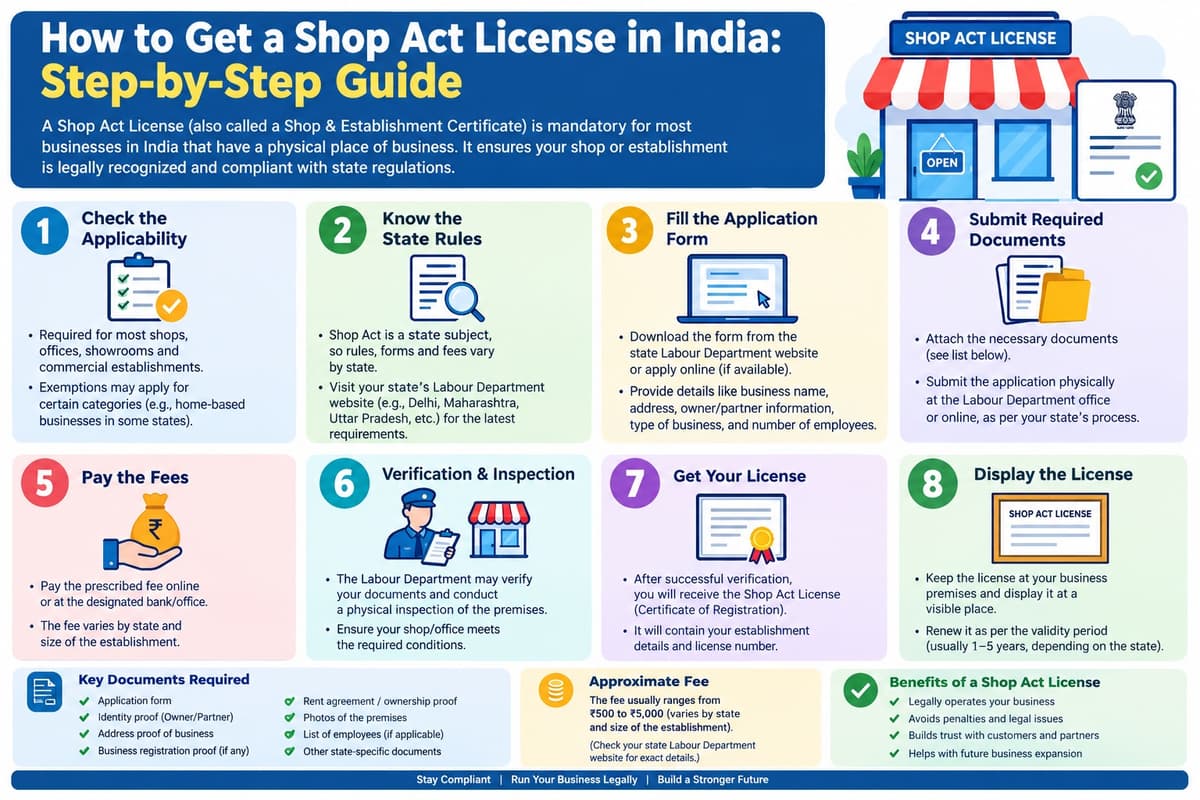
Starting a shop, retail store, office, restaurant, or other commercial establishment in India involves several legal and regulatory requirements. One important compliance requirement for eligible businesses is registration under the Shop and Establishment Act, commonly known as a Shop Act License or Shop Act Registration.
A Shop Act License helps establish the legal identity of a business and demonstrates compliance with the applicable state's rules for shops and commercial establishments. It may also be required when opening a current bank account, applying for other business registrations, or completing documentation requested by banks and authorities.
If you are planning to start a new business, this guide explains how to get a Shop Act License in India, including the online registration process, required documents, eligibility, fees, benefits, and renewal requirements.
What Is a Shop Act License?
A Shop Act License is a registration or certificate issued under the applicable state's Shops and Establishments legislation. It regulates working conditions and certain employment-related matters in shops, offices, commercial establishments, restaurants, and other covered businesses.
The rules differ from state to state. Some states issue a registration certificate, while others provide an online intimation or registration process depending on the establishment's category and employee count.
The Shop and Establishment Act generally covers matters such as:
Working hours and rest intervals
Weekly holidays
Wages and overtime provisions
Leave and holidays
Employment conditions
Maintenance of prescribed records
Applicable requirements for opening and closing establishments
Important: A Shop Act License is different from a municipal trade license, GST registration, and company incorporation. Depending on your business activity and location, you may need more than one registration.
Who Needs a Shop Act License in India?
The requirement depends on the applicable state law, the type of establishment, and the number of employees. Businesses commonly covered include:
Retail shops and wholesale businesses
Grocery stores and general stores
Offices and consultancy firms
Restaurants, cafés, and food outlets
Salons, beauty parlours, and wellness businesses
Coaching centres and commercial service providers
Private companies and branch offices
E-commerce businesses operating from commercial premises, where applicable
Other shops and commercial establishments covered by state legislation
Small businesses, sole proprietorships, partnership firms, LLPs, and private limited companies may all need to comply where the relevant law applies.
Before applying, check whether your state requires full registration, online intimation, or another form of compliance for your particular establishment.
Benefits of Shop Act Registration
Obtaining Shop Act Registration can help business owners meet applicable legal requirements and organise their business documentation.
1. Supports Legal Compliance
Registration helps eligible businesses comply with the applicable Shops and Establishments legislation.
2. Helps With Business Documentation
The certificate or acknowledgement may serve as supporting evidence of the establishment's existence and business address.
3. Can Support Current Bank Account Applications
Banks may request a Shop Act certificate or another accepted business proof when opening a current account. The exact requirements depend on the bank.
4. Useful for Business Operations
A registration document can be useful when dealing with vendors, service providers, financial institutions, or other organisations that request establishment-related documentation.
5. Helps Establish Business Details
The application records information such as the business name, address, nature of activity, employer details, and employee information, as required by the relevant state.
Documents Required for Shop Act License
The required documents vary by state, business structure, and application category. Commonly requested documents include the following.
| Document | Purpose |
|---|---|
| Aadhaar card or other accepted identity proof | Identity verification |
| PAN card | Tax and identity details |
| Business address proof | Verification of the establishment's address |
| Rent agreement or lease deed | Evidence of rented premises, where applicable |
| Electricity bill or other accepted utility bill | Address verification |
| Passport-size photograph | Applicant or proprietor identification, where required |
| Business PAN or incorporation documents | Business entity verification, where applicable |
| Partnership deed | Partnership firm applications, where applicable |
| Certificate of Incorporation | Company or LLP applications, where applicable |
| Employee details | Employment information, where required |
| Business activity details | Description of the establishment's operations |
Additional documents may be required depending on the state portal and type of business.
Tip: Keep your business name, address, applicant details, and supporting documents consistent across the application to reduce the chances of objections or delays.
How to Get a Shop Act License in India Online
The online Shop Act License process generally involves the following steps. The exact portal, form, documents, and deadlines depend on your state.
Step 1: Identify the Applicable State Portal
Visit the official Labour Department or Shops and Establishments registration portal for the state where your business operates.
For example, Maharashtra, Delhi, Karnataka, Gujarat, and other states have their own applicable procedures. Do not assume that one state's application process applies throughout India.
Step 2: Check Registration or Intimation Requirements
Review the applicable state law and portal instructions to determine whether your establishment requires registration, online intimation, or another compliance procedure.
Check the requirements for your business category and employee count before proceeding.
Step 3: Create an Account or Log In
Register on the official portal using the details requested, such as your mobile number, email address, or other verification information.
If you already have an account, sign in and select the relevant Shop and Establishment service.
Step 4: Fill Out the Application Form
Enter the required information accurately. This may include:
Name of the establishment
Name and details of the proprietor, employer, or authorised representative
Complete business address
Nature of business activity
Date of commencement
Number of employees
Working hours and weekly holiday details, where requested
Contact details
Review all information before submitting the form.
Step 5: Upload the Required Documents
Upload the identity proof, address proof, premises documents, and business-related documents specified by the portal.
Make sure the files are clear, readable, and in the permitted format and size.
Step 6: Pay the Applicable Fees
If the portal requires a registration or processing fee, pay the amount through the authorised payment method.
The fee may vary according to the state, establishment category, employee count, and applicable rules. Some registration or intimation categories may have different fee arrangements.
Save the payment receipt for future reference.
Step 7: Submit the Application
Check the form and documents, complete any required declaration, and submit the application.
Save the application number or acknowledgement so that you can track its status.
Step 8: Track the Application Status
Use the official portal to check whether the application is pending, under review, approved, or requires clarification.
If the department requests additional documents or corrections, respond according to the instructions and within the specified timeline.
Step 9: Download the Certificate or Acknowledgement
Once the application is approved or the applicable procedure is completed, download the Shop Act registration certificate, intimation acknowledgement, or other document issued by the portal.
Keep a digital copy and a printed copy if required for your business records.
Shop Act License Fees in India
There is no single nationwide fee applicable to every Shop Act License application. Fees and registration requirements are governed by the relevant state's law and administrative process.
The total cost may depend on:
State or union territory
Type of establishment
Number of employees
Registration or intimation category
Government charges
Professional fees, if you hire a consultant
To determine the exact cost, check the current fee schedule on your state's official portal.
If you hire a professional service provider, confirm whether the quoted amount includes government fees, document preparation, application submission, and follow-up support.
Shop Act License Processing Time
The processing time varies by state and application category. Some online procedures may be completed relatively quickly, while applications requiring document verification, corrections, or departmental review may take longer.
To avoid unnecessary delays:
Submit accurate information.
Upload complete and readable documents.
Use the correct state portal.
Monitor application notifications.
Respond promptly to any department queries.
Always rely on the timeline stated by the relevant department rather than assuming a fixed number of days across India.
Shop Act License in Different States
Although the general purpose of Shop Act Registration is similar across India, the applicable law and process differ by state.
Shop Act License in Delhi
Businesses covered by Delhi's applicable Shops and Establishments requirements should check the Delhi Labour Department's official services and instructions. The appropriate procedure depends on the establishment and current rules.
Shop Act License in Maharashtra
Businesses operating in Maharashtra should review the state's applicable Shops and Establishments legislation and the official Labour Department portal. Registration or intimation requirements may depend on the number of workers and other statutory conditions.
Shop Act License in Karnataka
Business owners in Karnataka should consult the relevant state Labour Department services to confirm registration requirements, application details, documents, and fees.
Shop Act License in Gujarat
Businesses in Gujarat should use the applicable state or local government portal and verify the procedure for their type of establishment.
Note: These examples are not a substitute for checking the current rules in your state. Always confirm the latest requirements through the relevant official department.
Difference Between Shop Act License, Trade License, and GST Registration
Business owners sometimes confuse these registrations, but each serves a different purpose.
| Registration | Main purpose |
|---|---|
| Shop Act License | Compliance with applicable Shops and Establishments legislation |
| Municipal Trade License | Permission or authorisation for specified business activities under applicable local rules |
| GST Registration | Compliance with GST requirements when registration is mandatory or otherwise applicable |
| Udyam Registration | Registration as a micro, small, or medium enterprise under the applicable MSME framework |
| Company Incorporation | Creation of a company as a legal entity under company law |
Depending on your business, you may need one or several of these registrations. Obtaining one does not automatically replace the others.
Common Mistakes to Avoid During Shop Act Registration
Avoid these common errors when applying for a Shop Act License online:
Selecting the wrong state portal: Apply through the authority responsible for your establishment's location.
Entering incorrect business details: Ensure the establishment name and address match the supporting documents.
Uploading incomplete documents: Check the current document checklist before submission.
Ignoring employee-related details: Provide the required workforce and working-condition information.
Assuming fees are the same everywhere: Verify the applicable state's current fee schedule.
Missing application notifications: Track the application and respond to department queries promptly.
Ignoring continuing compliance: Review applicable renewal, amendment, display, recordkeeping, and employment-related requirements.
How FirstStartup Can Help With Shop Act Registration
FirstStartup provides professional business registration and compliance support for entrepreneurs, startups, and established businesses.
If you need help understanding the Shop Act Registration process, preparing documents, or identifying the relevant state procedure, professional assistance can help you organise the application.
FirstStartup offers support across business registration and compliance services, including company incorporation, GST registration, MSME registration, trademark registration, income tax return filing, and ongoing compliance.
Visit FirstStartup.in to explore the available services.
Before engaging a service provider, confirm the scope of work, applicable government fees, professional charges, and expected timeline.
Frequently Asked Questions About Shop Act License
1. How can I get a Shop Act License in India?
Identify the applicable state portal, check the registration requirements, complete the online application, upload the required documents, pay applicable fees, and submit the form. After completing the required procedure, obtain the certificate or acknowledgement issued by the authority.
2. Can I apply for a Shop Act License online?
Yes, many states provide online registration or intimation facilities. The exact process and eligibility depend on the applicable state legislation and the type of establishment.
3. Is a Shop Act License mandatory for every business?
Not necessarily. The requirement depends on the state's law, the nature of the establishment, employee count, and applicable exemptions or alternative procedures.
4. What documents are required for Shop Act Registration?
Common documents include identity proof, PAN, business address proof, rent agreement where applicable, photographs, and business constitution documents. The exact checklist varies by state.
5. How much does a Shop Act License cost?
There is no uniform fee for all of India. Government charges depend on the applicable state rules and registration category. Professional service fees may be additional.
6. How many days does it take to get a Shop Act License?
The timeline varies by state, application category, and verification requirements. Check the official portal for the applicable service timeline.
7. Is a Shop Act License the same as a trade license?
No. A Shop Act License relates to applicable Shops and Establishments legislation, whereas a municipal trade license relates to permissions under relevant local rules. A business may need both, depending on its activity and location.
8. Can a sole proprietor apply for a Shop Act License?
Yes, a sole proprietor can apply where the applicable state requirements cover the establishment. The proprietor must submit the documents and information requested by the relevant authority.
9. Is a Shop Act License required for a home-based business?
It depends on the state law, the nature of the activity, the premises, and any applicable exemptions. Home-based businesses should verify their specific requirements before applying.
10. Does a Shop Act License need renewal?
Renewal requirements depend on the relevant state legislation and the type of registration or certificate issued. Check whether your state requires renewal, amendments, or other ongoing compliance.
11. Can I open a current bank account without a Shop Act License?
Possibly. Banks accept different combinations of business and address documents, depending on the entity and account type. A Shop Act certificate may be requested, but it is not necessarily the only acceptable document.
12. Can I use a Shop Act License for GST registration?
A Shop Act certificate may serve as supporting business documentation in some circumstances, but it does not replace GST registration. GST requirements must be assessed separately.
Conclusion
Getting a Shop Act License in India is an important compliance step for businesses covered by the applicable Shops and Establishments legislation. The process generally involves selecting the correct state portal, checking eligibility, preparing documents, submitting the application, paying any applicable fees, and obtaining the relevant certificate or acknowledgement.
Since rules, fees, employee thresholds, and procedures vary by state, verify the latest official requirements before applying.
If you are setting up a new business, FirstStartup can help you explore relevant business registration and compliance services so that you can focus on building your business while organising the required documentation.