
How to Get Organic Food Certification in India? Complete Step-by-Step Guide
First Startup
May 25, 2026
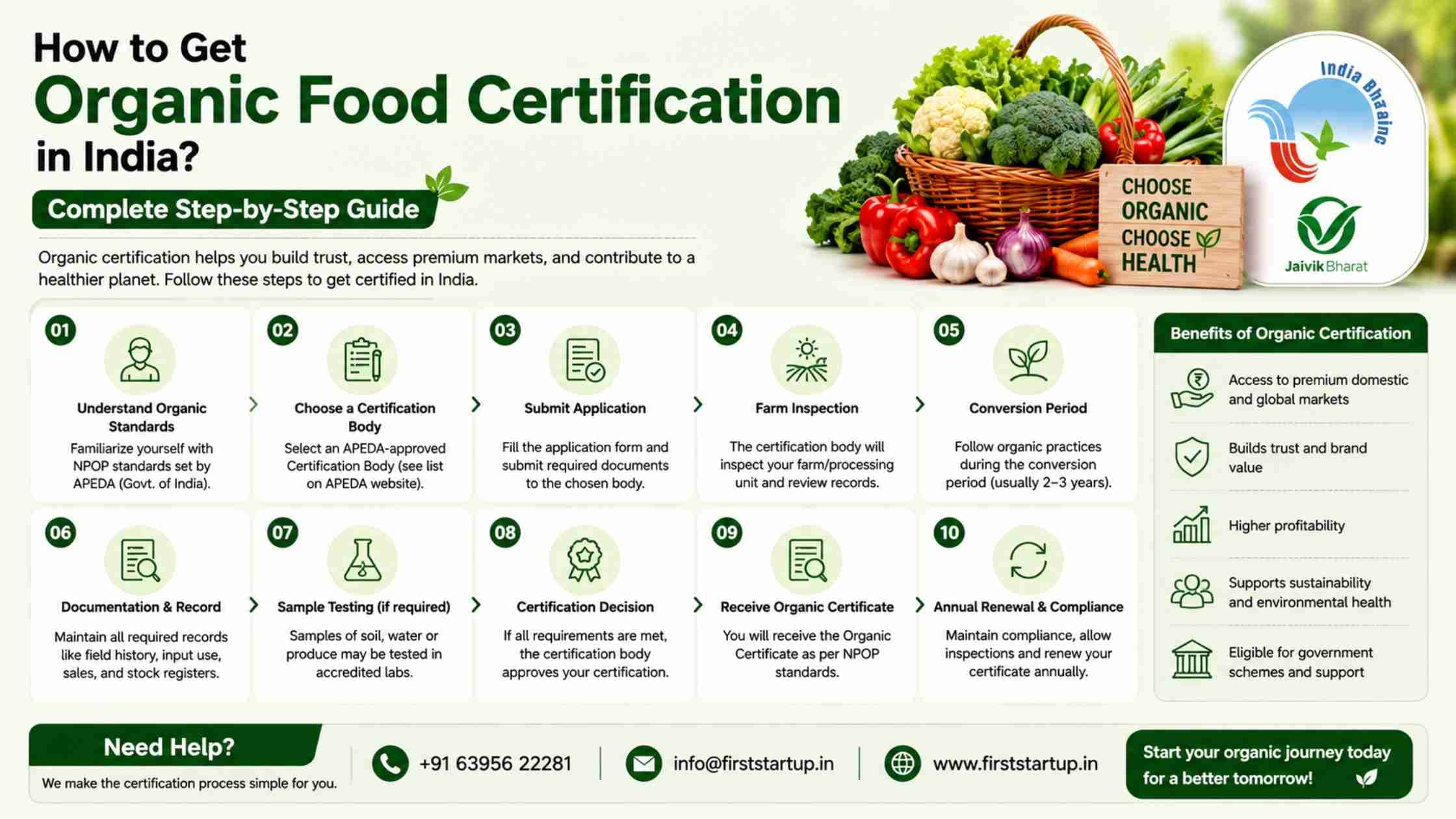
Organic farming is becoming one of the fastest-growing agricultural sectors in India. Consumers today prefer chemical-free fruits, vegetables, grains, dairy products, and packaged foods. Because of this growing demand, organic food businesses and farmers are increasingly looking for organic food certification in India.
Organic certification helps farmers, food manufacturers, exporters, startups, and retailers prove that their products are produced without harmful chemicals, pesticides, or synthetic fertilizers. It also builds customer trust and improves market value.
In this detailed guide, you will learn everything about organic food certification in India, including eligibility, certification process, required documents, cost, benefits, and government authorities involved.
What is Organic Food Certification?
Organic food certification is an official approval provided by authorized certification bodies that confirms agricultural products are produced according to organic farming standards.
The certification ensures that:
- No synthetic fertilizers are used
- No harmful pesticides are used
- GMOs (Genetically Modified Organisms) are avoided
- Soil and water conservation methods are followed
- Organic processing and packaging standards are maintained
Certified organic products can use the official organic logo and can be legally sold as “organic” in India and international markets.
Types of Organic Certification in India
India mainly follows two major organic certification systems:
1. NPOP Certification (National Programme for Organic Production)
The Agricultural and Processed Food Products Export Development Authority under the Ministry of Commerce manages NPOP certification.
NPOP certification is mainly used for:
- Export of organic products
- Organic farming businesses
- Food processing units
- Organic traders and manufacturers
It is recognized by many international markets.
2. PGS-India Certification (Participatory Guarantee System)
The Ministry of Agriculture & Farmers Welfare supports PGS certification for small farmers and local markets.
PGS certification is:
- Low-cost
- Community-based
- Suitable for farmer groups
- Mainly for domestic sales
Why Organic Certification is Important
Organic certification provides several business and legal benefits.
1. Builds Customer Trust
Consumers prefer certified organic products because certification confirms quality and authenticity.
2. Higher Product Value
Certified organic foods often sell at premium prices in local and international markets.
3. Export Opportunities
Many countries require valid organic certification before importing food products.
4. Legal Use of Organic Labels
Without certification, businesses may face restrictions on marketing products as “organic.”
5. Better Market Access
Certified products can be sold through:
- Supermarkets
- Organic stores
- E-commerce platforms
- International markets
Who Can Apply for Organic Food Certification?
The following entities can apply for organic certification in India:
- Individual farmers
- Farmer producer organizations (FPOs)
- Organic food startups
- Food processing companies
- Exporters
- Traders
- Retailers
- Dairy farms
- Tea and spice plantations
- Poultry and livestock farms
Products That Can Get Organic Certification
Many agricultural and food products are eligible for certification, including:
- Fruits
- Vegetables
- Pulses
- Rice and wheat
- Tea and coffee
- Spices
- Honey
- Dairy products
- Herbal products
- Processed organic foods
Step-by-Step Process to Get Organic Food Certification in India
Step 1: Choose the Type of Certification
First, decide whether you need:
- NPOP certification
- PGS certification
Businesses involved in exports generally choose NPOP certification.
Step 2: Select an Accredited Certification Body
You must apply through an authorized certification agency approved by APEDA.
Popular certification bodies include:
- INDOCERT
- ECOCERT
- Control Union
- OneCert
- Lacon Quality Certification
These agencies inspect and verify organic practices.
Step 3: Submit Application Form
The applicant must provide complete details regarding:
- Farm location
- Farming practices
- Crop details
- Processing activities
- Storage facilities
Step 4: Prepare Organic System Plan (OSP)
An Organic System Plan includes:
- Farm history
- Soil management methods
- Crop rotation practices
- Pest control techniques
- Harvesting methods
- Storage details
This document is important for certification approval.
Step 5: Inspection by Certification Agency
The certification body conducts a physical inspection of:
- Farm land
- Production process
- Storage unit
- Processing facility
- Packaging system
Inspectors also verify records and farming practices.
Step 6: Sample Testing
In some cases, soil, water, or product samples may be tested in laboratories to confirm compliance with organic standards.
Step 7: Certification Approval
After successful inspection and verification, the certification body issues an organic certificate.
The certificate allows the use of organic labels and logos.
Documents Required for Organic Food Certification
The required documents may vary depending on the applicant type, but commonly required documents include:
For Farmers
- Aadhaar Card
- PAN Card
- Address proof
- Land ownership documents
- Farm map
- Previous farming history
For Companies
- PAN Card
- Certificate of Incorporation
- GST Registration
- Factory License
- Product details
- Processing unit information
Additional Documents
- Soil test reports
- Water test reports
- Organic System Plan
- Input records
- Production records
Time Required for Organic Certification
The certification timeline depends on the type of farming and previous land usage.
Generally:
- New farms may require a conversion period of 2–3 years
- Existing organic farms may receive certification faster
- Processing unit certification may take a few months
Organic Food Certification Cost in India
The cost of organic certification in India depends on several factors such as:
- Farm size
- Number of products
- Certification type
- Inspection requirements
- Certification agency
- Processing activities
Below is an estimated cost structure.
| Certification Type | Estimated Cost |
|---|---|
| PGS Certification for Small Farmers | ₹5,000 – ₹20,000 |
| NPOP Certification for Small Farms | ₹15,000 – ₹50,000 |
| Medium Agricultural Businesses | ₹50,000 – ₹1,50,000 |
| Organic Food Processing Units | ₹75,000 – ₹3,00,000 |
| Export-Oriented Organic Businesses | ₹1,00,000+ |
The cost may include:
- Application fees
- Inspection fees
- Laboratory testing charges
- Certification fees
- Annual renewal fees
Large businesses with multiple products or export activities may have higher certification costs.
Annual Renewal Cost
Organic certification is not a one-time process. Businesses must renew certification annually.
Renewal costs generally range between:
- ₹10,000 to ₹1,00,000+
depending on the business size and inspection requirements.
Conversion Period in Organic Farming
The conversion period is the transition time required to convert conventional farming land into certified organic land.
During this period:
- Chemical fertilizers are stopped
- Organic farming methods are adopted
- Soil quality is improved naturally
The conversion period usually lasts:
- 2 years for annual crops
- 3 years for perennial crops
Organic Labeling Rules in India
Certified products can use the official organic logo after approval.
The label should include:
- Certification body name
- Certification number
- Organic logo
- Product details
Incorrect labeling may result in penalties or cancellation of certification.
Government Support for Organic Farming
The Indian government supports organic farming through various schemes.
Popular Schemes Include
1. Paramparagat Krishi Vikas Yojana (PKVY)
Supports cluster-based organic farming.
2. Mission Organic Value Chain Development for North Eastern Region (MOVCDNER)
Encourages organic farming in northeastern states.
3. National Programme for Organic Production (NPOP)
Promotes organic exports and certification.
Benefits of Organic Farming for Businesses
Organic food businesses enjoy several advantages:
- Premium pricing
- Growing consumer demand
- Export opportunities
- Better brand reputation
- Eco-friendly image
- Increased customer loyalty
Organic products are especially popular among health-conscious consumers.
Challenges in Organic Certification
Although organic farming offers many benefits, businesses may face challenges such as:
- Long conversion period
- Documentation requirements
- Certification costs
- Need for continuous compliance
- Lower initial yields
However, proper planning and expert guidance can simplify the process.
Tips for Getting Organic Certification Easily
Maintain Proper Records
Keep detailed records of:
- Seeds
- Fertilizers
- Harvesting
- Sales
- Storage
Avoid Chemical Contamination
Ensure nearby farms do not contaminate organic crops.
Follow Organic Standards Strictly
Use only approved organic inputs and farming methods.
Choose the Right Certification Agency
Work with experienced and recognized certification bodies.
Can Startups Sell Organic Products Without Certification?
Businesses can sell natural or chemical-free products, but legally marketing products as “organic” generally requires proper certification.
Certification increases consumer confidence and reduces legal risks.
Organic Food Market Growth in India
India’s organic food industry is growing rapidly because of:
- Health awareness
- Demand for chemical-free food
- Growth of e-commerce
- Government support
- Export demand
Organic startups, food brands, and farmers are seeing significant business opportunities in this sector.
FSSAI Registration for Organic Food Businesses
Apart from organic certification, organic food businesses in India may also require Food Safety and Standards Authority of India (FSSAI) registration or license to legally manufacture, process, store, distribute, or sell food products.
FSSAI registration is mandatory for most food-related businesses, including:
- Organic food manufacturers
- Food startups
- Online organic food sellers
- Retail shops
- Food processing units
- Importers and exporters
- Organic packaging businesses
Types of FSSAI License
| Business Type | FSSAI Type |
|---|---|
| Small food businesses | Basic FSSAI Registration |
| Medium-sized businesses | State FSSAI License |
| Large businesses/exporters | Central FSSAI License |
Conclusion
Organic food certification in India is an important step for farmers, food manufacturers, startups, and exporters who want to build trust and expand their business legally.
Whether you are a small farmer or a large food processing company, obtaining organic certification can help you access premium markets, improve brand value, and increase profitability.
By following the correct certification process, maintaining proper records, and complying with organic standards, businesses can successfully establish themselves in the growing organic food industry.
If you are planning to start an organic food business or apply for organic certification, professional guidance can help simplify the registration and compliance process.