
How to Change the Partnership Deed in the GST Portal?
First Startup
Nov 11, 2026
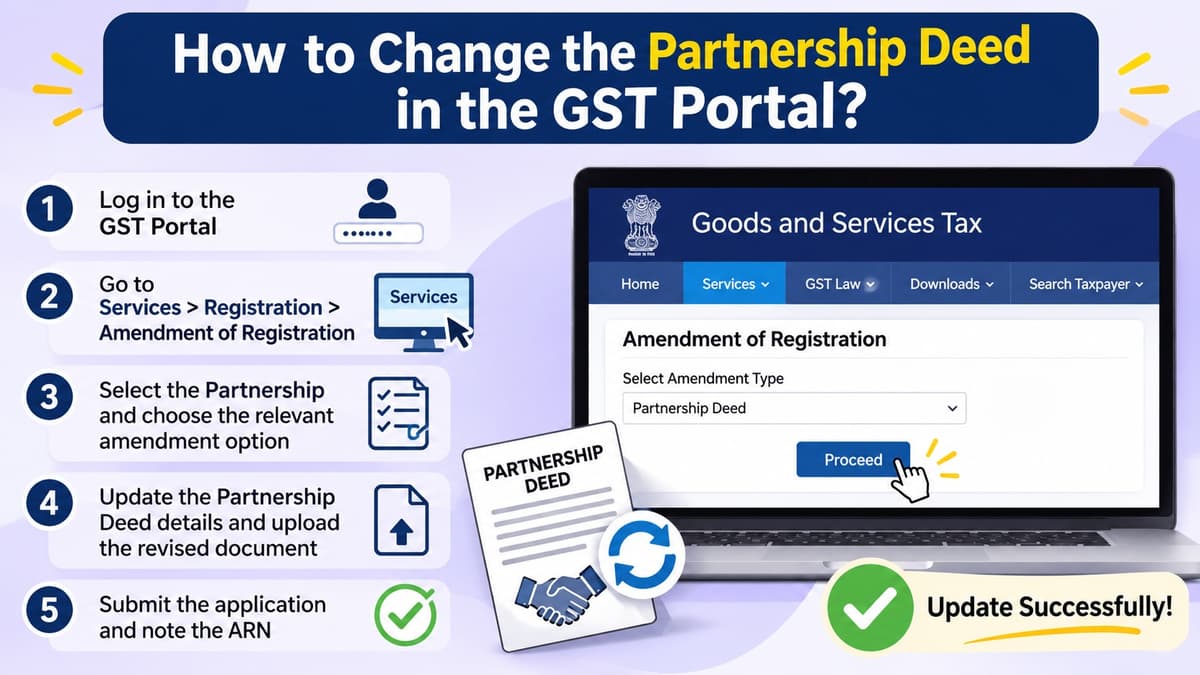
How to change the partnership deed in the GST portal is an important process for businesses that need to update their partnership details due to changes in partners, profit-sharing ratios, business addresses, or other partnership-related information. When a partnership firm makes changes to its partnership deed, it may also need to update its GST registration details to keep its business information accurate and compliant with GST regulations.
The GST portal provides an online facility to amend registration details. Partnership firms can use this facility to update relevant information by submitting an amendment application along with supporting documents.
In this guide, we will explain how to change the partnership deed in the GST portal, which documents are required, and how to complete the GST amendment process online.
What Is a Partnership Deed?
A partnership deed is a legal agreement between two or more individuals who agree to operate a business together. It contains important information about the partnership firm, including the names of partners, their capital contributions, profit-sharing ratios, responsibilities, and business terms.
Whenever there is a significant change in the partnership arrangement, the existing partnership deed may need to be amended or replaced with a revised partnership deed.
Common reasons for changing a partnership deed include:
Addition of a new partner to the firm.
Retirement or removal of an existing partner.
Change in the profit-sharing ratio.
Change in capital contribution.
Change in the business name.
Change in the rights and responsibilities of partners.
Change in the registered office or business address.
Why Do You Need to Update the Partnership Deed on the GST Portal?
If a partnership firm is registered under GST, certain changes in its partnership structure or registration details must be updated on the GST portal.
Updating GST registration helps maintain accurate business records and ensures that the details available with the GST department match the firm's current legal documents.
Some important reasons to update partnership details include:
Change in Partners: When a new partner joins or an existing partner retires, the firm's registration details may need amendment.
Change in Business Details: If the firm's legal name or principal place of business changes, the GST registration should be updated accordingly.
Legal Compliance: Maintaining updated GST registration details helps businesses meet applicable GST requirements.
Accurate Business Records: Updated details help avoid inconsistencies between GST records and partnership documents.
Documents Required to Change the Partnership Deed in the GST Portal
Before starting the GST amendment process, keep the necessary documents ready. Depending on the nature of the amendment, the following documents may be required:
Revised Partnership Deed.
PAN Card of the Partnership Firm.
PAN Card of the new partner, if applicable.
Aadhaar Card of the new partner, if applicable.
Address proof of the business.
Passport-size photographs of the new partner, if applicable.
Authorization letter or consent of partners, wherever applicable.
Supporting documents related to the proposed changes.
The documents required may vary depending on the type of amendment being made.
How to Change the Partnership Deed in the GST Portal Online?
Follow these steps to update the relevant partnership details through the GST portal.
Step 1: Visit the GST Portal
Visit the official GST website at https://www.gst.gov.in/.
Log in using your GSTIN username and password. Enter the captcha code to access your GST dashboard.
Step 2: Navigate to Amendment of Registration
After logging in:
Open the Services section.
Select Registration.
Click on Amendment of Registration (Core Fields) or Amendment of Registration (Non-Core Fields), depending on the change required.
Step 3: Select the Relevant Details
Choose the section where the amendment is required.
For example:
For changes in the principal place of business, select the relevant address section.
For changes in partner details, select the Promoters/Partners section.
For changes in authorized signatory details, select the relevant authorized signatory section.
Step 4: Update Partner Information
If a new partner has joined the firm or an existing partner's details need updating, make the necessary changes in the Promoters/Partners section.
Enter the required details, such as:
Full name of the partner.
PAN details.
Residential address.
Contact details.
Designation or status.
Upload the required supporting documents wherever applicable.
Step 5: Upload the Revised Partnership Deed
Upload a scanned copy of the revised partnership deed in the relevant document upload section, if required.
Ensure that the document is clear, complete, and contains the updated details of all partners.
Step 6: Verify the Amendment Application
Review all the information entered in the amendment application.
Check the following details carefully:
Partner names and PAN details.
Business information.
Updated partnership details.
Supporting documents.
Contact information.
Make sure the information matches the revised partnership deed.
Step 7: Submit the Application
After completing the amendment application, submit it using the available verification method.
The application can generally be verified through:
Digital Signature Certificate (DSC).
Electronic Verification Code (EVC).
Other permitted verification methods, as applicable.
After successful submission, an Application Reference Number (ARN) is generated. Keep the ARN for future reference.
Difference Between Core and Non-Core GST Amendments
Understanding the difference between core and non-core amendments is important when changing partnership details.
Core Amendment | Non-Core Amendment |
|---|---|
Changes in business address | Changes in certain contact details |
Changes in partner details, where classified as core | Changes in bank account details |
Changes in authorized signatory details, where classified as core | Other permitted non-core changes |
Requires GST officer approval | Generally processed without officer approval |
Core amendments generally require approval from the GST officer, whereas non-core amendments are generally updated without such approval.
The exact classification depends on the field being amended under the GST portal.
How Long Does It Take to Update Partnership Details on the GST Portal?
The processing time depends on the type of amendment and whether the GST department requires additional clarification.
Non-Core Amendments: Generally updated without approval from a GST officer.
Core Amendments: Generally subject to approval by the GST officer.
Additional Clarification: If the department raises a query, the applicant must provide the requested information within the prescribed time.
You can track the application status using the ARN generated after submission.
Important Points to Remember While Changing a Partnership Deed
Before submitting an amendment application on the GST portal, consider the following points:
Prepare a properly executed revised partnership deed.
Ensure that the PAN details of all partners are correct.
Upload clear and readable supporting documents.
Update only the details that have actually changed.
Check whether the amendment is classified as core or non-core.
Keep the ARN for tracking the application.
Complete any additional clarification requested by the GST department within the prescribed time.
Important: A change in the constitution of a partnership firm may require a fresh GST registration rather than an amendment, particularly where there is a change in the firm's PAN. GST registration is PAN-based, so the applicable procedure must be checked before filing.
Frequently Asked Questions (FAQs)
1. Can I change my partnership deed in the GST portal?
Yes, you can update relevant GST registration details after changing your partnership deed. The amendment process depends on the nature of the change and applicable GST provisions.
2. How can I add a new partner to GST registration?
Log in to the GST portal, navigate to Amendment of Registration, select the Promoters/Partners section, enter the new partner's details, upload the required documents, and submit the application.
3. Is a revised partnership deed required for GST amendment?
A revised partnership deed may be required as supporting evidence when the partnership structure or terms have changed. The document requirements depend on the amendment.
4. Can I remove an existing partner from GST registration?
Yes, relevant partner details can be updated through the GST amendment process, subject to applicable requirements and the nature of the change.
5. Is there any fee for changing partnership details on the GST portal?
There is generally no government fee for filing an amendment application for GST registration.
6. What happens if I do not update partnership details in GST?
Failure to update relevant registration details may result in inconsistencies in GST records and potential non-compliance with applicable GST requirements.
7. Can I change the business name through GST amendment?
Yes, a business name change may be updated through the appropriate GST amendment process, provided the legal constitution and PAN of the registered entity remain unchanged.
Conclusion
Changing a partnership deed requires proper documentation and updating relevant business records. If your partnership firm is registered under GST, you should check whether the changes require an amendment to GST registration or a fresh registration.
By following the correct process on the GST portal and submitting the revised partnership deed along with the required documents, you can keep your GST registration details updated.
First Startup provides professional assistance with GST registration, GST amendments, partnership registration, accounting, and business compliance services. Our team can help you understand the applicable procedure and documentation requirements for your business.