
How Much Gold Can You Legally Keep at Home in India? Complete Rules Explained
CA Rahul
May 11, 2026
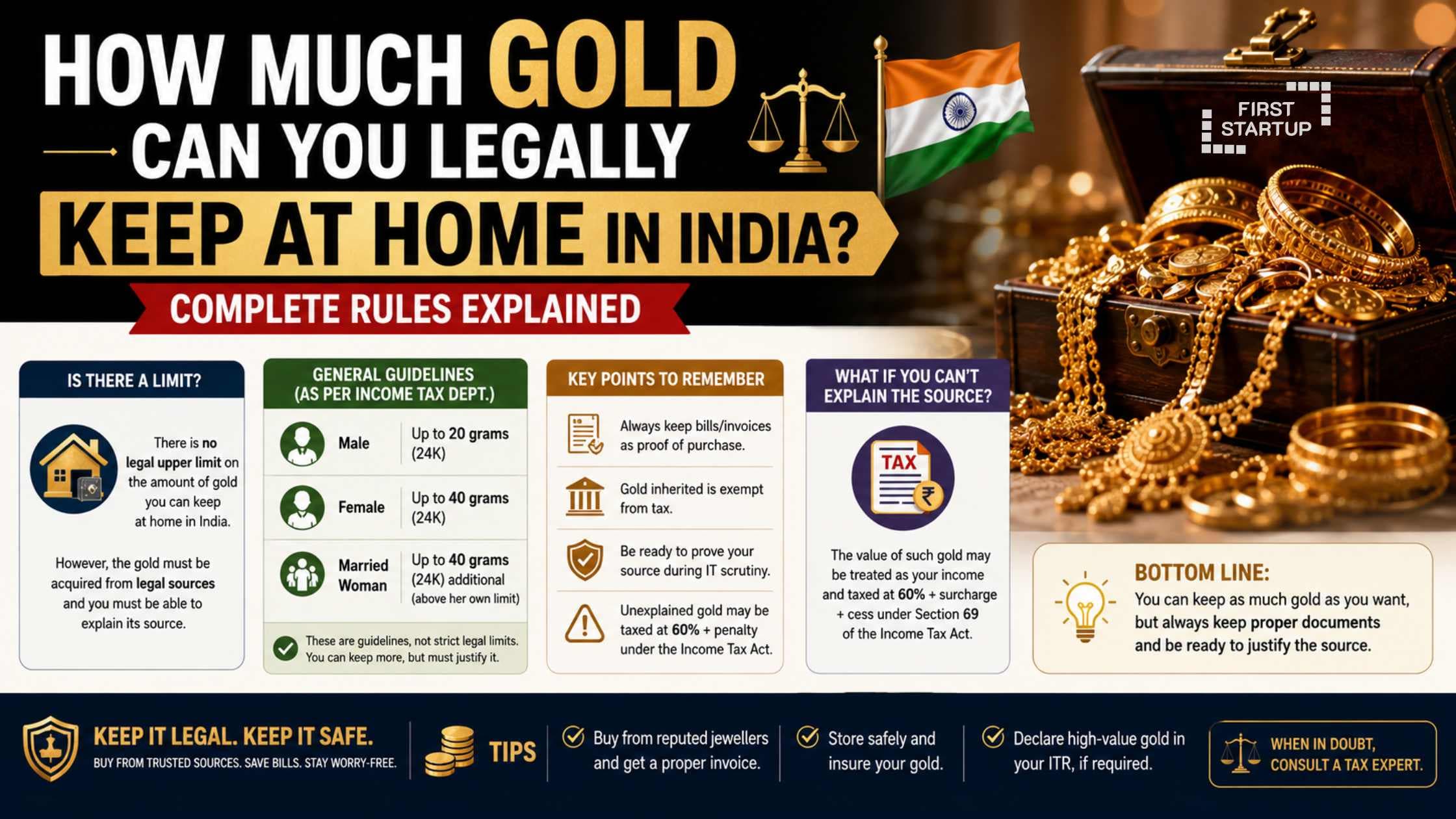
How Much Gold Can You Legally Keep at Home in India? Complete Rules Explained
Gold is more than just a metal in India — it represents tradition, security, investment, and family wealth. From weddings and festivals to long-term savings, Indian households often keep gold jewellery, coins, and bars at home.
But one question many people ask is:
“How much gold can you legally keep at home in India?”
The answer is important because many people misunderstand the Income Tax rules related to gold possession. While keeping gold at home is completely legal, there are certain guidelines issued by the government regarding jewellery ownership and tax scrutiny.
In this detailed guide, we will explain:
Gold limit at home in India
Rules for married women, unmarried women, and men
CBDT gold seizure guidelines
Gold jewellery vs gold bars & coins
Documents required for proof
Income Tax implications on gold
Is It Legal to Keep Gold at Home in India?
Yes, absolutely.
There is no fixed legal limit on how much gold you can own in India. A person can legally buy and keep gold at home as long as the source of income is genuine and properly explained.
However, during an Income Tax raid or investigation, the Income Tax Department follows certain CBDT (Central Board of Direct Taxes) guidelines regarding seizure of gold jewellery.
These rules help determine how much gold jewellery can generally remain unseized, even if purchase bills are not immediately available.
CBDT Gold Limit Guidelines in India
According to CBDT instructions, the following quantity of gold jewellery is generally considered acceptable:
| Category | Gold Jewellery Limit |
|---|---|
| Married Woman | 500 grams |
| Unmarried Woman | 250 grams |
| Male Member | 100 grams |
These limits apply mainly to gold jewellery and not necessarily to gold coins or bars.
Gold Limit for Married Women
A married woman is allowed up to:
500 grams of gold jewellery
This includes:
Necklaces
Bangles
Earrings
Rings
Traditional wedding jewellery
Indian families often gift jewellery during marriage, which is why married women receive a higher exemption limit.
Gold Limit for Unmarried Women
An unmarried woman can generally keep:
250 grams of gold jewellery
This may include:
Personal jewellery
Gifts from family
Festival purchases
Gold Limit for Men in India
Male members of the family are generally allowed:
100 grams of gold jewellery
This includes:
Gold chains
Rings
Bracelets
Religious jewellery
Gold Limit for a Family of 4
Let’s understand with an example.
Suppose a family consists of:
Husband
Wife
One daughter
One son
The approximate acceptable gold jewellery quantity may be:
| Family Member | Approx Gold Limit |
|---|---|
| Wife | 500 grams |
| Husband | 100 grams |
| Daughter | 250 grams |
| Son | 100 grams |
Total: Around 950 grams of gold jewellery
However, this is not an official combined family limit. Actual acceptance depends on:
Family background
Financial status
Customs and traditions
Source of income
Gold Jewellery vs Gold Bars & Coins
This is where many people get confused.
Gold Jewellery
Gold jewellery receives relaxation under CBDT guidelines because jewellery is commonly owned in Indian households for social and cultural reasons.
Gold Coins & Bars
Gold bars, biscuits, and coins do not enjoy the same automatic protection.
If you own:
Gold coins
Gold biscuits
Gold bars
you should keep proper proof such as:
Purchase invoices
Bank transaction records
ITR filings
Investment declarations
Without documentation, authorities may question the source of funds.
Can Income Tax Department Seize Gold?
Yes, but only in suspicious situations.
During Income Tax raids, authorities may investigate gold holdings if:
The quantity is unusually high
Income records do not support the purchase
No bills or proof are available
Cash purchases appear suspicious
However, jewellery within CBDT limits is generally not seized, especially if the family background and income justify ownership.
Important Documents You Should Keep
To avoid future tax problems, maintain proper records for all major gold purchases.
1. Purchase Bills
Always keep invoices from jewellers.
2. Bank Payment Proof
Online transactions and bank records help establish ownership.
3. Income Tax Returns (ITR)
Your declared income should support your gold investments.
4. Gift Deeds
Gold received during weddings or family occasions should ideally be documented.
5. Inheritance Documents
Inherited gold should be backed by:
Family records
Wills
Legal inheritance papers
Cash Purchase Rules for Gold in India
Buying gold in cash is allowed only within certain limits.
Large cash transactions may attract scrutiny from the Income Tax Department.
Jewellers may ask for:
PAN card
Aadhaar card
Payment details
Using banking channels is always safer and easier for future proof.
Tax Rules on Selling Gold
Owning gold is legal, but selling gold may create tax liability.
Short-Term Capital Gains (STCG)
If gold is sold within 24 months, profits are added to your taxable income.
Long-Term Capital Gains (LTCG)
If sold after 24 months, long-term capital gains tax may apply according to current tax laws.
Always consult a tax expert before large gold transactions.
Is Inherited Gold Taxable?
Inherited gold itself is generally not taxable at the time of inheritance.
However:
Proper proof of inheritance should exist
Future sale of inherited gold may attract capital gains tax
Maintaining family records is important.
Common Myths About Gold Possession in India
Myth 1: Keeping More Gold Is Illegal
False. There is no absolute legal ownership limit if the source is explained properly.
Myth 2: Government Can Confiscate All Gold
False. Legitimate jewellery holdings are usually protected under CBDT guidelines.
Myth 3: Bills Are Not Necessary
False. Bills and payment records are extremely important for high-value gold purchases.
Tips for Safe Gold Ownership
Follow these best practices:
Buy gold only from trusted jewellers
Always take proper GST invoices
Avoid undocumented cash purchases
Keep digital payment records
File Income Tax Returns regularly
Maintain inheritance and gift records
Final Thoughts
Gold continues to be one of the most trusted forms of savings and investment in India. While there is no fixed legal cap on gold ownership, understanding the CBDT jewellery guidelines is very important.
Commonly Accepted Jewellery Limits:
Married Woman: 500 grams
Unmarried Woman: 250 grams
Male Member: 100 grams
But remember — documentation matters more than quantity.
If your gold holdings are backed by:
Purchase bills
ITR records
Bank statements
Inheritance proof
Then you generally do not need to worry about legal issues.
Responsible buying, proper record-keeping, and transparent financial transactions are the safest ways to legally own gold in India.