
Know all about GST Registration Threshold limits
First Startup
Jan 29, 2026
Running a business and wondering if you have to obtain a GST registration number or not, then this article is for you. Through this article, we will explain the threshold limit required for GST registration, which will help you understand better.
So, without further ado. Let’s begin the discussion. Happy reading :)
GST registration under the Goods and Services Act is mandatory for every person who is engaged in the supply of goods or services. However, in order to promote ease of doing business, the Indian government has set a threshold limit for GST registration. If the annual turnover of any person or company exceeds this threshold limit then the GST registration needs to be obtained.
In the past, the CBIC has made a lot of changes to the GST threshold limit to promote the growth of MSMEs. The latest GST threshold limits are explained as follows:-
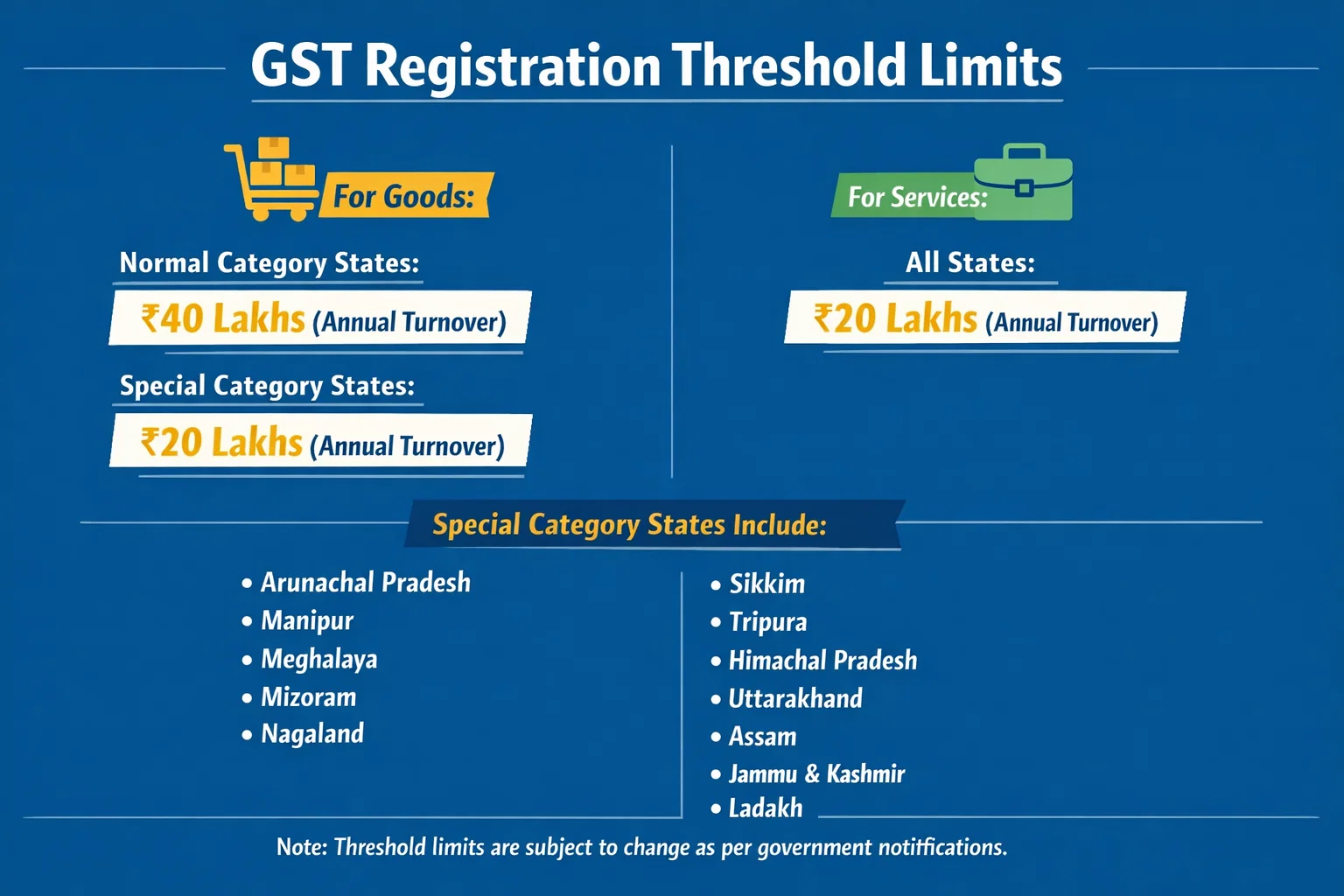
GST threshold limit of Rupees 40 lakhs in case of the supply of goods.
Every person engaged in the supply of goods needs to obtain the GST registration if the aggregate turnover of the business exceeds Rupees 40 lakhs in a particular financial year.
Please Note ~ Earlier, the said limit in case of a supplier of goods was Rupees 20 lakhs but as per vide notification No. 10/2019, the CBIC had increased the limit to Rupees 40 lakhs, with the exception given to the specified category of persons.
GST threshold limit of Rupees 20 lakhs in case of specified category of persons.
In the case of below mentioned specified goods suppliers, the GST threshold limit of business turnover is Rupees 20 lakhs.
➢ Supplier of ice cream and other edible ice, whether or not containing cocoa.
➢ Supplier of pan masala, tobacco, and other manufactured tobacco substitutes.
➢ Persons are required to obtain compulsory GST registration under section 24 of the CGST Act.
➢ Persons obtained voluntary registration under the GST regime.
➢ Persons engaged in making intra-state supplies in the States of Arunachal Pradesh, Manipur, Meghalaya, Mizoram, Nagaland, Puducherry, Sikkim, Telangana, Tripura, Uttarakhand.
Please note, that as per section 24 of the CGST Act, it is compulsory for the following specific persons to register under GST even if their aggregate turnover is less than the mentioned GST threshold limit.
➢ Interstate supplier of goods or services.
➢ The casual taxable person making taxable supplies.
➢ Taxpayers who are obligated to pay tax under the reverse charge mechanism.
➢ Non-Resident taxable person.
➢ An e-commerce supplier of goods or services.
➢ Any person who requires to deduct tax at source under section 51 of CGST Act, 2017.
➢ Input service distributor.
➢ Any person who engaged in supplies on behalf of another taxable person whether as an agent or otherwise.
➢ Every person supplying online information and database access or retrieval services from a place outside India to an unregistered person in India.
➢ Other persons may be notified by the Government.
GST threshold limit of Rupees 20 lakhs in case of the supply of services.
The GST registration limit for persons engaged in the supply of services in India is Rupees 20 lakhs i.e. if the aggregated value of services provided exceeds Rupees 20 lakhs then those service providers need to obtain the GST registration.
GST threshold limit of Rupees 10 lakhs in case of the Special Category States.
The GST registration limit for the person carrying business in the Special Category States i.e., Mizoram, Tripura, Manipur, and Nagaland is Rupees 10 lakhs.
We hope that now you get an understanding of GST threshold limits for various goods and service providers.
It’s time to discuss “How the aggregate turnover is computed for deciding the GST threshold limit?”
As per section 2(6) of the CGST Act, the “Aggregate turnover” is defined as under:-
“Aggregate turnover” means the aggregate value of all taxable and non-taxable supplies, exempt supplies, and exports of goods and/or services of a person having the same PAN, to be computed on all India basis and excludes taxes, if any, charged under the CGST Act, SGST Act, and the IGST Act, as the case may be.
As per the explanation given in the above quoted section, the “Aggregate Turnover” does not include the value of supplies on which tax is levied on a reverse charge basis and the value of inward supplies.
Therefore, while calculating the aggregate turnover for the GST threshold limit any GST taxes paid, goods, or services received under the reverse charge mechanism or for job work shall be excluded.
That’s all, folks we are concluding this article. If you require any assistance in GST registration or with any other compliances then feel free to reach out to us. Our team of experts at first startup is always happy to assist you all :)