
Difference Between Private Trust and Public Trust in India
First Startup
Oct 27, 2026
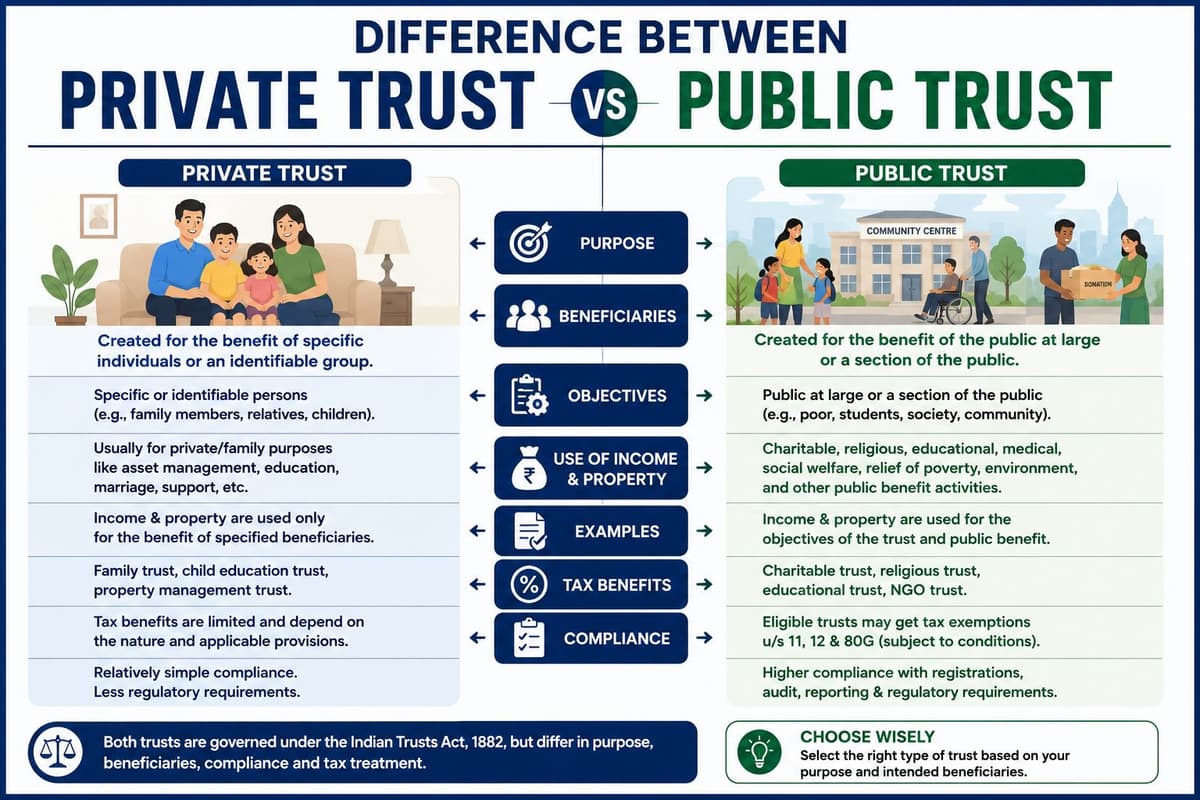
Trusts are commonly established in India to manage property, support family members, carry out charitable activities, and promote social welfare. However, before setting up a trust, it is important to understand the difference between a private trust and a public trust.
A private trust is generally created to benefit specific individuals or identifiable beneficiaries, such as family members. A public trust, on the other hand, is established to benefit the public or a sufficiently broad section of society, often through charitable, educational, religious, or social welfare activities.
Although both structures involve the management of assets by trustees for the benefit of beneficiaries, they differ in their objectives, beneficiaries, legal framework, administration, and compliance requirements.
In this guide, First Startup explains the difference between private trust and public trust in India, including their features, benefits, registration process, documents, and legal considerations.
What Is a Private Trust?
A private trust is a legal arrangement in which a settlor transfers or dedicates property to trustees to manage it for the benefit of specified or identifiable beneficiaries.
Private trusts in India are primarily governed by the Indian Trusts Act, 1882, subject to its scope and applicable exclusions. The Act generally applies to private trusts but does not govern every category of trust, including certain public or religious endowments.
Private trusts are commonly used for family wealth management, succession planning, property management, and providing financial support to specific beneficiaries.
Key Features of a Private Trust
Established for specified or identifiable beneficiaries.
Created through a trust deed or another legally valid arrangement, as applicable.
Managed by trustees according to the trust's terms.
May hold money, property, investments, or other permissible assets.
Commonly used for family and estate planning.
Must comply with applicable legal, tax, and property requirements.
Example of a Private Trust
Suppose a person wants to create a trust to manage family property and provide financial support to their children. The person can establish a private trust that identifies the beneficiaries and sets out how the trustees should manage and distribute the assets.
The trust's purpose, terms, and legal validity will depend on the trust deed and applicable law.
What Is a Public Trust?
A public trust is generally established for the benefit of the public or a sufficiently broad section of society. Public trusts often undertake charitable, educational, religious, medical, cultural, or social welfare activities.
The applicable legal framework depends on the state, the nature of the trust, and the activities it undertakes. Some states have specific public trust legislation, while other arrangements may be governed by different applicable laws and principles.
Public trusts are commonly used by individuals and groups who want to support society through organised charitable or community activities.
Key Features of a Public Trust
Established for public benefit or the benefit of a sufficiently broad section of society.
May undertake charitable, educational, religious, or social welfare activities.
Managed by trustees according to its deed and applicable legal requirements.
May receive donations and grants, subject to applicable conditions.
May be eligible to apply for tax registrations or exemptions if it satisfies the relevant requirements.
Must follow applicable accounting, reporting, and compliance obligations.
Example of a Public Trust
Suppose a group of individuals establishes a trust to provide education to underprivileged children, distribute food to people in need, or operate a charitable medical facility.
Such an arrangement may qualify as a public charitable trust if its purposes, beneficiaries, structure, and activities satisfy the applicable legal requirements.
Difference Between Private Trust and Public Trust
The main difference between a private trust and a public trust is the nature of their beneficiaries and objectives. A private trust generally benefits specified individuals, while a public trust is established for public or charitable purposes.
| Basis of Difference | Private Trust | Public Trust |
|---|---|---|
| Main objective | Benefits specified or identifiable beneficiaries | Benefits the public or a sufficiently broad section of society |
| Beneficiaries | Usually identified individuals or a defined class | Public or a sufficiently broad section of society |
| Common purpose | Family wealth management, succession planning, asset management | Charity, education, healthcare, religion, social welfare |
| Legal framework | Generally governed by the Indian Trusts Act, 1882, subject to its scope and exclusions | Depends on applicable state laws, trust category, and other relevant laws |
| Creation | Through a legally valid trust arrangement | Through a legally valid public-purpose trust arrangement |
| Management | Trustees act according to the trust terms | Trustees act according to the trust deed and applicable law |
| Use of assets | For the purposes and beneficiaries specified in the trust | For the stated public or charitable purposes |
| Donations | May receive funds subject to its terms and applicable law | May receive public donations, subject to applicable requirements |
| Tax benefits | No automatic charitable tax exemption merely because it is a trust | Tax exemptions may be available if statutory conditions are satisfied |
| Public fundraising | Depends on the trust's purposes and applicable law | May raise funds for permitted public-benefit activities |
| Compliance | Depends on the trust structure, assets, activities, and applicable laws | May involve state-specific registration, accounts, reporting, and tax compliance |
| Typical use | Family and private asset management | Charitable and community-benefit activities |
Important: The exact legal requirements for establishing and registering a public trust vary by state. The trust's name alone does not determine its legal classification or tax treatment.
Private Trust vs Public Trust: Which One Should You Choose?
The appropriate structure depends on what you want to achieve.
Choose a Private Trust If:
You want to manage family assets.
You want to provide for specific beneficiaries.
You need an arrangement for succession or estate planning.
You want trustees to manage assets under defined terms.
Your primary objective is private rather than public benefit.
Consider a Public Trust If:
You want to undertake charitable activities.
You plan to support education, healthcare, or social welfare.
You want to establish a charitable institution or community initiative.
You intend to use funds for public-benefit purposes.
You want to explore eligibility for applicable charitable registrations or tax exemptions.
A public trust is not automatically eligible for tax exemption or donor tax benefits. Eligibility depends on the applicable law, the trust's objects, its activities, and the registrations or approvals obtained.
Documents Required for Trust Registration in India
The documents required depend on the type of trust, the state, and the registration procedure. Common documents may include:
Trust deed containing the trust's objectives, powers, and terms.
Identity proof of the settlor and trustees.
Address proof of the settlor and trustees.
Passport-size photographs, where required.
Proof of the registered office or trust address.
Ownership proof or a no-objection certificate for the premises, where applicable.
Details of the initial trust property or fund.
Witness identification and other documents required by the relevant registration authority.
If immovable property is transferred to the trust, additional requirements relating to stamp duty, registration, title, and property law may apply.
Before submitting an application, confirm the latest documentation requirements with the appropriate state authority or a qualified professional.
How to Register a Private Trust in India
The process depends on the trust's terms, assets, and applicable law. The general steps may include the following.
Step 1: Define the Purpose
Identify the objectives of the trust, its beneficiaries, the property involved, and the responsibilities of the trustees.
Step 2: Draft the Trust Deed
Prepare a deed that sets out the trust's purpose, assets, beneficiaries, trustee powers, management rules, and other relevant terms.
Step 3: Arrange the Required Documents
Collect the identity and address documents, property records, and other information required for the proposed trust.
Step 4: Complete Applicable Stamp and Registration Formalities
Determine whether the deed must be stamped or registered and complete the applicable formalities. Requirements may vary depending on the trust property and the relevant law.
Step 5: Maintain Trust Records
Maintain records of the trust property, decisions, transactions, and distributions as required by law and the trust deed.
Professional legal advice can help ensure that the trust arrangement is appropriate for the intended beneficiaries and assets.
How to Register a Public Trust in India
Public trust registration procedures differ across states. The following steps provide a general overview.
Step 1: Select the Charitable or Public Purpose
Define the intended activities, such as education, healthcare, relief for disadvantaged people, or other lawful public-benefit objectives.
Step 2: Choose the Trustees
Identify suitable trustees and define their roles, responsibilities, powers, and decision-making procedures.
Step 3: Prepare the Trust Deed
Draft the trust deed with clear objectives, governance provisions, rules for using funds, and provisions for managing trust assets.
Step 4: Identify the Relevant Registration Authority
Check whether registration is handled by a public trust authority, charity commissioner, registrar, or another authority under the applicable state framework.
Step 5: Submit the Application
Submit the prescribed application, trust deed, supporting documents, and applicable fees to the relevant authority.
Step 6: Complete Verification
Respond to any queries and complete the verification or inspection process required by the authority.
Step 7: Obtain Registration and Maintain Compliance
After registration, maintain accounts and records and complete applicable reporting and tax-related requirements.
The process, forms, fees, and timelines can differ significantly from one state to another.
Tax Benefits for Private Trusts and Public Trusts
Tax treatment is an important consideration when choosing between a private trust and a public trust.
Tax Treatment of Private Trusts
Private trusts are subject to tax rules that depend on their structure, the nature of their beneficiaries, and the income they receive. The Income-tax Act contains specific provisions for the taxation of trust income, including rules for representative assessees and different types of beneficiaries.
A private trust does not automatically receive charitable tax exemptions merely because it is legally established as a trust.
Tax Benefits for Public Charitable Trusts
Eligible public charitable or religious trusts may be able to apply for tax exemption under the relevant provisions of the Income-tax Act, subject to the applicable conditions and registration requirements.
Depending on eligibility, relevant provisions may include registration under Section 12AB and approval under Section 80G for qualifying donor deductions.
These benefits are not automatic. The trust must satisfy the applicable requirements, follow the relevant conditions, and complete the required registration or approval process.
Can a Private Trust Be Converted into a Public Trust?
Changing a private trust into a public trust is not necessarily a simple conversion. The feasibility and procedure depend on the original trust deed, the settlor's intentions, the nature of the trust property, beneficiary rights, and applicable laws.
Where a change is legally possible, it may require formal amendments, consent or approval, compliance with property law, or proceedings before the relevant authority or court.
A trust should not change its stated purpose or beneficiary arrangements without first obtaining appropriate legal advice.
Common Mistakes to Avoid When Creating a Trust
Avoid these common mistakes when establishing a private or public trust:
Choosing the trust structure without clearly defining its objectives.
Using a generic trust deed that does not address the intended arrangement.
Failing to define the powers and duties of trustees.
Ignoring state-specific registration and stamp duty requirements.
Assuming that every public trust qualifies for tax exemption.
Confusing trust registration with income-tax registration.
Failing to maintain proper financial and property records.
Overlooking applicable annual filings and compliance obligations.
Careful planning and professional assistance can help reduce legal and administrative difficulties.
Frequently Asked Questions (FAQs)
1. What is the difference between a private trust and a public trust?
A private trust generally benefits specified or identifiable beneficiaries, while a public trust is established for the benefit of the public or a sufficiently broad section of society.
2. Which law governs private trusts in India?
The Indian Trusts Act, 1882 generally governs private trusts within its scope, subject to the Act's exclusions and other applicable laws.
3. Which law governs public trusts in India?
The applicable framework depends on the state and the type of trust. Some states have specific public trust legislation, while other legal provisions may apply to particular arrangements.
4. Can a public trust earn income?
A public trust may receive income from lawful activities, donations, investments, or property, subject to its objectives and applicable law. Its funds must be managed and applied according to the governing terms and legal requirements.
5. Is registration compulsory for every trust in India?
The requirements depend on the type of trust, its assets, the state, and the applicable law. Certain property transfers and public trust arrangements may require specific registration formalities. The relevant legal requirements should be checked before creating the trust.
6. Can a private trust receive donations?
A private trust may receive funds where permitted by its terms and applicable law. However, receiving donations does not automatically make it a public charitable trust or qualify it for charitable tax benefits.
7. Can a public trust obtain 12AB registration?
An eligible public charitable or religious trust may apply for registration under Section 12AB, subject to the relevant statutory conditions and procedures.
8. Is 80G approval available to every public trust?
No. A public trust must satisfy the applicable eligibility and compliance requirements to obtain approval under Section 80G. Approval is not automatic.
9. Can a family establish a public trust?
Yes, a family can establish a public trust if the trust is genuinely created for qualifying public-benefit purposes and complies with the applicable legal requirements. A trust intended only to benefit family members would generally be private in nature.
10. Which is better: a private trust or a public trust?
Neither structure is universally better. A private trust may suit family asset management and specific beneficiaries, while a public trust may suit charitable and public-benefit activities. The choice depends on the intended purpose, beneficiaries, assets, and legal requirements.
Conclusion
Understanding the difference between a private trust and a public trust is essential before establishing a trust in India. A private trust generally focuses on specified beneficiaries and private asset management, whereas a public trust is established for charitable or other qualifying public-benefit purposes.
The appropriate structure depends on your objectives, the assets involved, the beneficiaries, and the legal framework applicable in your state. Registration, taxation, and compliance requirements should be assessed carefully before proceeding.
First Startup helps entrepreneurs and organisations understand business registration and compliance requirements. If you are planning to establish a trust or a charitable organisation, seek appropriate professional guidance to identify the relevant registration procedure and documentation.
Visit FirstStartup.in to explore registration and compliance support.