
Difference Between MGT-7 and MGT-7A: Meaning, Applicability, Due Date & Filing Requirements
First Startup
Nov 11, 2026
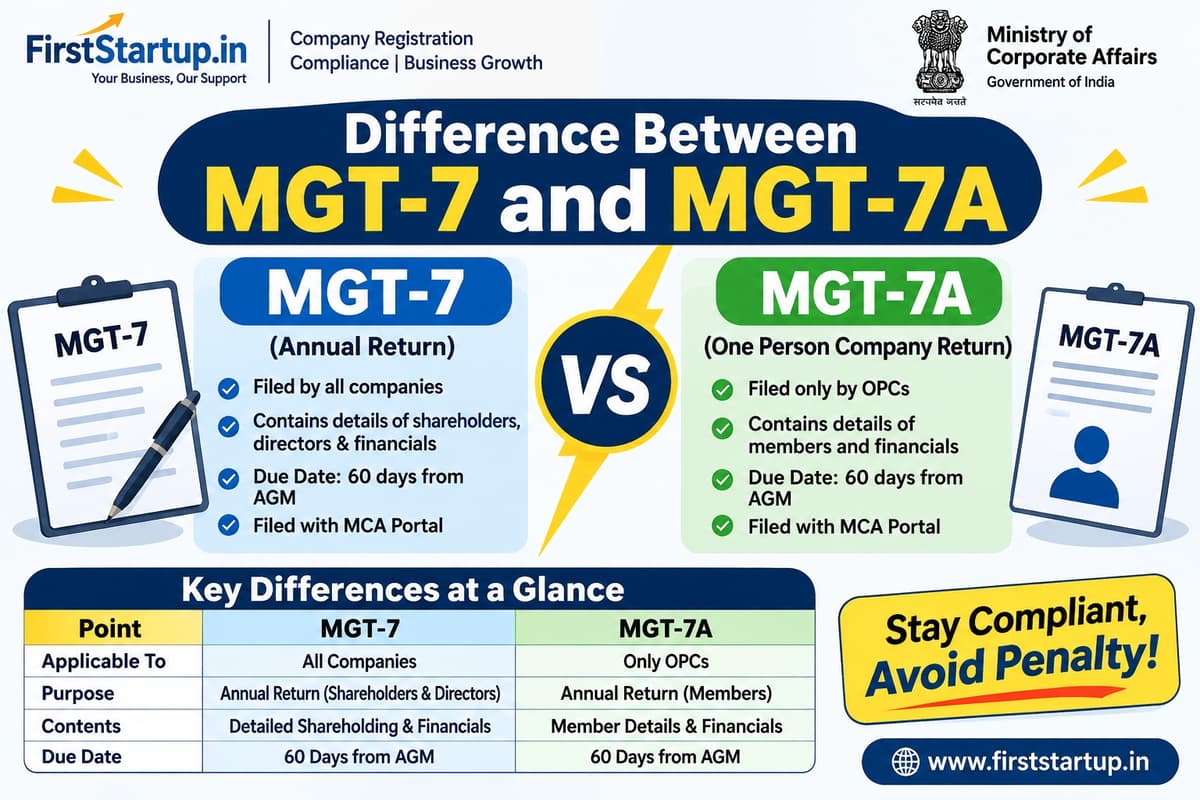
Difference Between MGT-7 and MGT-7A is an important topic for companies registered under the Companies Act, 2013. Both forms are used to file the annual return with the Ministry of Corporate Affairs (MCA), but their applicability, reporting requirements and filing details are different.
Every company registered in India must understand which annual return form applies to it to maintain proper ROC compliance and avoid penalties.
In this blog, we will explain the difference between MGT-7 and MGT-7A, their applicability, due dates, required documents, filing process and penalties.
1. What is Form MGT-7?
Form MGT-7 is the annual return form prescribed under Section 92 of the Companies Act, 2013. It is filed by companies that are not eligible to file the simplified Form MGT-7A.
The form contains important information about the company, including:
Company name, CIN and registered office address.
Details of share capital and shareholding pattern.
Details of members and shareholders.
Information about directors and key managerial personnel.
Changes in directors and shareholders during the financial year.
Details of board meetings and general meetings.
Details of penalties and other compliance-related matters.
MGT-7 helps the Registrar of Companies (ROC) maintain updated information about registered companies.
2. What is Form MGT-7A?
Form MGT-7A is an abridged annual return introduced by the Ministry of Corporate Affairs (MCA) through the Companies (Management and Administration) Amendment Rules, 2021.
It was introduced to simplify annual return filing requirements for One Person Companies (OPCs) and Small Companies.
MGT-7A contains essential company information in a simplified format, reducing the reporting burden on eligible businesses.
The form is applicable from Financial Year 2020-21 onwards for eligible OPCs and Small Companies.
3. Difference Between MGT-7 and MGT-7A
The main difference between MGT-7 and MGT-7A is their applicability and reporting format. MGT-7 is the regular annual return form, whereas MGT-7A is the abridged annual return form for eligible small companies and OPCs.
Basis | Form MGT-7 | Form MGT-7A |
|---|---|---|
Meaning | Annual Return | Abridged Annual Return |
Applicability | Other companies | OPCs and Small Companies |
Legal provision | Section 92 | Section 92 |
Reporting format | Detailed | Simplified |
Company category | Companies not eligible for MGT-7A | Eligible OPCs and Small Companies |
Filing authority | ROC through MCA | ROC through MCA |
Filing frequency | Annually | Annually |
Due date | Within 60 days of AGM | Within 60 days of AGM or applicable AGM due date |
Purpose | Annual company information | Simplified annual company information |
4. Who is Required to File MGT-7?
The following companies generally need to file Form MGT-7:
Private Limited Companies that are not Small Companies.
Public Limited Companies.
Listed Companies.
Holding Companies.
Subsidiary Companies.
Section 8 Companies.
Other companies that do not qualify for MGT-7A.
A company must check its legal status and eligibility before selecting the annual return form.
5. Who is Required to File MGT-7A?
Form MGT-7A is applicable to the following eligible companies:
One Person Company (OPC): An OPC registered under the Companies Act, 2013 is required to file its annual return using Form MGT-7A.
Small Company: A company qualifying as a Small Company under Section 2(85) of the Companies Act, 2013 can file its annual return using Form MGT-7A.
However, certain companies are excluded from the definition of a Small Company, even if they meet the prescribed capital and turnover limits.
6. Small Company Eligibility Criteria for MGT-7A
Under Section 2(85) of the Companies Act, 2013, a company must satisfy the prescribed conditions to qualify as a Small Company.
The current prescribed limits are:
Particulars | Maximum Limit |
|---|---|
Paid-up share capital | ₹10 Crore |
Annual turnover | ₹100 Crore |
Both conditions must be satisfied.
Important: The following companies are not treated as Small Companies:
A holding company or subsidiary company.
A company registered under Section 8.
A company or body corporate governed by a special Act.
Therefore, meeting the financial limits alone does not automatically make a company eligible for MGT-7A.
7. Due Date for Filing MGT-7 and MGT-7A
Both MGT-7 and MGT-7A are required to be filed within 60 days from the date of the Annual General Meeting (AGM).
If the company does not hold its AGM, the annual return must be filed within 60 days from the date on which the AGM should have been held, along with a statement explaining why the AGM was not conducted.
For an OPC, the applicable AGM provisions and due date must be considered.
Example:
If a company conducts its AGM on 30 September 2026, its annual return filing deadline will generally be 29 November 2026.
8. Documents Required for MGT-7 and MGT-7A Filing
Before filing the annual return on the MCA portal, companies should arrange the following information and documents:
Company Corporate Identification Number (CIN).
Company PAN details.
Registered office address.
Details of directors and shareholders.
Shareholding pattern.
Details of share transfers, if applicable.
Details of board meetings and general meetings.
Details of members and changes during the financial year.
Details of penalties and other applicable disclosures.
Digital Signature Certificate (DSC) of the authorised signatory.
Additional information or attachments may be required depending on the company's category and applicable filing requirements.
9. Filing Process for MGT-7 and MGT-7A
Companies can file their annual returns electronically through the Ministry of Corporate Affairs portal.
Follow these general steps:
Step 1: Visit the MCA Portal
Visit the official Ministry of Corporate Affairs website and log in using the appropriate credentials.
Step 2: Select the Applicable Form
Choose Form MGT-7 or MGT-7A according to the company's eligibility.
Step 3: Enter Company Details
Provide the CIN, company name, registered office address and other required details.
Step 4: Provide Shareholding Information
Enter the required information about shareholders, members, share capital and changes during the financial year.
Step 5: Add Director Details
Provide details of directors and key managerial personnel as required by the form.
Step 6: Attach Required Documents
Upload the applicable attachments and supporting documents.
Step 7: Digital Signature
Complete the digital signature requirements using the authorised signatory's DSC.
Step 8: Submit the Form
Submit the form on the MCA portal, complete the applicable payment and save the Service Request Number (SRN) and acknowledgement for future reference.
10. MGT-8 Certification Requirement
MGT-8 is a certificate issued by a practising Company Secretary (PCS) regarding the company's annual return.
Under Section 92(2) of the Companies Act, 2013, annual return certification is required for:
Every listed company.
Every company having paid-up share capital of ₹10 crore or more.
Every company having turnover of ₹50 crore or more.
The requirement for MGT-8 certification should be checked separately from the eligibility to file MGT-7A. A Small Company may still need MGT-8 certification if it meets the applicable statutory threshold.
11. Penalty for Not Filing MGT-7 or MGT-7A
Failure to file the annual return within the prescribed time can result in penalties under Section 92(5) of the Companies Act, 2013.
The statutory penalty includes:
₹10,000 for the initial default.
An additional ₹100 for every day the failure continues after the first day.
Maximum penalty of ₹2,00,000 for the company.
Maximum penalty of ₹50,000 for an officer in default.
Companies should complete their annual return filing within the prescribed deadline to avoid additional compliance costs and penalties.
12. Frequently Asked Questions (FAQs)
Q1. What is the main difference between MGT-7 and MGT-7A?
MGT-7 is the regular annual return form applicable to companies other than eligible OPCs and Small Companies. MGT-7A is an abridged annual return form specifically designed for eligible OPCs and Small Companies.
Q2. Is MGT-7A mandatory for Small Companies?
Yes. Eligible Small Companies are required to file their annual returns in Form MGT-7A under Rule 11 of the Companies (Management and Administration) Rules, 2014.
Q3. Is MGT-7 applicable to Private Limited Companies?
Yes. Private Limited Companies that do not qualify as Small Companies must file Form MGT-7.
Q4. What is the due date for MGT-7 filing?
MGT-7 must generally be filed within 60 days from the date of the AGM.
Q5. What is the due date for MGT-7A filing?
MGT-7A must generally be filed within 60 days from the date of the AGM or the applicable date by which the AGM should have been held.
Q6. Can an OPC file MGT-7 instead of MGT-7A?
An OPC is required to file its annual return using the prescribed Form MGT-7A.
Q7. Is MGT-8 required with MGT-7A?
MGT-8 certification requirements should be examined under Section 92(2), independently of whether the company files MGT-7 or MGT-7A.
Q8. What happens if a company does not file its annual return?
Non-filing can attract statutory penalties under Section 92(5) of the Companies Act, 2013.
13. Conclusion
Understanding the difference between MGT-7 and MGT-7A is essential for maintaining annual ROC compliance. MGT-7 applies to companies that are not eligible for the abridged return, while MGT-7A is designed for One Person Companies and eligible Small Companies.
Choosing the correct form, preparing accurate company information and completing the filing within the prescribed due date can help businesses avoid unnecessary penalties and compliance issues.
First Startup provides professional company compliance and ROC filing assistance, helping businesses manage their annual compliance requirements.
For assistance with MGT-7, MGT-7A and other ROC compliance services, contact First Startup.