
How to Convert Proprietorship to Private Limited Company in India?
First Startup
Aug 11, 2026
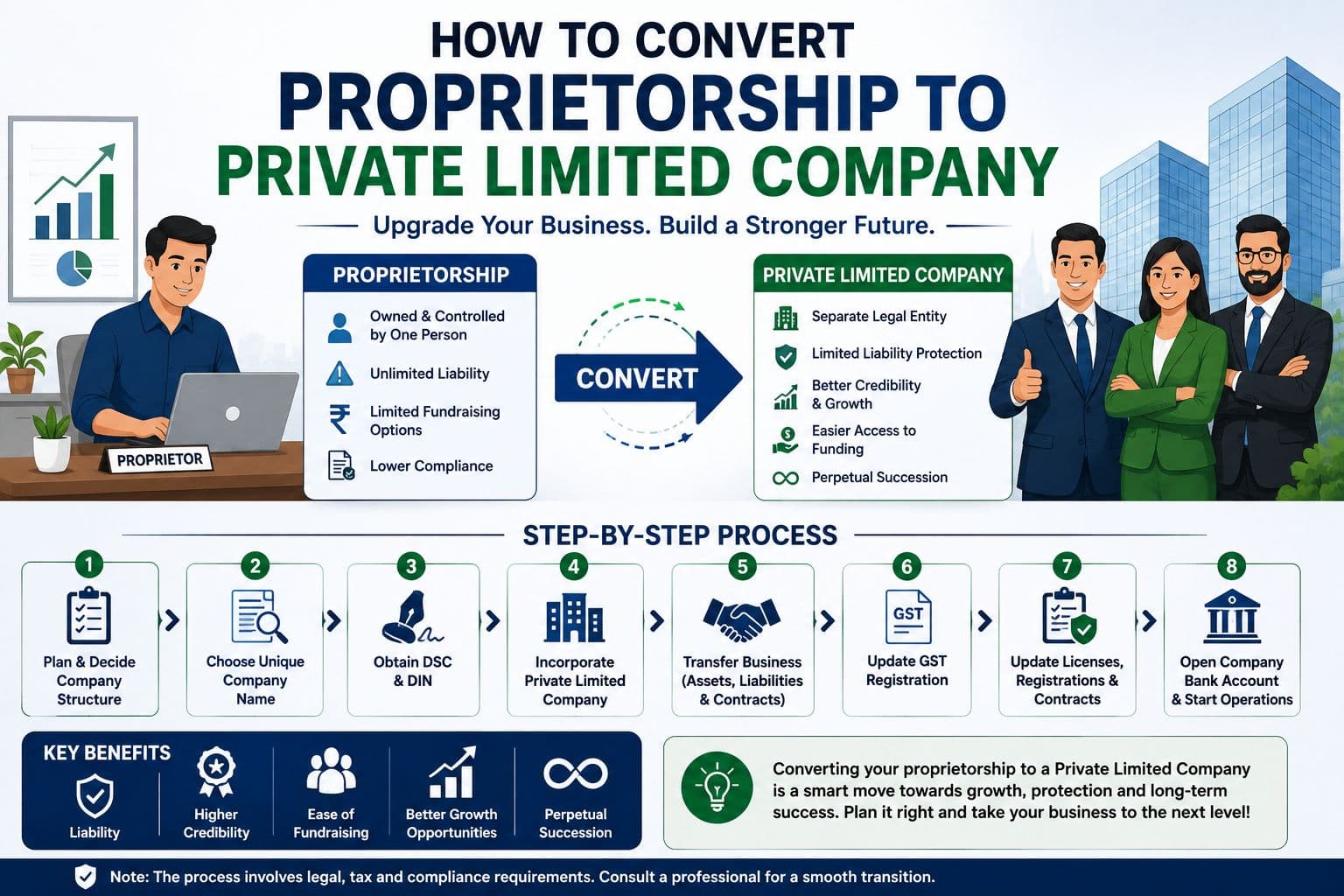
Converting a proprietorship firm into a Private Limited Company is a popular option for business owners who want to expand their business, raise investment, build a separate legal identity, or improve their business credibility.
A sole proprietorship and a Private Limited Company are different business structures. A proprietorship does not have a separate legal identity from its owner, while a Private Limited Company is a separate legal entity incorporated under the Companies Act, 2013.
In this guide, we explain how to convert a proprietorship into a Private Limited Company, eligibility, documents required, step-by-step process, benefits, tax considerations, and important compliance requirements.
What Is a Proprietorship?
A sole proprietorship is a business owned and controlled by one individual. The owner and the business are generally treated as the same legal person.
A proprietorship is easy to start and has relatively simple compliance requirements. It is commonly used by small businesses, freelancers, traders, consultants, retailers, and service providers.
However, as the business grows, the owner may want a structure that offers:
Separate legal identity
Limited liability
Better business credibility
Easier access to investment
Better opportunities for expansion
In such cases, converting the business into a Private Limited Company may be considered.
What Is a Private Limited Company?
A Private Limited Company is a separate legal entity registered under the Companies Act, 2013.
It is owned by shareholders and managed by directors. Unlike a sole proprietorship, the company's identity is separate from the identity of its owners.
A Private Limited Company generally requires at least:
2 members/shareholders
2 directors
The company can have a maximum of 200 members, subject to the applicable provisions of company law.
Can a Proprietorship Be Converted Into a Private Limited Company?
Yes, a proprietorship business can be transferred to or succeeded by a newly incorporated Private Limited Company, subject to applicable legal and tax requirements.
Technically, a proprietorship does not simply "change its legal form" into a company in the same way that one company changes its structure. Instead, a new Private Limited Company is incorporated, and the proprietorship business and its assets/liabilities are transferred to the company through the appropriate documentation and arrangements.
Where the applicable tax conditions are satisfied, the transfer may also qualify for specific tax treatment under the Income-tax Act.
Why Convert a Proprietorship Into a Private Limited Company?
Business owners commonly consider conversion for the following reasons.
1. Separate Legal Identity
A Private Limited Company has its own legal identity, separate from its shareholders.
This can make it easier to enter into contracts, own assets, employ staff, and conduct business in the company's name.
2. Limited Liability
In a company, shareholders' liability is generally limited to the amount unpaid on their shares, subject to applicable law and circumstances.
This can provide greater protection compared with the unlimited personal liability generally associated with a proprietorship.
3. Better Business Credibility
A Private Limited Company can provide a more formal corporate structure and may improve credibility with customers, vendors, financial institutions, and business partners.
4. Easier Fundraising
A Private Limited Company can issue shares to investors subject to applicable law.
This can make the structure more suitable for businesses planning to raise equity investment.
5. Business Expansion
A company structure can be useful when expanding operations, entering new markets, adding shareholders, or building a long-term business.
6. Perpetual Succession
The company continues to exist independently of changes in its shareholders or directors, subject to the law.
Step-by-Step Process to Convert Proprietorship Into Private Limited Company
Step 1: Decide the New Company Structure
Before starting the process, determine whether a Private Limited Company is appropriate for your business.
You should consider:
Number of proposed shareholders
Proposed directors
Business activities
Ownership structure
Capital requirements
Future investment plans
A minimum of two members and two directors is generally required for a Private Limited Company.
Step 2: Choose a Suitable Company Name
Select a unique and legally acceptable name for the proposed company.
For example:
Existing Proprietorship: Rahul Digital Solutions
Proposed Company: Rahul Digital Solutions Private Limited
The proposed name should comply with applicable MCA naming rules and should not conflict with existing company names or trademarks.
It is also advisable to conduct a trademark search before finalizing the name.
Step 3: Obtain DSC and DIN
The proposed directors generally need a Digital Signature Certificate (DSC) for electronic filings.
Directors also require Director Identification Number (DIN) as applicable under the incorporation process.
The incorporation application can then be prepared and submitted through the MCA system.
Step 4: Incorporate the Private Limited Company
The proposed company is incorporated by filing the applicable incorporation forms with the Ministry of Corporate Affairs.
The incorporation process generally involves submitting details relating to:
Company name
Registered office
Directors
Shareholders
Share capital
Business activities
Memorandum of Association
Articles of Association
Once the application is approved, the company receives its Certificate of Incorporation.
Step 5: Transfer the Proprietorship Business to the Company
After incorporation, the existing proprietorship business can be transferred to the newly incorporated company.
This may include transferring:
Business assets
Inventory
Intellectual property
Customer contracts
Business relationships
Liabilities, where agreed
Other business-related rights and obligations
A proper Business Transfer Agreement (BTA) or other appropriate documentation may be required depending on the transaction.
The exact structure should be reviewed from legal and tax perspectives before implementation.
Step 6: Transfer Assets and Liabilities
The business owner should identify all assets and liabilities belonging to the proprietorship.
Assets may include:
Machinery
Furniture
Computers
Vehicles
Inventory
Domain names
Intellectual property
Business equipment
The transfer should be properly documented and recorded in the company's books.
Any applicable stamp duty, tax, registration, or contractual requirements should also be considered.
Step 7: Update GST Registration
If the proprietorship has a GST registration, the business owner should review the GST implications of transferring the business to the newly incorporated company.
A Private Limited Company has a separate PAN and legal identity, so the company's GST registration is generally separate from the proprietorship's GST registration.
The appropriate GST registrations and transfer procedures should be completed based on the circumstances of the business.
Step 8: Update Business Licences and Registrations
After transferring the business, applicable registrations and licences should be updated.
These may include:
GST Registration
MSME/Udyam Registration
FSSAI Registration
Import Export Code (IEC)
Shop and Establishment Licence
Professional licences
Trade licences
Industry-specific registrations
Not every registration will automatically transfer to the new company, so each licence should be reviewed separately.
Step 9: Update Bank Accounts and Contracts
The company should open its own bank account.
Customers and vendors should be informed about the change in business structure.
Where necessary, contracts and agreements should be amended or executed in the company's name.
This is particularly important for:
Vendor agreements
Customer contracts
Lease agreements
Loan documents
Payment gateway accounts
E-commerce accounts
Employment agreements
Tax Considerations When Converting Proprietorship to Private Limited Company
Tax planning is an important part of the conversion process.
The Income-tax Act contains provisions that can provide tax-neutral treatment for certain transfers of a sole proprietorship business to a company if prescribed conditions are satisfied.
These conditions should be carefully reviewed before transferring the business.
Factors that may need consideration include:
Transfer of assets
Transfer of liabilities
Shareholding of the proprietor
Consideration received
Continuity of business
Capital gains implications
Depreciation
GST implications
Stamp duty
Because tax treatment depends on the exact structure of the transaction, professional tax advice is recommended before executing the transfer.
Documents Required
Common documents required for incorporation and business transfer may include:
For Company Incorporation
PAN and identity proof of proposed directors
Address proof of directors
Passport-size photographs, where applicable
Registered office address proof
Utility bill
NOC from property owner, where applicable
Proposed company name
Business activity details
Shareholding details
Digital Signature Certificates
For Business Transfer
Depending on the transaction, documents may include:
Business Transfer Agreement
Asset list
Liability details
Proprietorship financial statements
Bank statements
GST documents
Existing business licences
Customer/vendor contracts
Intellectual property documents
Inventory details
Additional documents may be required depending on the business and the nature of assets being transferred.
Proprietorship vs Private Limited Company
| Basis | Proprietorship | Private Limited Company |
|---|---|---|
| Legal Identity | Owner and business are generally not separate | Separate legal entity |
| Owners | One owner | Minimum 2 members |
| Directors | Not applicable | Minimum 2 directors |
| Liability | Generally unlimited | Generally limited, subject to law |
| Compliance | Comparatively simple | Higher compliance |
| Fundraising | Limited | More suitable for equity investment |
| Continuity | Closely linked to owner | Perpetual succession |
| Ownership Transfer | More difficult | Shares can be transferred subject to restrictions |
| Credibility | Suitable for small businesses | Formal corporate structure |
| Taxation | Individual/proprietor tax rules | Corporate tax provisions |
Advantages of Converting to a Private Limited Company
Limited Liability Protection
The corporate structure can help separate personal assets from business liabilities, subject to applicable law.
Better Funding Opportunities
The company can raise equity capital by issuing shares in accordance with applicable laws.
Improved Credibility
A registered company can provide a more formal business structure when dealing with clients, vendors and investors.
Easier Ownership Structuring
Shareholding can be divided among founders or investors.
Long-Term Business Continuity
The company has an existence independent of individual shareholders.
Better Expansion Opportunities
A corporate structure can be more suitable for businesses planning rapid growth, partnerships, investment, or expansion.
Disadvantages to Consider
Conversion is not suitable for every business.
A Private Limited Company generally involves greater compliance requirements, such as:
ROC filings
Annual financial statements
Annual return filing
Board meetings
Maintenance of statutory records
Audit requirements
Corporate tax compliance
Professional fees and government filing costs may also be higher than those associated with a basic proprietorship structure.
Therefore, the decision should be based on the business's size, growth plans, funding requirements, and long-term objectives.
Frequently Asked Questions
Can I directly convert my proprietorship into a Private Limited Company?
A proprietorship does not convert into a company through a simple change of registration. Generally, a new Private Limited Company is incorporated and the proprietorship business is transferred or succeeded by the company through appropriate documentation.
Can I keep the same business name?
You may be able to use a similar or the same business name if the proposed company name is available and complies with applicable MCA naming rules and trademark requirements.
Will my GST number remain the same?
Generally, a Private Limited Company has a separate PAN and legal identity, so a separate GST registration is generally required where the company is liable for GST registration.
Can I transfer my proprietorship assets to the company?
Yes, business assets can generally be transferred to the company, subject to applicable legal, tax, valuation, stamp duty, and contractual requirements.
Is conversion completely tax-free?
Not automatically. Certain tax-neutral provisions may apply if the prescribed conditions are satisfied. The exact tax treatment should be reviewed before the transfer.
How many directors are required for a Private Limited Company?
A Private Limited Company generally requires at least two directors.
How many shareholders are required?
A Private Limited Company generally requires at least two members/shareholders.
Do I need to close the proprietorship after forming the company?
The proprietorship should be appropriately discontinued or its business activities transferred, depending on the structure adopted. Relevant GST, tax, bank, licence and other registrations should also be reviewed and closed or updated where necessary.
Conclusion
Converting a proprietorship into a Private Limited Company can be an important step for a growing business. It can provide a separate legal identity, limited liability, better credibility, improved ownership structure, and greater opportunities for raising investment.
However, the process involves more than simply registering a company. The existing business may need to be transferred to the new company, while assets, liabilities, GST, licences, contracts, bank accounts and tax implications must be carefully handled.
Before proceeding, it is advisable to evaluate the tax and legal implications and prepare the required business transfer documentation properly.
If your proprietorship is growing and you are planning to move to a Private Limited Company structure, professional assistance can help make the incorporation and business transfer process smoother and more compliant.