
Compliance Launch Sequence After Company Incorporation in India
First Startup
May 19, 2026
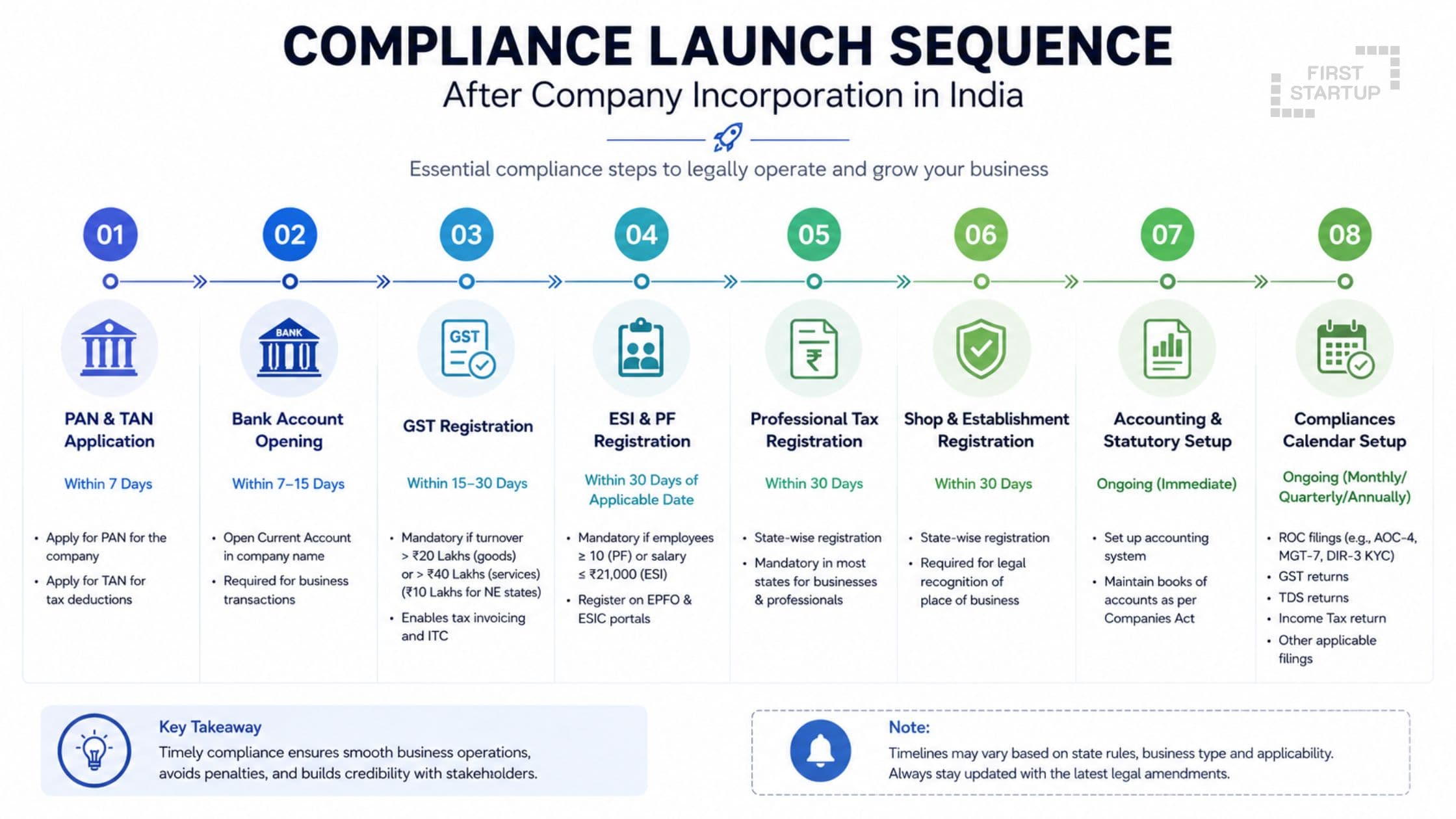
Starting a company is an exciting milestone, but incorporation is only the beginning. Once your company receives the Certificate of Incorporation (COI), several mandatory compliances must be completed within specific timelines to ensure your business remains legally compliant and operational.
From opening a bank account to filing Form INC-20A, appointing auditors, issuing share certificates, and annual filings — every step plays a crucial role in building a strong legal foundation for your company.
This guide explains the complete Compliance Launch Sequence for newly incorporated companies in India.
Why Post-Incorporation Compliance Matters
Many startups focus only on company registration and overlook post-incorporation compliances. However, non-compliance can lead to:
Heavy penalties
Director disqualification
Company strike-off by ROC
Difficulty in fundraising
Banking and taxation issues
Proper compliance management helps your company stay legally protected and investor-ready.
Step-by-Step Compliance Launch SequenceTier 1 – Open Company Bank AccountTimeline:
Timeline:
Immediately after incorporation
The first step after receiving the COI and PAN is opening a current bank account in the company’s name.
Documents Required:Certificate of Incorporation
PAN Card
MOA & AOA
Board Resolution
KYC of Directors
Why It’s Important
Certificate of Incorporation
PAN Card
MOA & AOA
Board Resolution
KYC of Directors
The company bank account is required for:
Receiving share capital
Business transactions
GST registration
Vendor payments
Compliance filings
Tier 2 – Conduct First Board MeetingTimeline:
Within 30 days of incorporation
As per the Companies Act, every newly incorporated company must conduct its first Board Meeting within 30 days.
Agenda of First Board MeetingAppointment of first auditor
Opening bank account approval
Share certificate approval
Statutory registers maintenance
Authorization for compliance filings
Key Benefit
Appointment of first auditor
Opening bank account approval
Share certificate approval
Statutory registers maintenance
Authorization for compliance filings
This meeting officially activates the operational structure of the company.
Tier 3 – Appointment of First Auditor & Filing ADT-1Timeline:
Within 30 days
The Board of Directors appoints the first statutory auditor of the company.
Purpose of Auditor Appointment
The auditor is responsible for:
Financial auditing
Compliance verification
Annual financial reporting
Form ADT-1
Although filing ADT-1 for the first auditor is not mandatory in some cases, many professionals recommend filing it for proper compliance documentation.
Tier 4 – Issue Share CertificatesTimeline:
Within 60 days
The company must issue share certificates to subscribers and shareholders after receiving share capital.
What Is a Share Certificate?
A share certificate is legal proof of ownership in the company.
Important Details IncludedShareholder name
Number of shares
Face value
Certificate number
Company seal and signatures
Shareholder name
Number of shares
Face value
Certificate number
Company seal and signatures
Failure to issue share certificates within the prescribed timeline may attract penalties.
Tier 5 – File Form INC-20A (Commencement of Business)Timeline:
Within 180 days of incorporation
One of the most important compliances for newly incorporated companies is filing Form INC-20A.
Purpose of INC-20A
This form confirms:
Share capital has been deposited
The company has started business operations
Documents RequiredBank statement showing share capital receipt
Certificate from professionals (if applicable)
Consequences of Non-Filing
Bank statement showing share capital receipt
Certificate from professionals (if applicable)
If INC-20A is not filed:
The company cannot legally commence business
ROC may initiate strike-off action
Penalties may apply
Tier 6 – GST, MSME & Startup India RegistrationTimeline:
After COI & PAN issuance
Depending on the business model, companies may need additional registrations.
GST Registration
GST registration becomes mandatory if:
Turnover exceeds threshold limit
Interstate sales are involved
Selling through e-commerce platforms
Benefits of GST RegistrationInput tax credit
Legal invoicing
Better business credibility
MSME Registration (Udyam Registration)
Input tax credit
Legal invoicing
Better business credibility
MSME registration provides:
Subsidies
Easier business loans
Government scheme benefits
Protection against delayed payments
Startup India Registration
Eligible startups can apply for Startup India recognition to avail:
Tax benefits
Funding support
Intellectual property benefits
Startup ecosystem access
Tier 7 – Annual & Event-Based Compliances
Compliance is an ongoing process. After completing initial formalities, companies must regularly comply with ROC, Income Tax, and other regulatory requirements.
Important Annual CompliancesROC Annual Filing
Includes:
AOC-4
MGT-7
Income Tax Return Filing
Every company must file annual income tax returns regardless of profit or loss.
DIR-3 KYC
Directors must complete annual KYC filing to keep DIN active.
GST Returns
Monthly, quarterly, or annual GST returns depending on the registration type.
Event-Based Compliances
Certain filings become mandatory when specific events occur, such as:
Director appointment/resignation
Share transfer
Change in registered office
Increase in capital
Change in company name
Compliance Timeline Overview
| Compliance | Timeline |
|---|---|
| Open Bank Account | Immediately |
| First Board Meeting | Within 30 Days |
| Auditor Appointment | Within 30 Days |
| File ADT-1 | Within 30 Days |
| Issue Share Certificates | Within 60 Days |
| File INC-20A | Within 180 Days |
| GST/MSME/Startup India Registration | As Applicable |
| DIR-3 KYC | Annual |
| ROC Annual Filing | Annual |
Common Mistakes New Companies MakeDelaying INC-20A Filing
This is one of the most common and risky mistakes.
Ignoring Board Meetings
Even private limited companies must maintain proper meeting records.
Missing Annual Filings
Late filing results in heavy penalties and additional fees.
Improper Documentation
Maintaining statutory registers and records is mandatory.
Benefits of Proper Compliance Management
Proper compliance helps businesses:
Build investor confidence
Avoid legal penalties
Improve business credibility
Secure loans and funding
Maintain smooth operations
Conclusion
Incorporating a company is only the first step toward building a successful business. The real foundation is created through timely compliance and proper legal management.
From bank account opening and board meetings to GST registration, INC-20A filing, auditor appointment, and annual compliances — every stage is essential for keeping your company compliant and operational.
A structured compliance launch sequence ensures your startup is fully prepared for growth, funding, taxation, and long-term business success.