
Comparing OPC, LLP & Private Limited Company Which one to choose?
First Startup
Jan 22, 2026
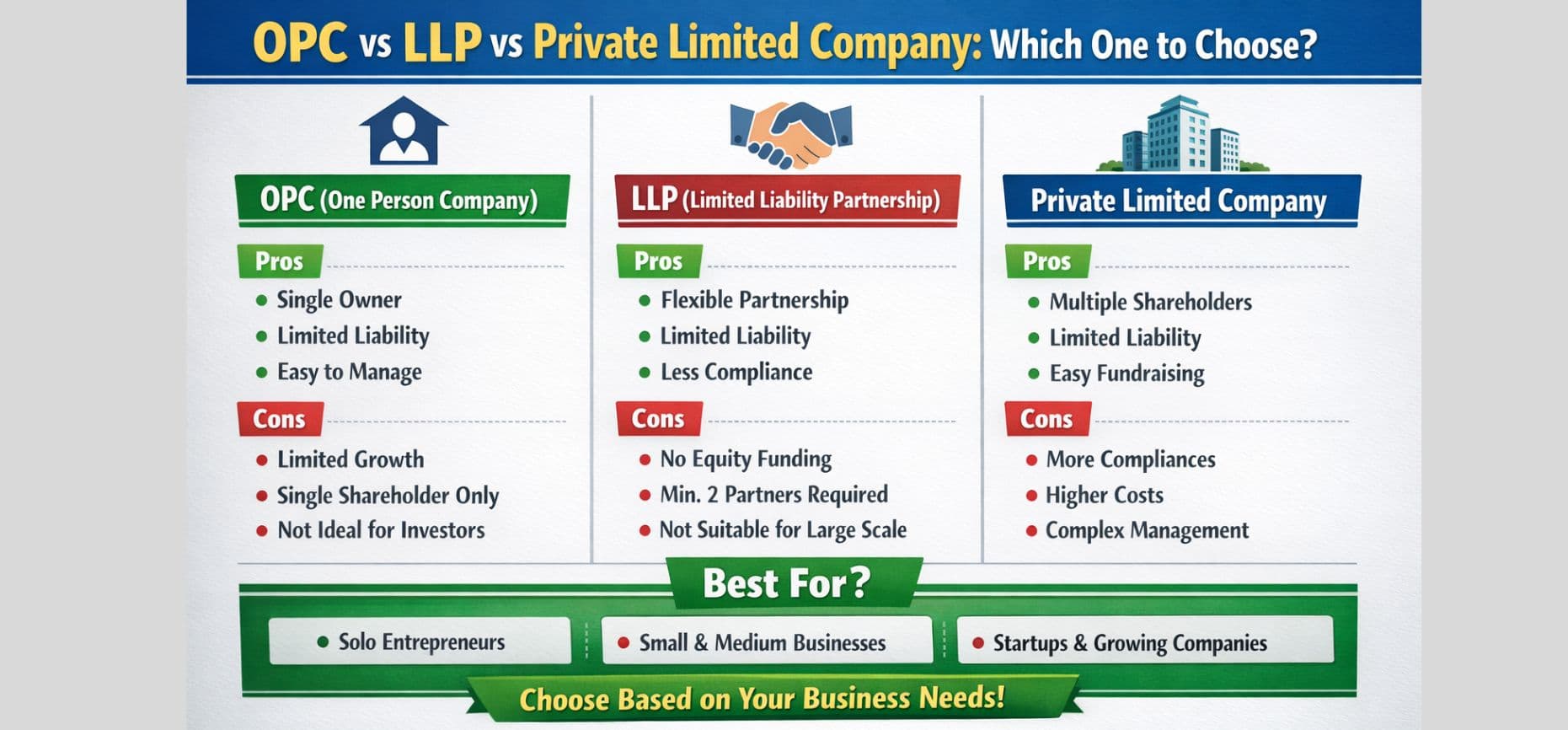
One Person Company (OPC); Limited Liability Partnership (LLP) and Private Limited Company Choice of Business- An Important Decision Selection of the form of business entity is one of the most important decisions before starting a business. This decision is required to be revisited periodically as the business develops.
One Person Company (OPC) –
- Introduction Section 2(62) of the Companies Act, 2013 define “one person company” as a company which has only one person as member.
- OPC is a type of Private Company as per Section 2(68) and Section 3(1) (c). Rule 3 of the Companies (Incorporation) Rules 2014 say, only a natural person who is an Indian citizen and resident in India:- shall be eligible to incorporate a One Person Company; Shall be a nominee for the sole member of a One Person Company. Resident in India means a person who has stayed in India for a period of not less than one hundred and eighty two days during the immediately preceding one calendar year. A person can incorporate only one “One Person Company”, at any point of time and the said person shall not be a nominee of more than a One Person Company.
Limited Liability Partnership (LLP) –
- Introduction LLP is an incorporated partnership formed and registered under the Limited Liability Partnership Act, 2008.
- LLP is an alternative business vehicle that gives the benefits of Limited Liability Company and flexibility of a partnership firm.
- LLP contains elements of both ‘a corporate structure’ as well as ‘partnership firm structure’; it is many a times termed as a hybrid of a company and a partnership.
- LLP is a separate legal entity which can continue its existence irrespective of changes in its partners.
- LLP is useful for small and medium enterprises, in general, and for the enterprises in services sector, in particular, Owing to flexibility in its structure and operation.
- LLP is also very suitable for professionals like company secretaries, chartered accountants, cost accountants, advocates etc. as it helps them to form multi-disciplinary limited liability partnership firms.
Private Limited Company -
- Private Limited Company is a most popular option to start a business in India by startups and businesses with higher growth aspirations.
- Private Limited Company is incorporated under the Companies Act, 2013 and governed by the Ministry of Corporate Affairs in India.
- It is a registered corporate structure that provides business a separate legal identity from its owners.
- It can be registered with minimum of two directors and subscribers/shareholders. A person can be both a director and shareholder in a Private Limited Company.
- The liability of the shareholders/members of a Private Limited Company is limited to the extent of unpaid amounts of shares held by them.
- DEFINITION OF PRIVATE COMPANY [SECTION 2(68)] “Private Company” means a company which by its articles: Restricts the right to transfer its shares; Limits the number of its members to 200; prohibits any invitation to the public to subscribe for any securities of the company.
Comparison between OPC, LLP & Private Limited Company
We have given a comparison between all these three as below:-
Particulars | OPC | LLP | PVT LTD Co. |
Governing Act | The Company Act, 2013 | Limited Liability Partnership Act, 2008 | The Company Act, 2013 |
Legal Entity | OPC has a district legal entity There is only one person, Director. | LLP has a separate legal entity, separate legal existence that means limited liability of partners. | It is registered as a Private Limited Company |
Cost factor | Low | Medium | Medium |
Registration Period | Upto 7 days | Upto 7 days | Upto 5 days |
Number of members required | One person Only | Minimum Two | Minimum 2 Maximum 200
|
Minimum Number of Directors and Shareholders | Member – 1 Director – 1 Nominee of Sole Member – 1 Note: Only a natural person who is an Indian Citizen and resident in India | 2 Designated Partners (one of India) | Members/Shareholders – 2 Directors – 2 Note: Directors and members may or may not be same. Only a natural person can be a director, also one person should be an Indian director i.e. resident in India (a person who has stayed in India for a period of not less than one hundred and eighty two days during the immediately preceding one calendar year) |
Share Capital | No minimum requirement, but if capital exceeds 50 lakh , OPC gets converted into Private Limited | No Minimum requirement | No Minimum Requirement |
Transparency | Medium | High | High |
Compliances | A very few annual compliances need to be done. | Monthly and annual Compliance (Form 8 and Form 11) need to be done. | Monthly and annual Compliance (Form AOC 4 and Form MGT ) need to be done. |
Separate Legal Entity | Yes | Yes | Yes |
Startup India Registration | Low | Medium | High |
Investor Preference | Low | Medium | High |
DOCUMENTS REQUIRED
Particulars | OPC | LLP | PVT LTD Co. |
Members | 1. PAN of Director / Shareholder 2. AADHAR Director / Shareholder 3. Voter id or Driving License or Passport 4. Latest Bank Statement or Electricity bill 5. Passport Size Photo or Digital Photo | 1. PAN of Designated Partners 2. AADHAR Designated Partners 3. Voter id or Driving License or Passport 4. Latest Bank Statement or Electricity bill 5. Passport Size Photo or Digital Photo | 1. PAN of Director / Shareholder 2. AADHAR Director / Shareholder 3. Voter id or Driving License or Passport 4. Latest Bank Statement or Electricity bill 5. Passport Size Photo or Digital Photo |
Company | 1. Latest Electricity bill of Proposed Registered Address 2. Rent Agreement & NOC From Landlord if any | 1. Latest Electricity bill of Proposed Registered Address 2. Rent Agreement & NOC From Landlord if any | 1. Latest Electricity bill of Proposed Registered Address 2. Rent Agreement & NOC From Landlord if any |