
How to Start an Automotive Ecommerce Startup in 2026
First Startup
Apr 24, 2026
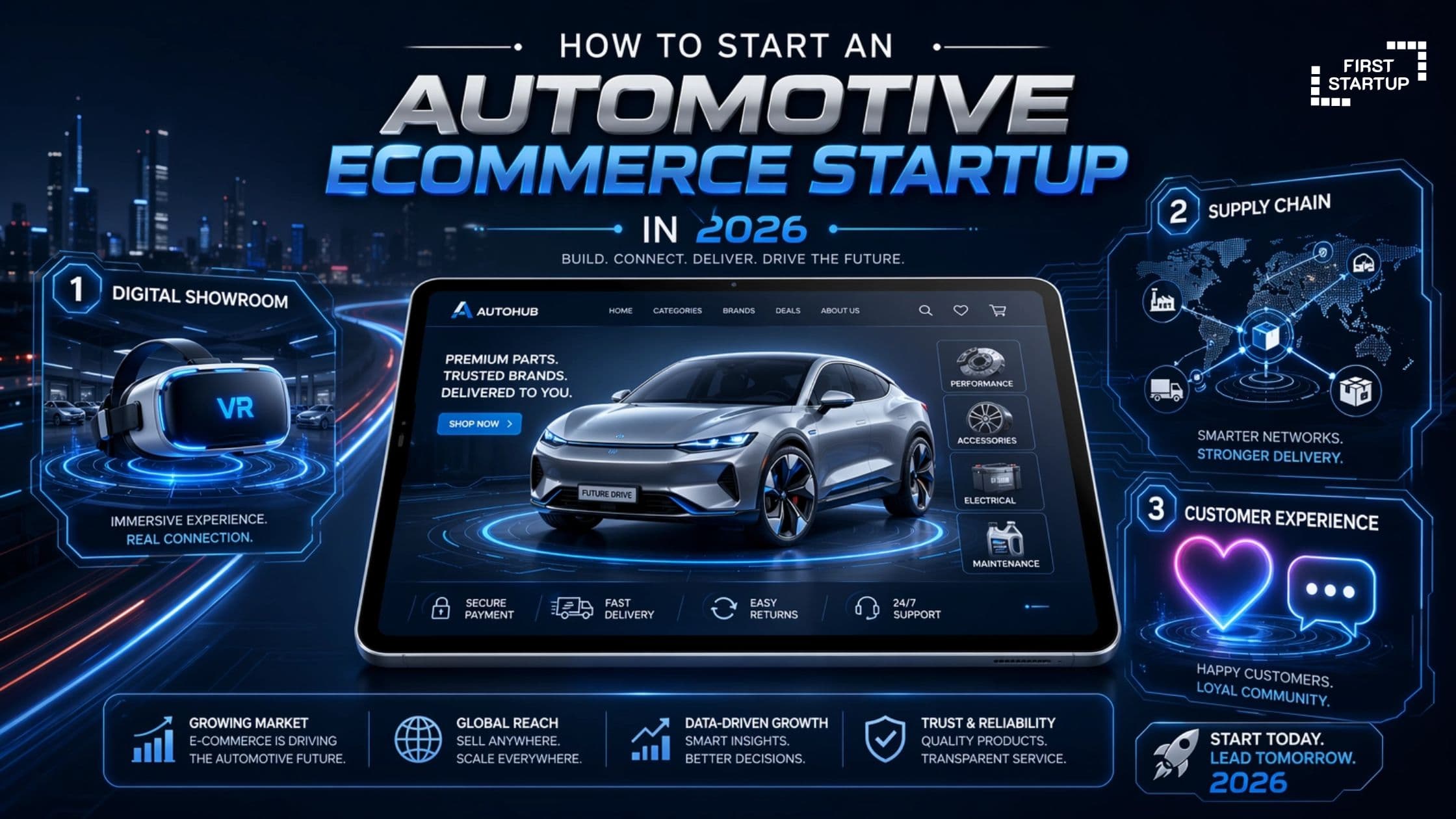
The automotive industry is no longer confined to grease-stained garages and neon-lit showrooms. In 2026, the "Digital Garage" has arrived. With the rapid expansion of the Electric Vehicle (EV) ecosystem, the integration of AI in vehicle diagnostics, and a consumer base that prioritizes convenience, the automotive ecommerce startup sector is one of the most lucrative frontiers for entrepreneurs.
Whether you are looking to build an auto parts online business in India or a global car accessories ecommerce business, the road to success requires a blend of technical expertise, logistics mastery, and digital savvy. This 1,500-word guide breaks down exactly how to start an auto parts business and scale it into a market leader.
Why 2026 is the "Golden Year" for Automotive Ecommerce
Before diving into the "how," we must understand the "why." Several macroeconomic and technological shifts have converged to make 2026 the perfect time to launch:
The EV Explosion: The transition from Internal Combustion Engines (ICE) to Electric Vehicles has created an entirely new category of parts. From high-tech charging cables to specialized cooling fluids and battery thermal management components, the EV aftermarket is a blue ocean.
Digital Adoption in Tier 2 & 3 Cities: In India and beyond, high-speed internet has reached the smallest towns. A mechanic in a rural village can now order a specific sensor online rather than traveling to a city hub.
The "Right to Repair" Movement: Global consumer advocacy is pushing for easier access to parts and manuals, empowering DIY enthusiasts to bypass expensive dealerships and buy parts directly from startups.
Supply Chain Resiliency: Modern ecommerce tools now allow startups to manage global inventories with surgical precision, reducing the risk of "dead stock."
Step 1: Choosing Your High-Octane Niche
The biggest mistake new founders make is trying to be "The Amazon of Cars" on Day 1. In 2026, the most successful ecommerce startup ideas focus on hyper-specialization.
Potential Niches:
The Spare Parts Specialist (OEM & Aftermarket): Focus on critical engine components, braking systems, or suspension kits. This requires high trust and precise fitment data.
EV Ecosystem Hub: Focus exclusively on home charging stations, portable EV chargers, and cabin accessories specific to brands like Tesla, Tata Motors, or Mahindra.
The Aesthetic & Performance Shop: Target the "Mod Culture." Think LED lighting, custom alloy wheels, high-end upholstery, and performance-mapping tools.
Eco-Friendly Detailing: A niche dedicated to waterless car washes, biodegradable ceramic coatings, and sustainable car care products.
Verified Used Parts (The Circular Economy): A marketplace for refurbished or "tested" parts from scrapped vehicles—a massive opportunity for sustainability-focused brands.
Tip: Start with a niche that has a high "repeat purchase" rate, such as car care or filtration kits, to build a steady cash flow while you scale into high-ticket items like gearboxes or batteries.
Step 2: Market Research & The Power of Data
In 2026, data is your fuel. You cannot rely on gut feeling.
Competitor Benchmarking: Analyze established players like Amazon Auto, Flipkart, and specialized platforms like Boodmo or PartsBigBoss. What are they missing? Is it technical support? Fast delivery? Installation services?
Gap Analysis: Look at search trends. If "EV home charger installation" has high search volume but low product availability, you’ve found your entry point.
Compatibility Mapping: The biggest pain point in this industry is the "Will it fit?" question. Research how your competitors handle vehicle-specific data (Year, Make, Model, Trim).
Step 3: Legal Setup & Registration in India
To run a legitimate auto parts online business in India, you must navigate the regulatory landscape. Skipping this step can lead to massive fines or platform bans.
Business Structure: Register as a Private Limited Company if you plan to raise VC funding, or an LLP for a more flexible, partner-owned model.
GST Registration: Non-negotiable for ecommerce. You need a GST number to sell on your own site or marketplaces.
MSME/Udyam Registration: This provides benefits in government tenders and easier access to credit.
Intellectual Property: Secure your domain name and Trademark your brand. In the crowded automotive space, your brand name is your most valuable asset.
Import/Export Code (IEC): If you plan to source specialized performance parts from Germany or EV components from China, an IEC is mandatory.
Step 4: Building Your Digital Showroom
Your website isn't just a shop; it’s a technical manual. Customers come to you because they have a problem (a broken car) or a desire (a faster car).
The Tech Stack
SaaS Platforms (Shopify/BigCommerce): Best for quick launches and robust security.
Open Source (WooCommerce/Magento): Best for highly customized "Vehicle Finders" and complex fitment databases.
Must-Have Features for 2026:
VIN (Vehicle Identification Number) Lookup: Allow users to type their VIN to see only the parts that fit their specific car.
AI Chatbots: Programmed to answer technical questions like, "Which engine oil is best for a 2022 Hyundai Creta Diesel?"
3D Product Visualizers: Let customers see how a set of rims will look on their car model before buying.
Progressive Web App (PWA): Ensure your site feels like an app on mobile devices, where 80% of your traffic will originate.
Step 5: Sourcing & Inventory Management
Where will your products come from? Your sourcing strategy determines your margins.
The Manufacturer Route: Buying directly from companies like Bosch, Lumax, or Gabriel. This offers the best margins but requires significant upfront capital for bulk orders.
The Distributor Model: Working with regional wholesalers. Lower margins, but you can carry less inventory.
Dropshipping: You list the product, and the supplier ships it. This is excellent for testing ecommerce startup ideas for 2026 without financial risk, though you lose control over shipping speed.
Private Labeling: Once you identify a best-seller (e.g., microfiber towels or dash cams), manufacture them under your own brand name for 2x–3x the profit.
Step 6: Specialized Logistics & Packaging
Shipping a 50kg engine block is different from shipping a smartphone.
Packaging: Auto parts are often heavy or oily. Invest in double-walled corrugated boxes and leak-proof seals for fluids.
Courier Partners: Partner with companies like Delhivery, Blue Dart, or Ecom Express. For larger parts (bumpers, hoods), you may need specialized LTL (Less-than-Truckload) freight providers.
The Trust Factor: Provide real-time tracking. In the auto world, a car sitting on a lift in a workshop costs the owner money every day. Fast delivery isn't a luxury; it's a necessity.
Step 7: Marketing Your Automotive Startup
Growth in 2026 requires a multi-channel "Full-Funnel" approach.
1. SEO (The Long Game)
Don't just target "buy car parts." Target "Best brake pads for BMW X5 2026" or "How to install a home EV charger." This educational content brings users to your site for free.
2. Social Media & Influencers
The automotive world is visual.
Instagram/TikTok: High-energy clips of car restorations or "Before and After" detailing.
YouTube: Long-form "How-To" videos. If you show a customer how to change their air filter and provide a link to buy that exact filter, your conversion rate will skyrocket.
3. Performance Ads
Use Google Shopping Ads so your product image and price appear exactly when someone searches for a specific part number.
Step 8: Revenue Streams & Profitability
Don't just rely on the markup of a single sale.
B2B Partnerships: Create a "Technician Portal" where local mechanics get a 10% discount for bulk, recurring orders.
Subscription Models: "The Maintenance Box"—send oil, filters, and wipers to the customer every six months automatically.
Installation Add-ons: Partner with local garages. The customer buys the part from you and pays a fixed fee for installation at a partner workshop.
Step 9: Overcoming Industry Challenges
Every car accessories ecommerce business faces these "speed bumps":
High Returns: The #1 killer of auto ecommerce. Mitigate this by using high-resolution images, video fitment guides, and a "Verify with Expert" button before checkout.
Counterfeit Products: The market is flooded with fakes. Use hologram stickers or QR code verification to prove your parts are genuine.
Technical Support: You need a team that knows cars. If a customer asks about "torque specs," your support team needs to have the answer.
Step 10: Scaling to the Finish Line
Once you have a stable customer base, shift your focus to scaling:
Global Expansion: Middle Eastern and African markets have huge demands for Indian-manufactured auto parts.
Private Label Mastery: Transition from a "Store" to a "Brand."
Physical Experience Centers: Open small "Click & Collect" hubs where customers can pick up parts or get a quick 15-minute installation for accessories.
Conclusion
Starting an automotive e-commerce startup in 2026 is an ambitious journey, but the rewards are massive. By focusing on a specific niche, leveraging the EV revolution, and obsessing over compatibility data, you can build a business that doesn't just survive but dominates the digital landscape. With proper startup registration, you can also ensure your business is legally compliant and ready for long-term growth.
The road is open. It’s time to start your engine.