
Jaggery Business Setup in India: The Ultimate 2026 Guide to Cost, License & Profits
First Startup
Apr 17, 2026
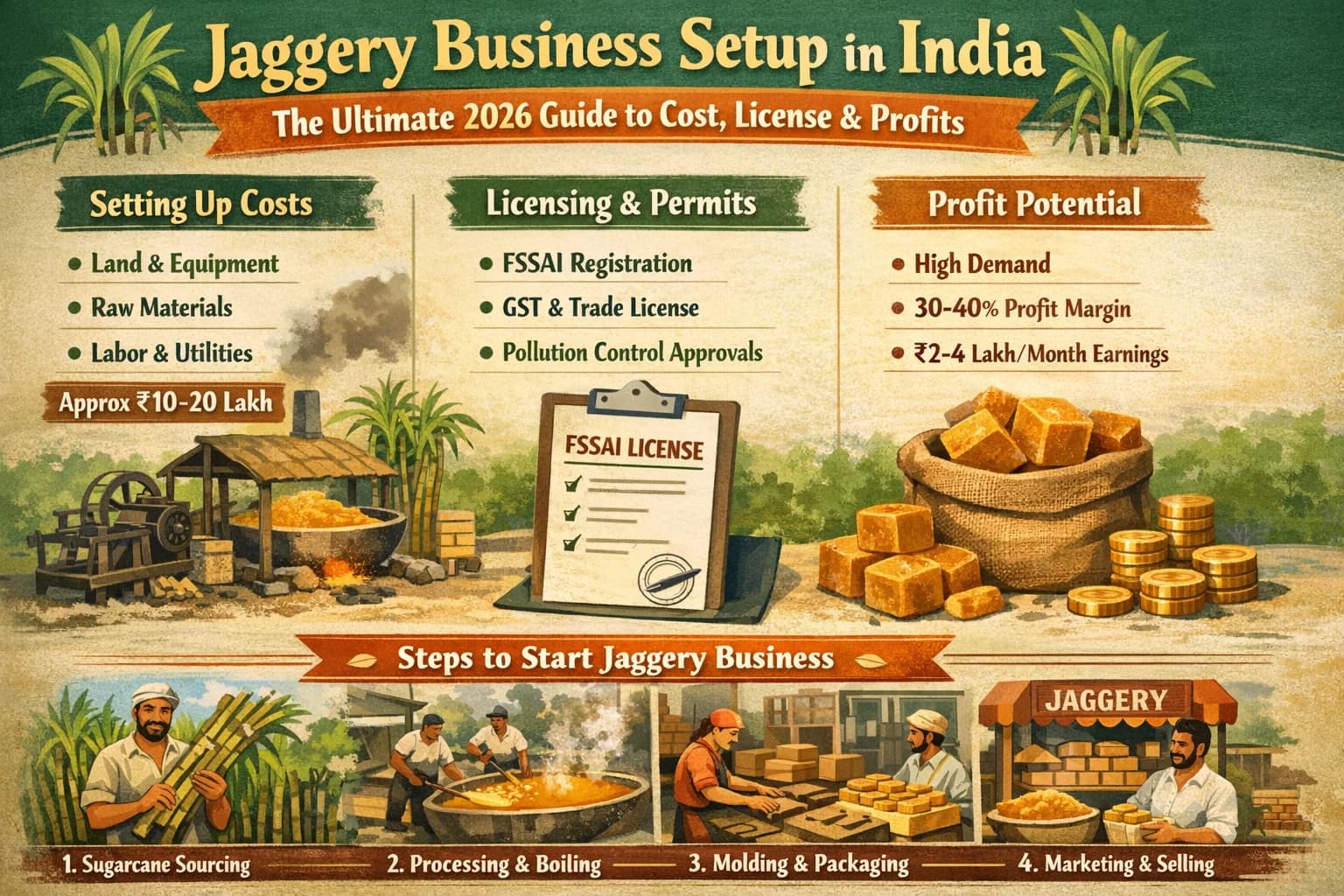
In an era where health-conscious consumers are ditching refined sugar for natural alternatives, the jaggery business in India has witnessed a massive resurgence. Once considered a rural, traditional trade, jaggery (or Gur) is now a staple in urban gourmet kitchens and a high-demand commodity in the export market.
If you are looking for a profitable, agro-based venture, this guide will walk you through how to start a jaggery business in India, covering everything from jaggery business setup costs to the legalities of the jaggery business license.
Why Start a Jaggery Business in India in 2026?
India is the world’s largest producer and consumer of jaggery. Unlike the refined sugar industry, which uses heavy chemicals, jaggery is perceived as a "superfood" rich in iron and minerals.
The Market Opportunity
Health Shift: As diabetes and obesity rates rise, millions of Indians are switching to jaggery powder for their daily tea and coffee.
Abundant Raw Material: India is the second-largest producer of sugarcane globally, ensuring that a jaggery manufacturing business has consistent access to raw materials.
Low Entry Barrier: While a sugar mill requires hundreds of crores, a jaggery business setup can be started with a relatively small investment.
Export Potential: There is a booming demand for organic Indian jaggery in the Middle East, Europe, and North America.
Types of Jaggery Business Models
Before calculating your jaggery business cost, you must decide which model fits your vision:
Traditional Jaggery Units (Kolhu): Small-scale units producing solid blocks.
Jaggery Powder Processing: Converting blocks into easy-to-use powder. This is currently the highest-growth segment.
Value-Added Jaggery: Infusing jaggery with ginger, cardamom, or peanuts to create premium "health snacks."
Organic Jaggery Brand: Focusing on chemical-free production and high-end retail packaging.
Detailed Jaggery Business Cost & Investment
The jaggery business cost varies significantly based on the scale of automation. Here is a breakdown of the capital required in 2026:
1. Small-Scale Setup (₹3 Lakhs – ₹7 Lakhs)
Ideal for rural entrepreneurs or those starting near sugarcane farms.
Equipment: Basic sugarcane crusher and open boiling pans.
Space: 1,000 – 2,000 sq. ft.
Labour: 4–6 workers.
2. Medium-Scale Semi-Automated Unit (₹8 Lakhs – ₹25 Lakhs)
Recommended for those targeting urban supermarkets and online platforms.
Equipment: Semi-automatic crushers, stainless steel boiling tanks, and a pulverizer for powder.
Space: 3,000 – 5,000 sq. ft.
Focus: Branded packaging and quality control.
3. Large-Scale Fully Automated Plant (₹30 Lakhs – ₹1 Crore+)
Required for export-oriented units.
Equipment: Vacuum evaporators (to maintain nutrition), automatic molding, and nitrogen-flush packaging machines.
Capacity: 5–10 tons per day.
Mandatory Jaggery Business License & Registration
To operate legally and build trust with retailers, you must secure the following:
FSSAI License: Since jaggery is a food product, an FSSAI registration (or license for larger units) is mandatory. It ensures your product meets safety standards.
GST Registration: Necessary for inter-state trade and selling on e-commerce platforms like Amazon.
Udyam (MSME) Registration: Essential to avail of government subsidies and low-interest bank loans.
Pollution Control NOC: Since jaggery units use furnaces (bhattis), you need a No-Objection Certificate from the State Pollution Control Board.
Trade License: Obtained from your local municipal authority.
The Jaggery Manufacturing Process
Understanding the jaggery manufacturing business flow is crucial for maintaining quality.
Extraction: Sugarcane is crushed to extract juice. In 2026, modern crushers achieve up to 80% juice extraction.
Clarification: The juice is collected in large tanks. Traditionally, plant-based clarificants like Deola (ladyfinger extract) are used to remove impurities. Avoid chemical bleaching agents to maintain your "Organic" status.
Boiling: The juice is heated in a series of pans. As the water evaporates, the juice thickens into a golden syrup.
Cooling & Shaping: The thick paste is moved to cooling trays. For blocks, it’s poured into moulds. For powder, it is dried further and processed through a pulverizer.
Analyzing Jaggery Business Profit Margins
The jaggery business profit is highly dependent on your branding.
Loose/Bulk Selling: If you sell unbranded blocks to wholesalers, your profit margin might be 10% to 15%.
Branded Retail: If you package organic jaggery powder under your own brand, the margins jump to 30% to 50%.
Example Profitability Table:
| Component | Cost/Price (per kg) |
| Raw Sugarcane Cost | ₹3.5 – ₹5 |
| Processing & Labour | ₹10 – ₹15 |
| Packaging & Marketing | ₹5 – ₹10 |
| Total Production Cost | ₹20 – ₹30 |
| Retail Selling Price | ₹60 – ₹120 |
Step-by-Step Jaggery Business Plan India
If you are wondering how to start a jaggery business in India, follow this structured roadmap:
Phase 1: Research & Sourcing
Don't start far from your raw materials. Transporting sugarcane is expensive because it loses water weight quickly after harvest. Identify a cluster of farmers within a 20km radius of your unit.
Phase 2: Infrastructure & Machinery
Invest in stainless steel (SS 304 grade) equipment. In 2026, food safety inspectors are strict about rust and hygiene. Ensure your furnace is fuel-efficient to save on heating costs.
Phase 3: Branding & Packaging
In the modern market, the "cover" sells the book. Use stand-up pouches with zippers for jaggery powder. Clearly highlight "No Added Chemicals" or "Sulphur-Free" on the label.
Phase 4: Sales & Distribution
B2B: Tie up with local bakeries and sweet shops that want to offer "Sugar-Free" sweets.
Online: List your products on Amazon, BigBasket, and Zepto.
Exports: Register with APEDA (Agricultural and Processed Food Products Export Development Authority) to tap into international markets.
Challenges to Overcome
Seasonality: Sugarcane is typically available for 6–8 months. You must plan your cash flow for the off-season.
Shelf Life: Jaggery is hygroscopic (it absorbs moisture). Use high-quality moisture-proof packaging to prevent the product from turning into a sticky mess during monsoon.
Price Volatility: Sugarcane prices are often regulated by the government; keep a buffer in your jaggery business plan.
Pro-Tips for 2026 Success
Liquid Jaggery (Joni Bella): Consider producing liquid jaggery, which is gaining popularity as a pancake syrup alternative.
Solar Drying: Use solar tunnels to dry your jaggery powder. It reduces electricity costs and is a great marketing point for "Green Energy" branding.
Government Schemes: Look into PMEGP (Prime Minister’s Employment Generation Programme) for subsidies up to 35% on your project cost.
Conclusion
The jaggery business in India is a golden opportunity (literally!) for entrepreneurs who want to bridge the gap between traditional agriculture and modern retail. By focusing on a clean jaggery business setup, completing your startup registration, and securing the right jaggery business license, you can turn a humble block of gur into a premium global brand.
The transition from a commodity to a branded health product is where the real jaggery business profit lies. Start small, focus on purity, and scale with the growing health trend after completing your Startup Registration for better compliance and growth opportunities.