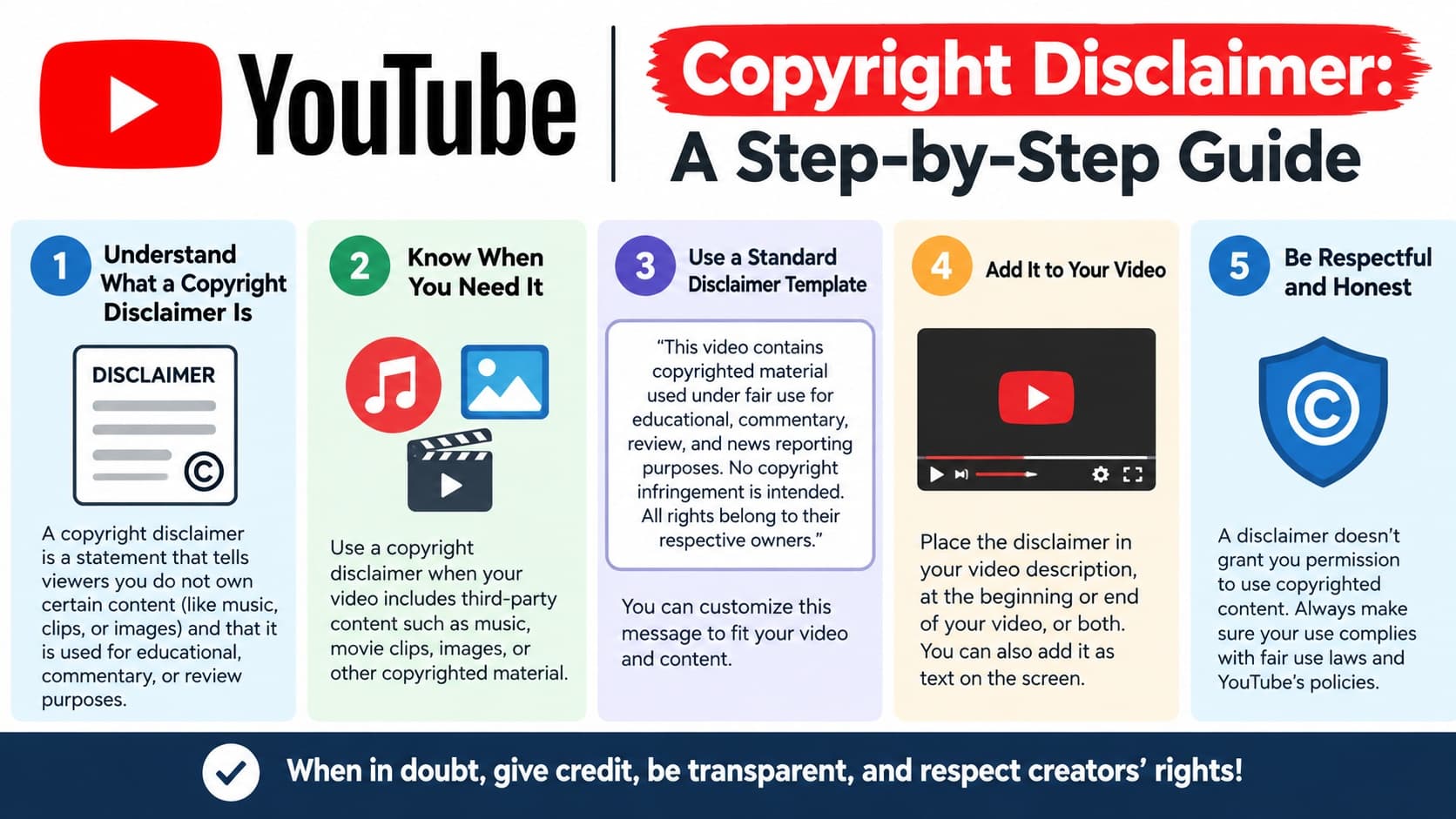
YouTube Copyright Disclaimer: A Step-by-Step Guide
First Startup
Oct 13, 2026
YouTube has become one of the most popular platforms for sharing videos, building an audience, and earning money through content creation. However, creators must understand copyright rules before uploading videos that contain music, movie clips, images, sound effects, or other content created by someone else.
A YouTube copyright disclaimer is a statement that creators may use to explain the intended use of copyrighted material in their videos. However, adding a disclaimer does not automatically make the use of copyrighted content legal or protect a video from copyright claims.
In this guide, we explain what a YouTube copyright disclaimer is, when it may be useful, how to write one, and what creators should know about copyright protection.
What Is a YouTube Copyright Disclaimer?
A YouTube copyright disclaimer is a statement included in a video's description, credits, or other accompanying material to clarify how copyrighted content is being used.
Creators sometimes include disclaimers when their videos contain commentary, criticism, reviews, educational explanations, or other material that discusses existing copyrighted works.
For example, a creator reviewing a film might use a short clip to explain a particular scene. The creator may include a disclaimer describing the review's purpose, but whether the clip can legally be used depends on the circumstances and applicable copyright law.
A disclaimer is not a substitute for obtaining permission when permission is required.
Why Is a YouTube Copyright Disclaimer Important?
A well-written disclaimer can help explain the purpose of a video and acknowledge the original creators. However, it does not independently establish that the video complies with copyright law.
Here are some reasons creators may include a disclaimer:
Clarifying the purpose: Explains whether the video is intended for commentary, criticism, review, education, or another purpose.
Acknowledging original creators: Provides attribution when appropriate or required by a licence.
Communicating usage intentions: Helps viewers understand the context in which material is presented.
Supporting transparency: Makes it easier to understand the relationship between the video and referenced works.
Remember that attribution and disclaimers do not replace copyright permission or other legal requirements.
YouTube Copyright Disclaimer Template
You can adapt the following template to your video's actual content and purpose.
Example copyright disclaimer:
"This video may contain references to copyrighted material used for commentary, criticism, review, educational discussion, or other purposes. All rights in third-party material remain with their respective owners. The inclusion of such material does not imply ownership or endorsement. Where required, appropriate permissions and licences should be obtained."
Important: Use this statement only when it accurately describes your video. It does not guarantee protection against copyright claims, takedowns, or legal action.
YouTube Fair Use Disclaimer Example
Some creators use a fair use disclaimer when publishing reviews, educational videos, reaction videos, or commentary that incorporates excerpts from existing works.
A commonly used example is:
"Certain material in this video may be included for purposes such as criticism, commentary, news reporting, teaching, scholarship, or research. Whether a particular use qualifies as fair use depends on the facts and applicable law."
In the United States, fair use is assessed on a case-by-case basis using four statutory factors:
Purpose and character of the use: Whether the use has a transformative purpose and whether it is commercial or non-commercial.
Nature of the copyrighted work: Whether the original work is factual or creative.
Amount and substantiality: How much material is used and whether the portion includes the work's most important elements.
Effect on the market: Whether the use affects the market for the original work or its potential licensing opportunities.
No single factor automatically determines the outcome. Simply writing "no copyright infringement intended" or mentioning fair use does not make an otherwise infringing use lawful.
Other countries, including India, have their own copyright exceptions and legal tests.
How to Add a Copyright Disclaimer to a YouTube Video
Follow these steps to add a disclaimer to a video's description.
Step 1: Sign in to YouTube Studio
Open YouTube Studio and sign in using the Google account associated with your channel.
Step 2: Open Your Content
Select Content from the left-hand menu. You will see the videos uploaded to your channel.
Step 3: Select the Video
Choose the video for which you want to add or update the copyright disclaimer. Open its details page.
Step 4: Edit the Description
Locate the description field and add your disclaimer. Make sure it accurately reflects the material used in the video.
Step 5: Review Your Video's Content
Check whether the video contains third-party music, images, clips, or other copyrighted material. Confirm that you have the necessary permission, licence, or a valid legal basis for using it.
Step 6: Save Your Changes
Click Save to update the video details. Adding a disclaimer does not automatically remove an existing copyright claim or prevent future claims.
Where Should You Put a YouTube Copyright Disclaimer?
You can place a disclaimer in several locations, depending on your needs.
1. Video description: This is a common option because viewers can read the statement beneath the video.
2. Video credits: Credits can identify the original creators or sources of material used in a production.
3. On-screen text: A short statement can be displayed within the video when relevant.
4. Channel description: A channel-wide statement may explain your general approach to third-party content, but it cannot grant rights to material used in individual videos.
Where attribution is required by a licence, follow the specific attribution terms rather than relying on a generic disclaimer.
Does a YouTube Copyright Disclaimer Prevent Copyright Claims?
No. A copyright disclaimer does not automatically prevent a Content ID claim, copyright takedown request, or copyright strike.
YouTube uses systems such as Content ID to identify certain copyrighted material in uploaded videos. Depending on the rights holder's settings, a matched video may be monetised by the rights holder, tracked, or blocked.
A copyright owner may also submit a removal request where appropriate.
If you receive a claim, review the details in YouTube Studio. Dispute it only when you have a genuine basis, such as the necessary rights, a valid licence, a mistaken match, or a well-founded legal exception.
Submitting an invalid dispute may lead to further consequences.
How to Avoid Copyright Problems on YouTube
Creators can reduce copyright risks by following these practices:
Create original content: Use your own footage, photographs, graphics, scripts, and recordings whenever possible.
Obtain written permission: Contact the relevant copyright owner when your intended use requires permission.
Use properly licensed music: Review the licence terms for music and sound effects before publishing.
Check Creative Commons conditions: Verify the specific licence, attribution requirements, commercial-use restrictions, and modification rules.
Use YouTube Audio Library resources: Review the applicable terms for each track, including any attribution requirements.
Keep evidence: Save licences, permissions, receipts, and relevant correspondence.
Avoid copying entire works: Using a smaller excerpt may be relevant to a legal assessment, but there is no universally safe number of seconds.
Review monetisation rights: Permission to use content does not necessarily mean you can monetise it under every licence.
These practices can help creators make informed decisions, but no checklist guarantees that every video will be free from copyright disputes.
YouTube Copyright Disclaimer vs Copyright Permission
It is important to understand the difference between a disclaimer and permission.
| Copyright disclaimer | Copyright permission |
|---|---|
| Explains the intended use of material | Authorises a specified use when granted by the relevant rights holder |
| Does not automatically establish legal compliance | Can provide a legal basis within the licence or permission terms |
| Does not prevent all claims or takedowns | May help defend against claims when the use falls within the granted rights |
| Can be written by the video creator | Must come from someone authorised to grant the relevant rights |
For example, if you want to use a commercial song in a monetised video, a disclaimer saying that the music belongs to its owner does not replace any necessary licence.
Is a YouTube Copyright Disclaimer Required?
YouTube does not require every creator to add a generic copyright disclaimer to every video.
However, creators should comply with copyright law, YouTube's policies, and any licence conditions that apply to their content. Specific uses may require permission, attribution, or another legal basis.
The appropriate approach depends on the material used, the intended purpose, the applicable law, and the terms under which the content was obtained.
Copyright Disclaimer and Indian Copyright Law
Creators based in India should also consider the Copyright Act, 1957, and its applicable exceptions.
Section 52 sets out certain acts that do not constitute copyright infringement under specified conditions. Whether a particular use qualifies depends on the relevant provision and the facts of the situation.
The US fair use framework should not automatically be applied to videos published by Indian creators. India's legal framework differs, and the inclusion of a copyright disclaimer does not itself establish that a use is lawful.
For commercial projects or disputes involving significant financial or legal risk, consider consulting a qualified copyright professional.
Frequently Asked Questions (FAQs)
1. What is a YouTube copyright disclaimer?
A YouTube copyright disclaimer is a statement explaining the intended use of third-party copyrighted material in a video. It does not automatically grant permission or prevent copyright claims.
2. Can I copy a copyright disclaimer from another YouTube channel?
You can use a general template as a starting point, but you should adapt it to your content. A copied disclaimer does not provide legal protection simply because another channel uses it.
3. Does writing "no copyright infringement intended" protect my video?
No. This statement does not automatically prevent copyright infringement or copyright claims. The actual use of the material and the applicable legal rules determine whether the use is permitted.
4. Can I use copyrighted music if I give credit?
Not necessarily. Giving credit does not replace a required licence or permission. Check the music's licence terms before using it.
5. How many seconds of copyrighted content can I use on YouTube?
There is no universal rule allowing a specific number of seconds of copyrighted content. Even a short excerpt may raise copyright issues, depending on the circumstances.
6. Can I monetise a video that contains copyrighted material?
It depends on your rights to the material, the applicable licence, YouTube's monetisation policies, and any claims made by copyright owners. A disclaimer alone does not grant monetisation rights.
7. What should I do if my YouTube video receives a copyright claim?
Review the claim in YouTube Studio, identify the material involved, and check your licence or other legal basis for using it. Dispute the claim only if you have a genuine and supportable reason.
Conclusion
A YouTube copyright disclaimer can help explain the intended use of third-party material, but it is not a substitute for copyright permission, a valid licence, or compliance with applicable law.
Before publishing a video, creators should review the rights associated with music, footage, images, and other third-party materials. They should also keep relevant permissions and understand the difference between attribution, fair use, and other legal exceptions.
By creating original content, using licensed resources, and responding carefully to copyright claims, creators can build a more sustainable YouTube channel while reducing avoidable legal risks.