
How to Search a TM on IP India? Step-by-Step Trademark Search Guide
First Startup
Sep 16, 2026
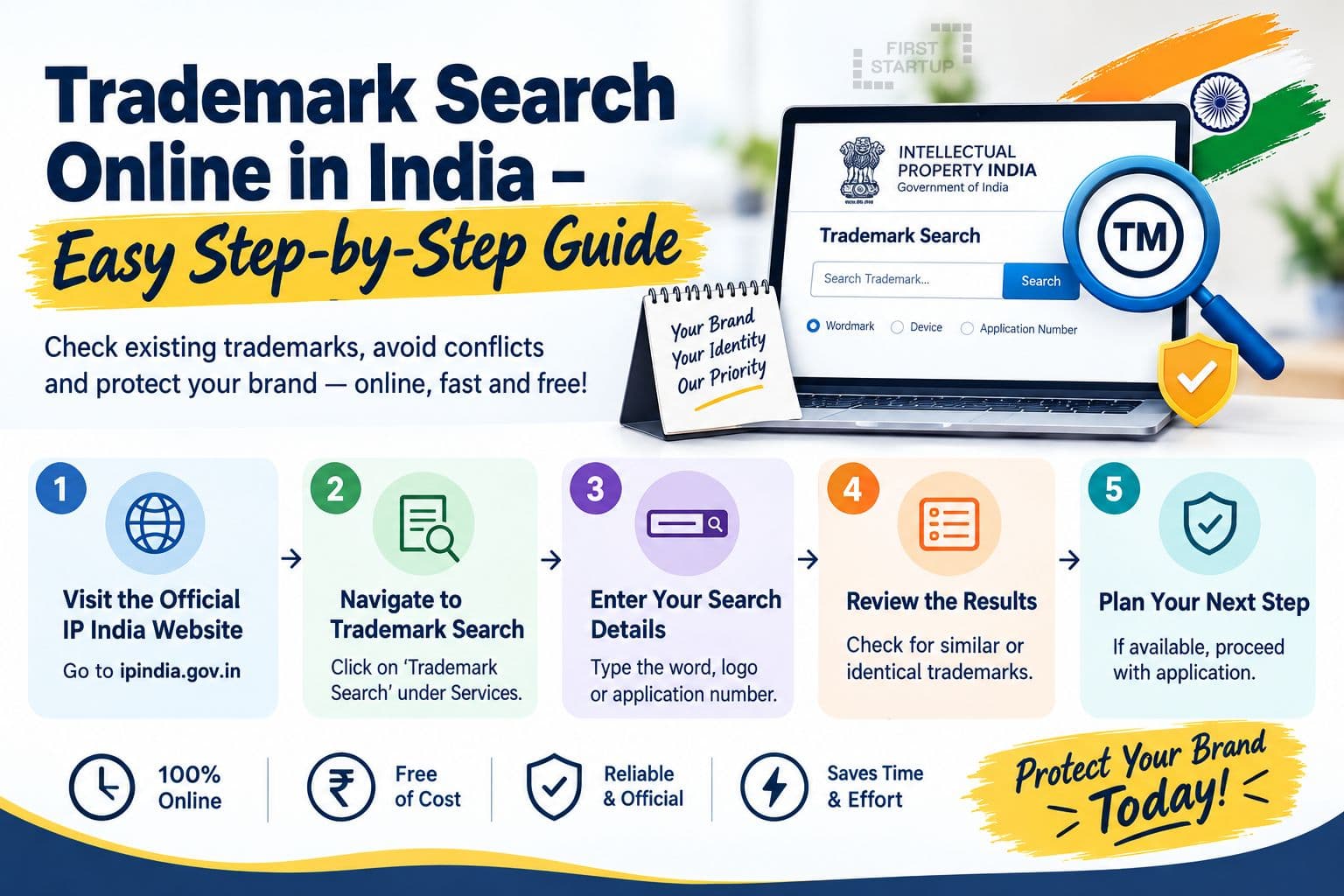
Learn the complete IP India trademark search process and check trademark availability, similar brand names, classes and existing applications online.
Before applying for Trademark Registration in India, it is important to check whether a similar or identical trademark already exists. A proper trademark search can help you understand whether your proposed brand name, logo, or mark may conflict with an existing trademark.
The IP India Trademark Search facility allows businesses, startups, entrepreneurs, and individuals to search trademark records online. By checking the available records before filing an application, you can identify potentially conflicting marks and make a more informed decision about your proposed trademark.
In this guide, we will explain how to search a TM on IP India, what information you need, how to perform the search, and what you should check in the results.
What Is a Trademark Search?
A trademark search is the process of checking the existing trademark database to find marks that are identical or similar to the trademark you want to register.
For example, if you want to register the brand name “ABC Fresh”, you should search for:
ABC Fresh
ABC
ABC Fresh Foods
Similar-sounding names
Similar spellings
Related trademarks in the same business category
A trademark search is generally performed before filing a trademark application because an existing similar trademark could create objections or opposition later.
Why Is IP India Trademark Search Important?
Searching a trademark on the IP India portal can provide useful information about existing trademark applications and registrations.
Some important benefits include:
1. Find Similar Trademarks
You can identify trademarks that are identical or similar to your proposed brand name.
2. Reduce the Risk of Objection
A search may help you identify potential conflicts before submitting your application.
3. Check Existing Applications
You can see whether another person or business has already applied for a similar trademark.
4. Understand Trademark Status
Search results can provide information about the status of trademark applications, such as whether an application is pending, registered, opposed, or otherwise processed.
5. Make Better Branding Decisions
If a proposed name has several similar trademarks, you may decide to evaluate another name before investing heavily in branding.
How to Search a TM on IP India?
The trademark search process can be completed online through the official IP India trademark system.
Follow these steps:
Step 1: Visit the IP India Website
First, visit the official IP India website and navigate to the trademark-related services.
Look for the option related to Trademark Search or the current public search facility.
The IP India portal is operated by the Office of the Controller General of Patents, Designs & Trade Marks (CGPDTM).
Step 2: Open the Trademark Search Facility
After opening the trademark search section, you will see the available search options.
Depending on the current IP India portal interface, the search facility may provide different fields or search methods.
You should carefully select the search option that matches the type of trademark information you want to check.
Step 3: Enter Your Trademark Name
Enter the proposed brand or trademark name in the search field.
Suppose your proposed brand name is:
“Green Basket”
Start by searching the exact phrase:
Green Basket
However, do not stop after finding no exact match.
You should also search variations such as:
Green Basket
GreenBaskets
Green Basket India
Green Basket Foods
Green Baskets
Similar-sounding words
This is important because trademark conflicts are not limited to exact word matches.
Step 4: Select the Appropriate Class
Trademarks in India are categorized into different classes based on the goods or services they cover.
There are 45 trademark classes, with Classes 1–34 generally covering goods and Classes 35–45 covering services.
For example:
Class 25 – Clothing, footwear and headgear
Class 30 – Certain food products, coffee, tea and related products
Class 35 – Advertising, business management and retail-related services
Class 41 – Education, training and entertainment services
Class 42 – Technology and software-related services
The correct class depends on the actual goods or services associated with your trademark.
For example, if you are launching a clothing brand, you should examine relevant trademarks in Class 25.
If you provide business consulting services, relevant service classes should be checked instead.
Step 5: Choose the Search Type
The trademark search system may provide different search approaches.
Depending on the portal interface, you may encounter options for searching by:
Wordmark
Phonetic similarity
Class
Application number
Proprietor information
Other available trademark details
For a new brand name, a wordmark search is an important starting point.
A phonetic search can also be useful because trademarks that sound similar may require additional attention.
Step 6: Review the Search Results
After submitting the search, the system will display matching records, if available.
Do not look only at the trademark name.
Review important information such as:
Trademark name
Application number
Application date
Class
Applicant/proprietor
Trademark status
Goods or services
Relevant descriptions
Associated details available in the record
The class and goods/services are particularly important when assessing whether a result is relevant to your proposed trademark.
How to Check If a Trademark Name Is Available?
A common question is:
“How do I know if my trademark is available?”
A trademark search does not simply work like checking whether a name appears or does not appear in the database.
You should examine several factors.
Exact Match
First, check whether an identical trademark already exists in the relevant class.
Similar Names
Next, look for names that are visually or phonetically similar.
For example:
FastKart
FastCart
Fast Karts
These names may deserve further examination depending on the goods/services and other circumstances.
Same Business Category
Pay special attention to similar marks used for related goods or services.
A similar name in an unrelated area may have a different legal significance depending on the circumstances.
Trademark Status
Check whether the existing mark is:
Registered
Objected
Opposed
Abandoned
Withdrawn
Pending
Other status shown in the official record
The status can provide important context, but it should not be interpreted in isolation.
What If You Find a Similar Trademark?
Finding a similar trademark does not automatically mean that you cannot use or register your proposed brand.
You should examine:
How similar the names are
Whether they have similar pronunciation
Whether the logos or visual elements are similar
The trademark classes involved
The goods or services covered
The status of the existing application
Whether the marks belong to related businesses
For a detailed assessment, professional trademark assistance can be useful before filing the application.
What Is a Phonetic Trademark Search?
A phonetic search focuses on trademarks that may sound similar, even when their spelling is different.
For example, two brand names may have different spellings but sound almost the same when pronounced.
This is why searching only the exact spelling of your proposed brand name may not be enough.
When conducting a trademark search, consider:
Alternative spellings
Singular and plural forms
Similar pronunciations
Abbreviations
Common spelling variations
Words with similar appearance
A broader search can help identify potentially relevant records.
What Information Should You Note From the Search?
When you find a potentially relevant trademark, save or record the important details.
A simple checklist can include:
| Information | What to Check |
|---|---|
| Trademark Name | Exact or similar name |
| Application Number | Official application reference |
| Class | Relevant trademark class |
| Applicant | Person/company that filed it |
| Application Date | Date of filing |
| Status | Current application status |
| Goods/Services | What the trademark covers |
| Similarity | Word, sound or visual similarity |
Keeping these details organized can make the next stage of trademark evaluation easier.
Common Mistakes While Searching a TM on IP India
Searching Only the Exact Name
Do not search only the exact spelling. Include similar spellings and phonetic variations.
Checking the Wrong Class
A trademark search should cover the class or classes relevant to your actual goods or services.
Ignoring Similar Trademarks
A different spelling does not necessarily mean there is no potential conflict.
Looking Only at the Status
The status of an application is important, but you should also examine the class, goods/services and similarity.
Filing Without a Proper Search
Submitting a trademark application without checking relevant existing marks can increase the risk of objections or other complications.
Can You Search a Trademark Online for Free?
Yes, the official IP India trademark search facility can be used to search trademark records online.
However, conducting a useful trademark search involves more than entering a name and checking whether an exact result appears.
For a business planning to invest significantly in a brand, it is advisable to conduct a broader search covering relevant classes, similar spellings and phonetic variations.
What Happens After a Trademark Search?
If your search does not reveal a significant conflict, you can proceed to evaluate the trademark application process.
The general process includes:
Select the trademark
Conduct a trademark search
Identify the appropriate class
Prepare the required information and documents
File the trademark application
Receive the application number
Monitor the application status
Respond to any examination objection, if applicable
Complete the applicable stages of the registration process
Receive trademark registration if the application is accepted and successfully processed
The actual outcome depends on the examination and other proceedings applicable to the particular application.
Final Thoughts
Knowing how to search a TM on IP India is an important step before applying for trademark registration in India. A proper search can help you identify identical or similar marks, understand existing applications, and evaluate possible conflicts before filing.
Remember that a basic name search is only the starting point. You should consider exact matches, phonetic similarities, relevant trademark classes, goods or services, and the status of existing applications.
If you are planning to register a brand, conducting a comprehensive trademark search before filing can help you make better-informed decisions about your trademark application.
Frequently Asked Questions (FAQs)
1. How can I search a TM on IP India?
You can visit the official IP India trademark services, open the available trademark search facility, enter your proposed trademark name, select the relevant search criteria and review the results.
2. Is IP India trademark search free?
The official trademark search facility can be used online to search available trademark records. Separate government fees may apply when you actually file a trademark application.
3. Can I search a trademark by name?
Yes, you can search trademark records using the available wordmark/search options. It is also useful to check spelling variations and phonetic similarities.
4. What are trademark classes?
Trademark classes categorize goods and services for trademark registration. India follows a classification system containing 45 classes.
5. Does finding no exact match mean my trademark is automatically available?
No. You should also check similar spellings, phonetic similarities, relevant classes and related goods or services before deciding to file.
6. Can I register a trademark if a similar name already exists?
It depends on the specific circumstances, including the similarity of the marks, classes, goods/services, and status of the existing trademark. A professional assessment may be appropriate before filing.
7. Why should I conduct a trademark search before registration?
A trademark search can help identify potentially conflicting marks before you submit your application and invest further in branding.