
Trademark Registration for Common Metals & Metal Building Materials in India
First Startup
Nov 13, 2026
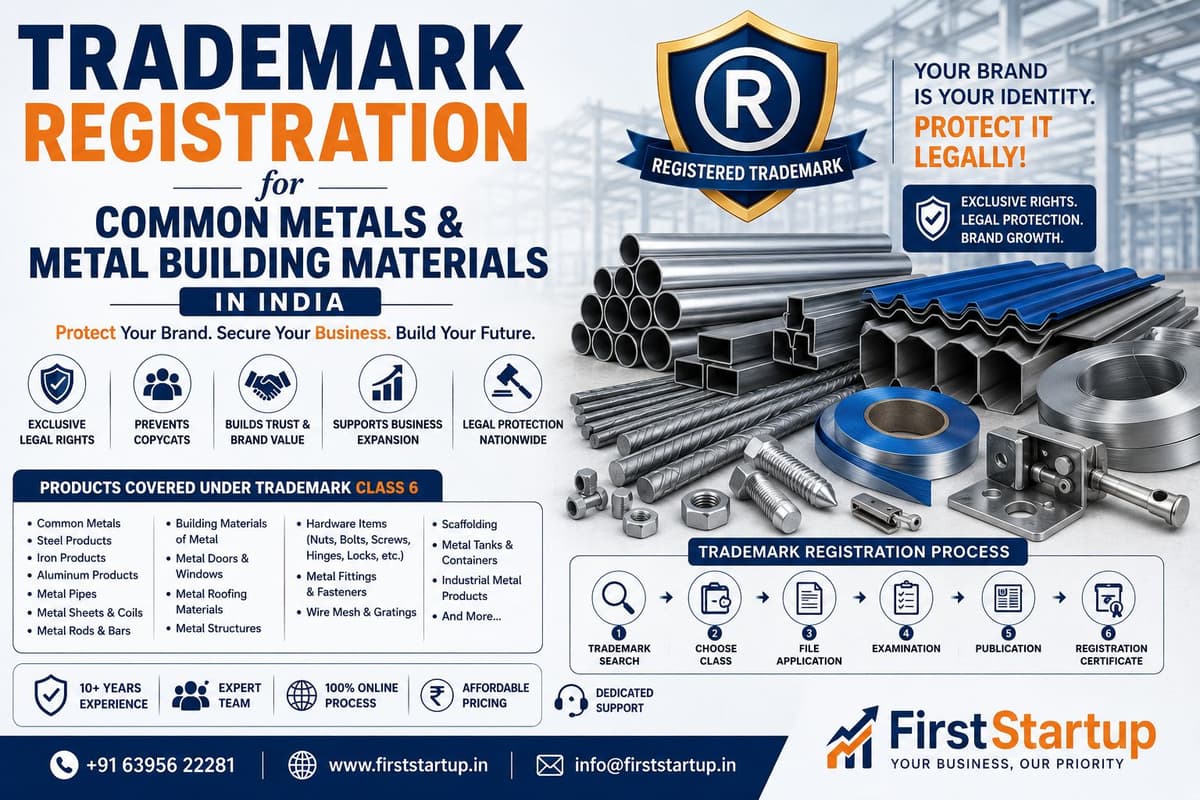
Are you planning to launch a brand dealing in common metals, metal products or building materials? Protecting your brand name, logo and business identity is important for building customer trust and establishing a strong market presence.
Trademark Registration for Common Metals & Metal Building Materials helps eligible manufacturers, wholesalers, distributors and traders protect their brand identity in the Indian market. Businesses dealing in iron, steel, aluminium, copper, metal sheets, pipes, metal roofing, building components and related products should consider trademark protection before investing heavily in branding and marketing.
A registered trademark provides legal protection for the registered mark in relation to the goods and services covered by the registration. It can help prevent unauthorised use of identical or deceptively similar marks for relevant goods.
In this guide, we explain trademark registration for common metals and metal building materials, the relevant trademark class, eligibility, documents, application process, government fees and benefits.
1. What Is Trademark Registration for Common Metals and Metal Building Materials?
Trademark registration is the legal process of protecting a distinctive brand name, logo, symbol, word, label or other eligible mark under the Trade Marks Act, 1999.
For businesses dealing in common metals and metal building materials, trademark registration can protect the identity under which their products are manufactured, marketed or sold.
Examples of products in this business category include:
Iron and steel products
Common metals and their alloys
Aluminium sheets and metal plates
Copper and brass products
Metal pipes and tubes
Metal roofing sheets
Metal building panels
Steel construction materials
Metal fittings and hardware
Metal building components
Reinforcing materials made of metal
Metal doors, frames and structural products
The exact goods description and classification should be checked before filing the trademark application.
2. Which Trademark Class Applies to Common Metals and Metal Building Materials?
Trademark Class 6 under the Nice Classification generally covers common metals and their alloys, ores, metal building materials, transportable buildings of metal and certain metal hardware products.
Businesses selling or manufacturing products covered by Class 6 may consider filing a trademark application in this class.
Examples of Products Covered Under Class 6
Common metals and their alloys
Unwrought or semi-wrought iron and steel
Aluminium and copper products
Metal building materials
Metal pipes and tubes
Metal roofing materials
Metal sheets and plates
Metal doors and windows
Metal gates and fencing
Metal construction fittings
Metal hardware
Metal storage containers
Important: Not every product made from metal automatically belongs to Class 6. Classification depends on the nature, function and description of the product. For example, metal hand tools, machinery and certain household products may fall under different trademark classes.
3. Who Should Apply for Trademark Registration?
Trademark registration can be useful for businesses operating in the metal and construction materials industry, including:
Metal Manufacturers
Manufacturers producing steel, aluminium, copper, iron and other metal products can protect their product brand names.
Building Material Suppliers
Businesses supplying metal roofing sheets, steel structures, metal panels and construction materials can register their distinctive brand identity.
Metal Wholesalers and Distributors
Wholesalers and distributors selling products under their own brand can consider trademark protection.
Hardware and Metal Product Companies
Businesses selling metal fittings, gates, grills, frames, pipes and related products can protect their eligible marks.
Startups and New Businesses
New metal product brands can apply for trademark registration to establish their identity before expanding into the market.
4. Types of Trademarks You Can Register
Depending on the distinctiveness and legal eligibility of the mark, businesses may apply for different types of trademarks.
Wordmark: Protects a brand name, word or combination of words.
Device mark or logo: Protects a distinctive graphical logo.
Label mark: Protects a distinctive label or combination of text and design.
Shape mark: May protect a distinctive product shape or packaging shape, subject to legal requirements.
Colour combination: May be registrable where the combination is distinctive and meets legal conditions.
For many metal and building material businesses, registering the brand name and logo is a practical starting point.
5. Documents Required for Trademark Registration
The documents depend on the applicant's legal structure and the type of trademark application.
Commonly required documents include:
Applicant's PAN card, where applicable.
Applicant's identity and address proof.
Business registration or incorporation documents, if applicable.
Brand name or logo.
Applicant's email address and mobile number.
Date of first use of the trademark, if claiming prior use.
User affidavit and supporting evidence, where required for a prior-use claim.
Authorisation through Form TM-48 when filing through an agent or attorney.
An applicant claiming to be a startup or small enterprise may need relevant supporting documentation to claim the applicable reduced government filing fee.
6. Trademark Registration Process for Common Metals & Metal Building Materials
The trademark application is filed online through the Indian Trade Marks Registry.
Step 1: Select Your Brand Name
Choose a distinctive name for your metal products or building material business. Avoid names that are generic, descriptive or likely to conflict with existing trademarks.
Step 2: Conduct a Trademark Search
Search the existing trademark database to identify identical or similar marks. This helps assess potential conflicts before filing.
Step 3: Identify the Correct Trademark Class
Determine whether Class 6 covers the actual goods. If your business also sells tools, machinery, retail services or other products, additional classes may need consideration.
Step 4: Prepare the Application
Prepare the applicant details, mark representation, goods description, class and supporting documents.
Step 5: File Form TM-A
Submit the trademark application using Form TM-A and pay the applicable government fee.
Step 6: Examination by the Trademark Registry
The Registry examines the application. It may accept the application, raise objections or require clarification.
Step 7: Reply to Examination Objections
If an examination report raises objections, an appropriate response should be filed within the prescribed period. A hearing may also be required.
Step 8: Publication in the Trademark Journal
If accepted, the mark is published in the Trademark Journal. Third parties may oppose the application within the prescribed opposition period.
Step 9: Trademark Registration Certificate
If the application successfully completes the registration process without a successful opposition, the Registry may issue the registration certificate.
7. Government Fees for Trademark Registration in India
The government filing fee for a trademark application depends on the applicant category and filing method.
Applicant category | E-filing fee per mark, per class |
|---|---|
Individual, startup or small enterprise | ₹4,500 |
Other applicants, including most companies | ₹9,000 |
These are standard government application fees for Form TM-A. Professional fees, if applicable, are separate. Additional government fees may apply for other trademark proceedings or services.
A business should check its eligibility for the reduced fee and the latest fee schedule before filing.
8. Benefits of Trademark Registration for Metal Businesses
Registering a distinctive trademark can provide several commercial and legal advantages.
Brand protection: Helps protect the registered mark for the goods covered by registration.
Legal rights: Provides statutory rights to the registered proprietor, subject to the Trade Marks Act.
Brand recognition: Helps customers identify products from a particular business.
Market credibility: Supports a consistent brand identity in a competitive market.
Business expansion: Helps protect a brand as the business expands into new markets.
Licensing opportunities: A registered trademark can be licensed or commercially exploited.
Protection against misuse: Provides a legal basis to take action against infringing use, subject to applicable law.
9. Trademark Registration Validity and Renewal
A registered trademark in India is valid for 10 years from the date of registration and can be renewed for further periods of 10 years.
Businesses should monitor renewal deadlines to maintain their trademark rights.
You can also use:
™ to indicate a claimed trademark, including while an application is pending.
® only after the trademark has been registered.
10. Common Mistakes to Avoid
When applying for trademark registration for common metals and metal building materials, avoid these mistakes:
Selecting a generic or descriptive brand name.
Skipping the trademark availability search.
Choosing an incorrect trademark class.
Providing an overly broad or inaccurate goods description.
Submitting incorrect applicant details.
Claiming an incorrect first-use date.
Ignoring examination objections.
Missing the opposition response deadline.
Assuming an application guarantees registration.
Using the ® symbol before registration.
11. Why Choose First Startup for Trademark Registration?
First Startup helps entrepreneurs, manufacturers, traders and businesses with trademark application and brand protection support.
Our services include:
Trademark name availability search.
Trademark application filing.
Trademark registration in Class 6.
Wordmark and logo registration.
Examination objection reply assistance.
Trademark hearing support.
Trademark renewal assistance.
Trademark registration for startups and small businesses.
Whether you manufacture steel products, aluminium sheets, metal pipes, roofing materials or other metal building products, our team can help you understand the trademark application process.
Contact First Startup
Website: www.firststartup.in
Phone: +91 63956 22281
Email: [email protected]
12. Frequently Asked Questions
1. Which trademark class is used for common metals and metal building materials?
Trademark Class 6 generally covers common metals and their alloys, metal building materials, metal pipes and tubes, ironmongery and other specified metal goods.
2. Can I register my steel company brand under Class 6?
Yes, if the trademark is distinctive and the goods covered by your application fall within Class 6. The final classification depends on the actual products.
3. Can aluminium products be registered under Trademark Class 6?
Many common aluminium products, including certain metal sheets and building materials, fall under Class 6. The precise product description should be checked.
4. What is the government fee for trademark registration in India?
The online government filing fee is ₹4,500 per mark per class for eligible individuals, startups and small enterprises, and ₹9,000 for other applicants.
5. How long is a trademark valid in India?
A registered trademark is valid for 10 years and can be renewed every 10 years.
6. Can I apply for a trademark before starting my metal business?
Yes. An application can generally be filed on a proposed-to-be-used basis if the applicant has a genuine intention to use the mark.
7. Can I register both my brand name and logo?
Yes. You can apply for a wordmark and a logo separately. Each mark requires its own application and applicable government fee.
8. What happens if someone copies my registered metal product brand?
A registered trademark owner can consider appropriate legal action against infringing use, subject to the rights granted by registration and the facts of the case.
9. Can one trademark application cover multiple classes?
A multi-class application may be filed where appropriate, but the government fee applies separately for each mark and each class.
10. Can First Startup help with Class 6 trademark registration?
Yes. First Startup can assist with trademark searches, application filing and related trademark support.
Conclusion
Trademark registration for common metals and metal building materials is an important step for manufacturers, suppliers, wholesalers and construction material brands looking to establish a recognisable business identity.
Trademark Class 6 generally covers common metals, metal alloys and various metal building products. Selecting the correct classification, conducting a trademark search and preparing an accurate application can help improve the quality of your filing.
If you are planning to protect your metal product brand, contact First Startup for trademark registration assistance in India.