
Top 10 Successful New Startups in India (2026)
First Startup
Nov 12, 2026
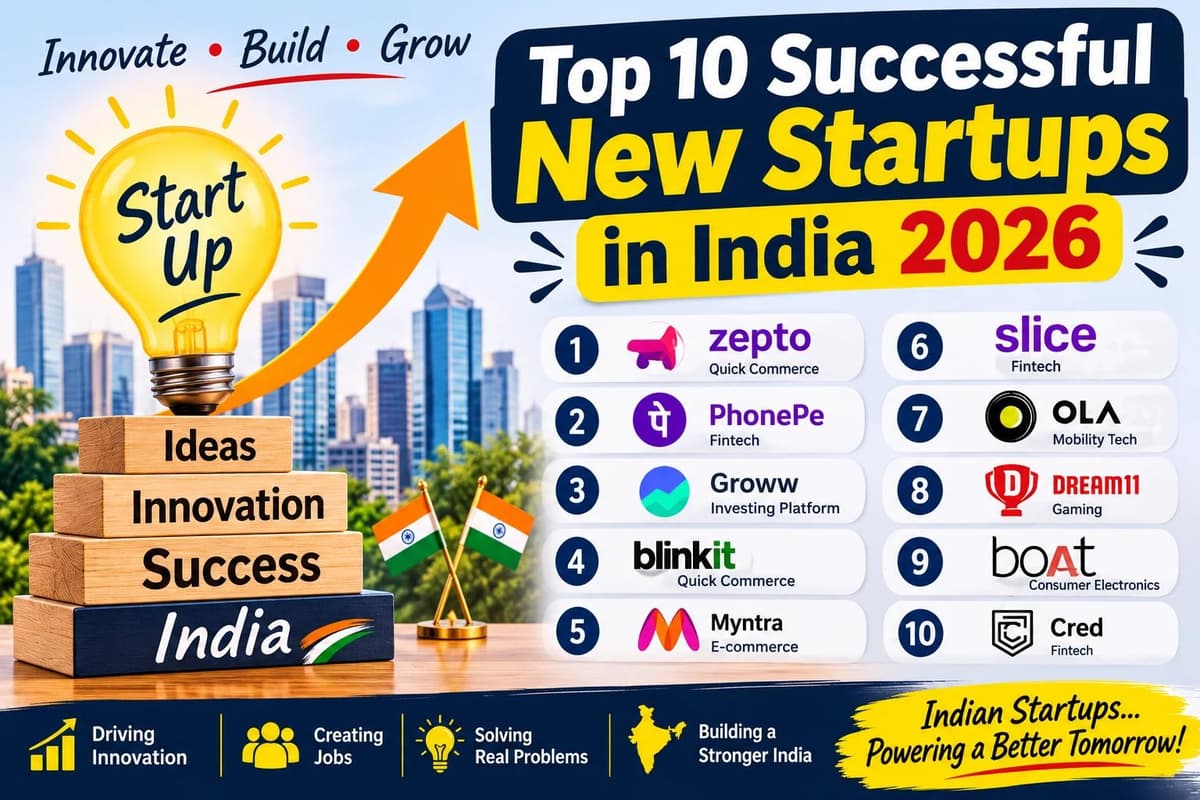
India has become one of the world's most active startup ecosystems, with entrepreneurs building innovative businesses across technology, e-commerce, education, healthcare, financial services, artificial intelligence and consumer products.
From quick-commerce platforms to AI-powered software companies, Indian startups are introducing new solutions to everyday problems and creating business opportunities for the next generation of entrepreneurs.
If you are looking for inspiration before starting your own business, exploring the top 10 successful new startups in India can help you understand emerging business models, customer needs and market opportunities.
In this guide, we explore 10 Indian startups featured in LinkedIn's 2026 Top Startups ranking, their business models and the lessons entrepreneurs can learn from them.
Top 10 Successful New Startups in India in 2026
The following companies appeared in LinkedIn's 2026 ranking of top Indian startups. The ranking considers factors such as employee growth, professional engagement, job interest and the ability to attract talent. It should not be treated as a ranking of revenue or profitability.
1. Zepto – Quick Commerce Startup
Industry: E-commerce and Quick Commerce
Zepto is one of India's recognised quick-commerce companies. Founded by Aadit Palicha and Kaivalya Vohra, the company focuses on delivering groceries, household essentials and other products through a technology-driven delivery network.
Its business model focuses on convenience, product availability and fast order fulfilment.
What makes Zepto successful?
Focus on customers who want convenient shopping.
Technology-based order management.
Local fulfilment and delivery operations.
Wide range of everyday products.
Focus on customer experience and repeat purchases.
Business lesson: Identify a common customer problem and build a business around solving it efficiently.
2. topmate.io – Creator and Professional Services Platform
Industry: Creator Economy and Professional Services
topmate.io is a platform that helps professionals, creators and experts monetise their knowledge. Users can offer paid consultations, mentoring sessions, webinars and other professional services.
The platform creates an opportunity for people to earn from their skills and experience without necessarily building a traditional service business.
What makes topmate.io interesting?
Helps professionals monetise expertise.
Connects experts with people seeking guidance.
Supports online consultations and mentoring.
Uses a digital platform to reach customers.
Business lesson: Your knowledge and professional experience can become the foundation of a scalable online business.
3. Matiks – Education and Learning Startup
Industry: EdTech and Educational Gaming
Matiks combines mathematics, learning and interactive gaming. Its platform focuses on making mental mathematics and problem-solving more engaging through challenges and competitive experiences.
Traditional learning methods may not appeal to every student. Matiks demonstrates how technology and gamification can create alternative learning experiences.
What makes Matiks different?
Combines education with interactive gaming.
Encourages regular learning and practice.
Focuses on mathematics and logical thinking.
Uses digital experiences to engage learners.
Business lesson: Businesses can create opportunities by making existing products or services more engaging and convenient.
4. Figuring Out Media & Education – Digital Media Startup
Industry: Media and Education
Figuring Out Media & Education is associated with digital media and educational content. The business focuses on creating content and building an audience through online platforms.
Digital media has created opportunities for entrepreneurs, educators and creators to reach large audiences without depending entirely on traditional publishing or broadcasting channels.
What makes this business model valuable?
Focus on digital content distribution.
Builds an audience around information and ideas.
Creates opportunities for content-based monetisation.
Uses online platforms to reach different audience groups.
Business lesson: Building a trusted audience around useful content can create long-term business opportunities.
5. Zetheta Algorithms – Financial Technology Startup
Industry: FinTech and Artificial Intelligence
Zetheta Algorithms operates in the financial technology space, focusing on algorithm-based financial solutions. The company represents the growing interest in technology-driven financial services and analytical tools.
FinTech startups can help businesses and individuals access more efficient financial products, tools and information.
What makes this sector promising?
Increasing adoption of digital financial services.
Demand for data-driven financial solutions.
Opportunities to automate complex processes.
Growing interest in financial technology.
Business lesson: Technology can create valuable business solutions when it makes complex services easier to access and use.
6. Snabbit – On-Demand Home Services Startup
Industry: Home Services
Snabbit operates in the on-demand home services category. Its business model focuses on connecting customers with household services through a digital platform.
Customers increasingly look for convenient ways to arrange everyday services. Platforms in this category aim to simplify service discovery, booking and fulfilment.
What makes Snabbit interesting?
Focuses on everyday household requirements.
Uses technology to connect customers and service providers.
Offers convenience through digital booking.
Addresses demand for organised home services.
Business lesson: Look for unorganised or inconvenient services in the market and explore ways to make them more accessible.
7. Emergent – AI-Powered Software Development Startup
Industry: Artificial Intelligence and Software
Emergent focuses on AI-powered software development. Its platform aims to make it easier for users to create applications and software products with the help of artificial intelligence.
AI tools are changing how businesses approach software development, automation and product creation.
What makes Emergent stand out?
Focus on AI-assisted software development.
Helps simplify application-building workflows.
Addresses demand for faster digital product development.
Operates in a rapidly developing technology category.
Business lesson: New technology can create startup opportunities when it reduces the time, cost or complexity of completing a task.
8. Weekday – AI-Powered Recruitment Startup
Industry: HR Technology and Recruitment
Weekday operates in the recruitment technology sector. Its business focuses on using technology and AI-supported processes to help companies identify and connect with potential candidates.
Recruitment can be time-consuming for businesses, especially when they need to identify suitable candidates from large talent pools.
What makes Weekday interesting?
Focuses on recruitment efficiency.
Uses technology to support hiring workflows.
Addresses the needs of employers and recruiters.
Operates in the growing HR technology market.
Business lesson: Businesses can succeed by improving time-consuming processes for other companies.
9. Sarvam – Artificial Intelligence Startup
Industry: Artificial Intelligence
Sarvam is an Indian AI company working on artificial intelligence technologies, with a focus on developing AI capabilities suited to Indian languages and use cases.
AI is creating opportunities in customer support, education, business automation, software, communication and other industries.
What makes Sarvam important?
Focuses on AI technology development.
Addresses opportunities related to Indian languages.
Works in an emerging technology sector.
Highlights the potential for India-focused AI solutions.
Business lesson: Entrepreneurs can explore opportunities by developing technology for local languages, customer needs and market conditions.
10. PALMONAS – Jewellery and Consumer Brand Startup
Industry: Jewellery and E-commerce
PALMONAS is a consumer jewellery brand offering modern jewellery products through a retail-focused business model.
The jewellery market offers opportunities for entrepreneurs who understand changing customer preferences, product design, branding and online shopping behaviour.
What makes PALMONAS interesting?
Focuses on modern jewellery products.
Uses brand identity to differentiate its offerings.
Serves customers through a consumer-focused business model.
Operates in the growing online retail market.
Business lesson: A strong brand, attractive products and a clear target audience can help a consumer business stand out.
What Makes These Startups Successful?
The startups listed above operate in different industries, but their business models offer several useful lessons for entrepreneurs.
1. Solving Real Customer Problems
A successful business begins with a problem that customers genuinely want to solve. Whether it is faster delivery, easier learning, recruitment or financial services, understanding customer needs is essential.
2. Using Technology Effectively
Technology can help startups improve customer experience, automate operations, manage data and reach a wider audience.
3. Understanding the Target Market
Startups need to identify their ideal customers and understand their purchasing behaviour. A focused target market can help businesses develop better products and marketing strategies.
4. Building a Strong Brand
Branding helps businesses communicate their value and build customer recognition. A clear business name, professional website and consistent customer experience can support brand growth.
5. Developing a Sustainable Business Model
Growth is important, but startups also need to understand their expenses, pricing, revenue streams and profitability. A sustainable business model supports long-term operations.
Best Startup Business Ideas to Explore in India in 2026
The success of these companies also highlights several business categories that new entrepreneurs can explore.
| Business Idea | Industry | Business Opportunity |
|---|---|---|
| AI Automation Services | Technology | Business process automation |
| Online Grocery Store | E-commerce | Convenient daily shopping |
| Digital Learning Platform | Education | Online courses and skill development |
| Home Services Platform | Services | Connecting customers with service providers |
| Digital Marketing Agency | Marketing | Online business promotion |
| Online Jewellery Brand | Retail | Direct-to-consumer products |
| Financial Technology Services | FinTech | Digital financial solutions |
| Recruitment Platform | HR Technology | Hiring and talent management |
| Automotive E-commerce | Automobile | Online spare parts and accessories |
| Content and Creator Platform | Media | Digital content and professional services |
Before selecting an idea, research customer demand, competition, investment requirements, operational challenges and applicable regulations.
How to Start Your Own Startup in India
If you are inspired by these successful startups and want to launch your own business, follow these basic steps.
Step 1: Select a Business Idea
Choose a product or service based on your skills, market research, budget and customer demand.
Step 2: Conduct Market Research
Study your competitors, identify your target audience and understand what makes your business different.
Step 3: Prepare a Business Plan
Define your business model, revenue sources, pricing strategy, marketing plan and estimated expenses.
Step 4: Choose a Business Structure
Select an appropriate legal structure for your business:
Private Limited Company
Limited Liability Partnership (LLP)
One Person Company (OPC)
Partnership Firm
Sole Proprietorship
The right structure depends on ownership, investment plans, liability considerations and future business goals.
Step 5: Complete Business Registration
Complete the applicable registration process and obtain the required business documents.
Step 6: Obtain Applicable Licences and Registrations
Depending on your business activities, you may need GST registration, MSME/Udyam registration, FSSAI licence, trademark registration or other industry-specific approvals.
Step 7: Build Your Website and Brand
Create a professional website, establish your brand identity and provide clear information about your products or services.
Step 8: Launch and Promote Your Business
Use SEO, social media, digital advertising, partnerships and customer referrals to reach your target audience.
Business Registration Services by First Startup
Starting a business involves more than selecting an idea. Entrepreneurs also need to choose an appropriate legal structure and understand their registration and compliance responsibilities.
First Startup provides professional assistance for individuals and businesses planning to establish or expand their operations in India.
Our services include:
Private Limited Company Registration
LLP Registration
OPC Registration
Partnership Firm Registration
GST Registration
MSME/Udyam Registration
Trademark Registration
FSSAI Registration and Licensing
Accounting and Bookkeeping
Income Tax Return Filing
ROC Compliance
Payroll and TDS Return Filing
Whether you are launching a technology company, e-commerce business, consulting firm or consumer brand, First Startup can assist with relevant business registration and compliance services.
Conclusion
The top 10 successful new startups in India demonstrate how entrepreneurs are creating opportunities across quick commerce, education, AI, financial technology, recruitment, home services, media and consumer retail.
Companies such as Zepto, topmate.io, Matiks, Snabbit, Emergent and Sarvam show different ways of using technology and customer-focused business models.
For aspiring entrepreneurs, the most important lesson is to identify a genuine customer problem, develop a practical solution and build a sustainable business around it.
If you are planning to start your own business in India, take the first step with proper market research, business planning and legal registration.
Contact First Startup for professional assistance with company registration, GST, MSME, trademark and business compliance services.
Website: https://www.firststartup.in/
Phone: +91 63956 22281
Email: [email protected]
Frequently Asked Questions (FAQs)
1. Which are the top 10 successful new startups in India in 2026?
The 10 companies featured in LinkedIn's 2026 Top Startups ranking are Zepto, topmate.io, Matiks, Figuring Out Media & Education, Zetheta Algorithms, Snabbit, Emergent, Weekday, Sarvam and PALMONAS.
2. Which industries are growing for startups in India?
Entrepreneurs are exploring opportunities in artificial intelligence, e-commerce, financial technology, education, healthcare, home services, electric mobility, software and digital media.
3. How can I start a startup in India?
Start by selecting a business idea, conducting market research, preparing a business plan, choosing a legal structure, completing applicable registrations and launching your product or service.
4. Which company registration is suitable for a startup?
A Private Limited Company is commonly considered by startups planning to raise investment or expand operations. LLP, OPC, partnership and proprietorship structures may also be suitable depending on the business requirements.
5. Is GST registration compulsory for every startup?
No. GST registration depends on applicable turnover thresholds, business activities, location and specific provisions of GST law. Certain businesses may require registration regardless of turnover.
6. Can I start a startup with a low investment?
Yes. Some business models, such as consulting, digital marketing, online services and certain software businesses, may be started with relatively limited initial resources. The actual investment depends on the business model and operating requirements.
7. What is the difference between a startup and a small business?
A startup generally aims to develop and scale a new or innovative business model, product or service. A small business may focus primarily on serving a local or defined customer market. Both can be valuable business opportunities.
8. How can First Startup help new entrepreneurs?
First Startup assists with company registration, GST registration, MSME registration, trademark registration, accounting, taxation and other business compliance services.