
How to Start a Moringa Powder Startup Business in India – Step-by-Step Guide (2026)
First Startup
Oct 27, 2026
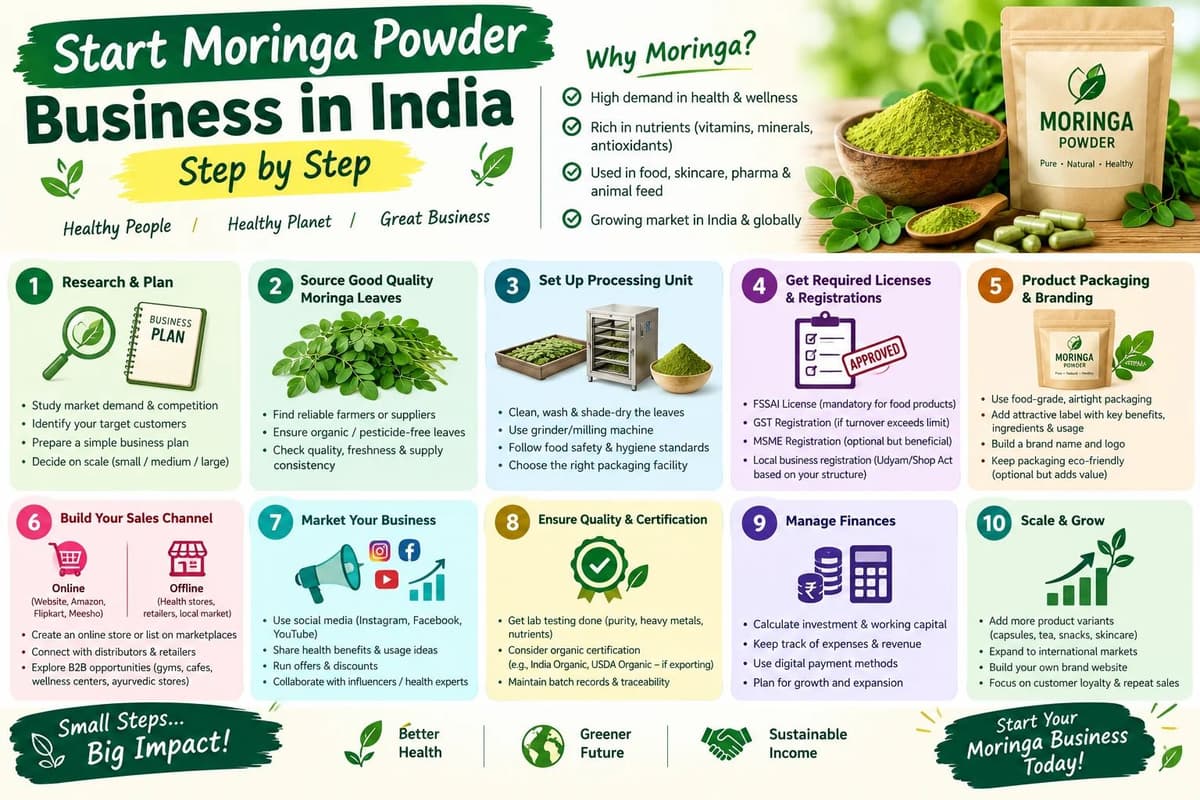
India offers opportunities for moringa cultivation, processing, private-label manufacturing, and online sales. However, building a successful business requires proper market research, product quality, legal registrations, packaging, and marketing.
In this guide, we explain how to start a moringa powder startup business in India, including business models, investment, manufacturing, licenses, packaging, marketing, and potential profitability.
What Is a Moringa Powder Business?
A moringa powder business involves sourcing moringa leaves or processed powder, manufacturing or purchasing finished products, packaging them under a brand name, and selling them to customers.
Depending on your budget and business goals, you can start with a small home-based operation, outsource manufacturing to a third party, or establish your own processing unit.
Common business opportunities include:
Moringa leaf powder for retail customers
Private-label moringa powder products
Bulk moringa powder supply to wholesalers
Organic moringa products, subject to applicable certification requirements
Moringa powder exports
Wholesale supply to food manufacturers and retailers
Before choosing a model, evaluate customer demand, sourcing options, competition, and the costs of meeting food safety requirements.
Why Start a Moringa Powder Business in India?
Moringa powder offers several potential business opportunities for entrepreneurs.
1. Availability of Raw Materials
Moringa trees grow in several parts of India. Depending on your location, you may be able to source fresh leaves directly from farmers or purchase processed moringa powder from established suppliers.
2. Multiple Sales Channels
You can sell through local retailers, wholesalers, your own website, online marketplaces, and business-to-business distribution networks.
3. Flexible Business Models
You do not necessarily need to establish a factory at the beginning. Contract manufacturing or private-label arrangements can help you test demand before investing in machinery.
4. Potential for Brand Development
A business can differentiate itself through product quality, transparent labelling, reliable sourcing, convenient packaging, and customer service.
Important: Demand and profitability are not guaranteed. Conduct market research and validate your product with potential customers before making a significant investment.
Step-by-Step Guide to Start a Moringa Powder Business in India
Step 1: Conduct Market Research
Start by understanding your target customers and the existing moringa powder market.
Research the following areas:
Popular moringa powder brands and their prices
Customer preferences for pack sizes, such as 100 g, 200 g, and 500 g
Demand from organic stores, supermarkets, and online shoppers
Wholesale prices offered by suppliers
Competitors' packaging, product claims, and customer reviews
Potential demand from food manufacturers and international buyers
Identify a specific target audience rather than attempting to sell to everyone immediately.
For example, you could focus on online retail customers, health-food stores, or bulk buyers.
Step 2: Choose Your Business Model
There are three common ways to start a moringa powder startup.
Option A: Private-label business
Purchase finished moringa powder from a suitable manufacturer and sell it under your own brand, subject to the required licences and compliant labelling.
This model can reduce your initial machinery and infrastructure requirements.
Option B: Small-scale manufacturing
Purchase fresh moringa leaves, clean and dry them, grind them into powder, and package the finished product.
This approach provides greater control over processing but requires suitable equipment, premises, quality controls, and food safety compliance.
Option C: Wholesale and export business
Purchase bulk moringa powder from verified suppliers and sell it to retailers, distributors, manufacturers, or overseas buyers.
Exporting requires additional checks relating to export registration, destination-country regulations, documentation, and product standards.
Choose the model that best matches your available capital, technical experience, and target market.
Step 3: Prepare a Business Plan
A business plan helps you estimate costs, understand your competition, and set realistic sales targets.
Your plan should include:
Business objectives and product range
Target customers and geographical markets
Raw material sourcing arrangements
Manufacturing or outsourcing costs
Packaging and branding expenses
Licences and registrations
Distribution and marketing costs
Expected monthly sales and cash flow
For example, if you plan to sell moringa powder in 100 g packs, calculate the total cost of producing, packaging, storing, marketing, and delivering each pack before deciding its selling price.
Step 4: Select a Business Name and Register Your Business
Choose a distinctive brand name that is easy to remember, pronounce, and use online. Check its availability before investing in packaging or marketing.
Depending on your business structure, you can consider the following options:
Sole Proprietorship: Suitable for an individual starting a small business.
Partnership Firm: Suitable for two or more individuals operating a business together under a partnership arrangement.
Limited Liability Partnership (LLP): Suitable for partners who want a registered entity with limited liability, subject to applicable law.
Private Limited Company: Suitable for entrepreneurs planning to build a scalable brand, bring in investors, or establish a more formal corporate structure.
The right option depends on your ownership arrangements, liability considerations, investment plans, and future growth.
FirstStartup.in can assist entrepreneurs with company registration and related business compliance services.
Step 5: Obtain the Required Licences and Registrations
Before selling moringa powder, identify the licences and registrations applicable to your business model.
FSSAI Registration or Licence
Moringa powder sold as a food product is generally subject to the applicable Food Safety and Standards Authority of India (FSSAI) requirements.
The type of registration or licence depends on factors such as the nature of the activity, scale of operations, and applicable eligibility criteria.
Manufacturers, repackers, marketers, and other food business operators should verify the requirements applicable to their specific activities.
GST Registration
GST registration may be required depending on your turnover, the nature of your supplies, applicable exemptions, and other legal conditions. Online and interstate selling can involve additional considerations.
Check the current GST rules for your particular business before commencing sales.
Udyam Registration
Eligible micro, small, and medium enterprises can apply for Udyam Registration through the official government portal. It can provide access to certain MSME-related benefits, subject to the relevant schemes and eligibility conditions.
Trademark Registration
Consider registering your brand name or logo as a trademark to help protect your brand identity.
The appropriate trademark class depends on the goods and services involved. A trademark application does not guarantee registration, and the name should be checked for conflicting marks.
Other Applicable Approvals
Depending on your premises, production process, and business scale, you may need additional local, factory, environmental, fire safety, or other approvals.
If you plan to export, check the requirements for an Importer Exporter Code (IEC), customs documentation, destination-country food regulations, and any relevant product-specific approvals.
Tip: Confirm the applicable requirements with the relevant authorities before investing in a production facility.
Step 6: Source Quality Raw Materials
Raw material quality has a direct impact on the consistency and safety of your finished product.
You can source moringa leaves from farmers or purchase processed powder from established manufacturers.
When evaluating suppliers, consider:
Freshness and traceability of the leaves
Pesticide and contaminant testing
Hygienic handling and transportation
Moisture levels and storage conditions
Consistency of colour, aroma, and texture
Availability of laboratory test reports
Supplier documentation and reliability
Do not rely on appearance alone to assess product quality. Arrange appropriate testing based on the product and applicable food safety standards.
Step 7: Understand the Moringa Powder Manufacturing Process
If you plan to manufacture the product yourself, establish a documented process with appropriate hygiene and quality controls.
The typical process includes the following stages:
1. Harvesting: Obtain suitable moringa leaves from reliable sources.
2. Sorting: Remove damaged, diseased, or unsuitable leaves.
3. Washing: Clean the leaves using a validated method and safe water.
4. Drying: Use a suitable controlled drying process to reduce moisture while preserving product quality.
5. Grinding: Grind the dried leaves using food-grade equipment.
6. Sieving: Remove unwanted coarse particles and achieve a consistent texture.
7. Quality testing: Conduct relevant checks for moisture, microbiological safety, contaminants, and other product specifications.
8. Packaging: Pack the finished powder in suitable food-grade packaging under hygienic conditions.
9. Storage: Store finished packs in a clean, dry environment protected from moisture, heat, pests, and contamination.
Drying and storage require particular attention because excess moisture can contribute to spoilage. Establish appropriate product specifications and validate the process rather than relying on a fixed drying time for every batch.
Step 8: Purchase the Required Machinery
If you choose in-house manufacturing, the equipment will depend on your production capacity and process.
Common equipment may include:
Leaf washing equipment
Sorting tables and food-grade trays
A suitable drying system
A food-grade pulverizer or grinder
Sieving equipment
Weighing scales
Sealing and packaging machines
Storage containers and quality testing equipment
Before purchasing machinery, compare its capacity, energy consumption, cleaning requirements, maintenance costs, and suitability for food processing.
Small businesses using contract manufacturing may not need to purchase this equipment themselves.
Step 9: Create Attractive and Compliant Packaging
Packaging influences product presentation, shelf life, and customer confidence.
Possible packaging options include food-grade pouches, resealable stand-up pouches, and suitable jars.
Your packaging should protect the powder from moisture, light, and contamination as appropriate for the product.
Check the applicable labelling requirements, which may include:
Product name
Ingredient list
Net quantity
Nutritional information, where required
FSSAI logo and licence number, as applicable
Manufacturer, packer, or marketer details, as applicable
Batch or lot identification
Date marking and storage instructions
MRP and consumer care information, as applicable
Only make nutritional, health, organic, or medicinal claims that are legally permitted and adequately supported. Moringa powder should not be marketed as a treatment or cure for a disease without an appropriate legal basis.
Step 10: Calculate the Initial Investment
The investment required depends on whether you outsource production or manufacture the powder yourself.
The following figures are illustrative planning estimates, not verified market quotations.
| Business model | Indicative initial budget |
|---|---|
| Private-label pilot business | ₹50,000–₹2 lakh |
| Small processing setup | ₹2 lakh–₹10 lakh |
| Larger processing operation | ₹10 lakh or more |
Actual costs may be higher or lower depending on location, equipment, rent, production capacity, inventory, testing, packaging, staffing, and working capital.
A basic startup budget should account for:
Business registration and applicable licences
Initial raw material or finished product purchases
Packaging design and printing
Equipment, if required
Quality testing
Website and marketplace setup
Advertising and distribution
Working capital for operating expenses
Keep a reserve for unexpected costs and slower-than-expected sales.
Step 11: Calculate the Selling Price and Profit Margin
Do not calculate profitability by comparing the selling price with raw material cost alone.
Consider a hypothetical example for a 100 g retail pack.
| Cost component | Illustrative cost |
|---|---|
| Moringa powder | ₹18 |
| Packaging and label | ₹8 |
| Processing and quality control | ₹5 |
| Total product cost before other expenses | ₹31 |
Suppose the selling price is ₹79 per pack. The difference between selling price and the estimated product cost is ₹48.
However, this is not net profit. You must still account for applicable taxes, shipping, marketplace commissions, payment fees, advertising, discounts, returns, overheads, and other expenses.
For example, if these additional costs total ₹30 per pack, the remaining contribution would be ₹18 before any other fixed costs and applicable taxes.
Use actual supplier quotations and sales data to build a realistic financial forecast.
Step 12: Choose the Right Sales Channels
Once your product is ready and compliant, select sales channels that match your target audience.
Online marketplaces: Explore platforms such as Amazon and Flipkart, subject to seller eligibility and category requirements.
Your own website: Build an online store with clear product information, transparent pricing, and secure payment options.
Local retail stores: Approach health-food shops, grocery stores, and suitable speciality retailers.
Wholesale distribution: Supply bulk quantities to retailers, distributors, and food businesses.
Social media: Use Instagram, Facebook, and other relevant channels to build brand awareness and direct customers to your sales pages.
Export markets: Research overseas demand, buyer requirements, shipping costs, and applicable export rules before accepting international orders.
Start with one or two channels, measure customer acquisition costs and repeat purchases, and expand when the economics are sustainable.
Step 13: Market Your Moringa Powder Brand
A good marketing strategy explains what makes your product different without making misleading health claims.
Useful approaches include:
Publish educational content about moringa powder and its food uses.
Share sourcing and manufacturing information where verifiable.
Use clear product photography and informative packaging.
Optimise your website for relevant search terms.
Collect genuine customer reviews in accordance with platform rules.
Offer introductory bundles or subscription options where suitable.
Build relationships with retailers and distributors.
Test paid advertising with small budgets and track conversions.
Relevant SEO topics include “moringa powder business in India,” “moringa powder manufacturing business,” “moringa powder business cost in India,” and “FSSAI licence for moringa powder business.”
Avoid exaggerated claims about weight loss, immunity, disease prevention, or treatment. Ensure advertisements and product pages comply with applicable food advertising rules.
Common Challenges in the Moringa Powder Business
Entrepreneurs should prepare for several potential challenges.
Maintaining consistent quality: Different suppliers and processing conditions can affect the final product.
Managing shelf life: Moisture control, suitable packaging, and validated storage conditions are essential.
Building customer trust: New brands need clear product information, reliable fulfilment, and consistent quality.
Controlling marketing costs: Marketplace commissions and advertising can reduce margins.
Meeting compliance requirements: Food safety, labelling, tax, and business regulations must be considered from the beginning.
Managing competition: A distinctive brand, reliable sourcing, and competitive unit economics can help a business stand out.
Tips for Building a Successful Moringa Powder Startup
Begin with a manageable product range and test customer demand.
Verify suppliers before placing large orders.
Use appropriate quality testing and documented production procedures.
Maintain accurate inventory, sales, and expense records.
Calculate margins after distribution and marketing costs.
Protect your brand identity through appropriate trademark checks.
Expand only after confirming repeat demand and sustainable economics.
Keep all registrations, licences, and labels up to date.
Frequently Asked Questions (FAQs)
1. Is moringa powder business profitable in India?
It can be profitable if the business manages raw material costs, product quality, pricing, distribution, and marketing effectively. Actual profitability depends on sales volume and operating expenses.
2. How much investment is required to start a moringa powder business?
A small private-label operation may be planned with an illustrative budget of ₹50,000–₹2 lakh. An in-house processing unit may require ₹2 lakh–₹10 lakh or more, depending on its size and equipment.
3. Is an FSSAI licence required for moringa powder?
Food businesses dealing in moringa powder generally need the applicable FSSAI registration or licence. The correct category depends on the activity and relevant eligibility criteria.
4. Can I start a moringa powder business from home?
A home-based model may be possible if the premises and operations satisfy applicable food safety, hygiene, local, and other legal requirements. Contract manufacturing can be an alternative if home processing is unsuitable.
5. Which business registration is best for a moringa startup?
A proprietorship may suit a small individual-owned business, while an LLP or private limited company may be more appropriate for certain partnership, liability, or growth plans. The best option depends on your circumstances.
6. Can I sell moringa powder online?
Yes, subject to applicable food business, labelling, tax, marketplace, and other legal requirements. You can explore your own website and eligible online marketplaces.
7. Is organic certification compulsory for moringa powder?
Not every moringa product is automatically required to be certified organic. However, if you market a product as organic, applicable certification and labelling requirements must be followed.
8. Can I export moringa powder from India?
Yes, subject to the applicable Indian export requirements and the destination country's food safety, labelling, documentation, and import rules.
9. Which machinery is needed for moringa powder manufacturing?
Depending on production scale, equipment may include washing and drying systems, a grinder, sieving equipment, weighing scales, and packaging machinery.
10. How can FirstStartup.in help me start my moringa powder business?
FirstStartup.in provides business registration and compliance assistance, including company registration, GST registration, trademark services, and support with applicable business formalities. Food-specific licensing requirements should be assessed according to your activities.
Conclusion
Starting a moringa powder startup business in India involves more than purchasing leaves and packaging them for sale. Entrepreneurs need a clear business model, reliable sourcing, safe processing, compliant labelling, appropriate registrations, and a practical sales strategy.
You can begin with a private-label model to test demand or invest in your own processing unit when your business is ready to scale. Before committing significant funds, validate your product, calculate the complete cost per pack, and check the applicable regulatory requirements.
Planning to start your moringa powder business?
FirstStartup.in can assist you with company registration, GST registration, trademark registration, and business compliance support to help you establish your venture.
Visit https://www.firststartup.in/ to explore business registration and compliance services.