
How to Start a Startup Without Money in India
First Startup
Oct 27, 2026
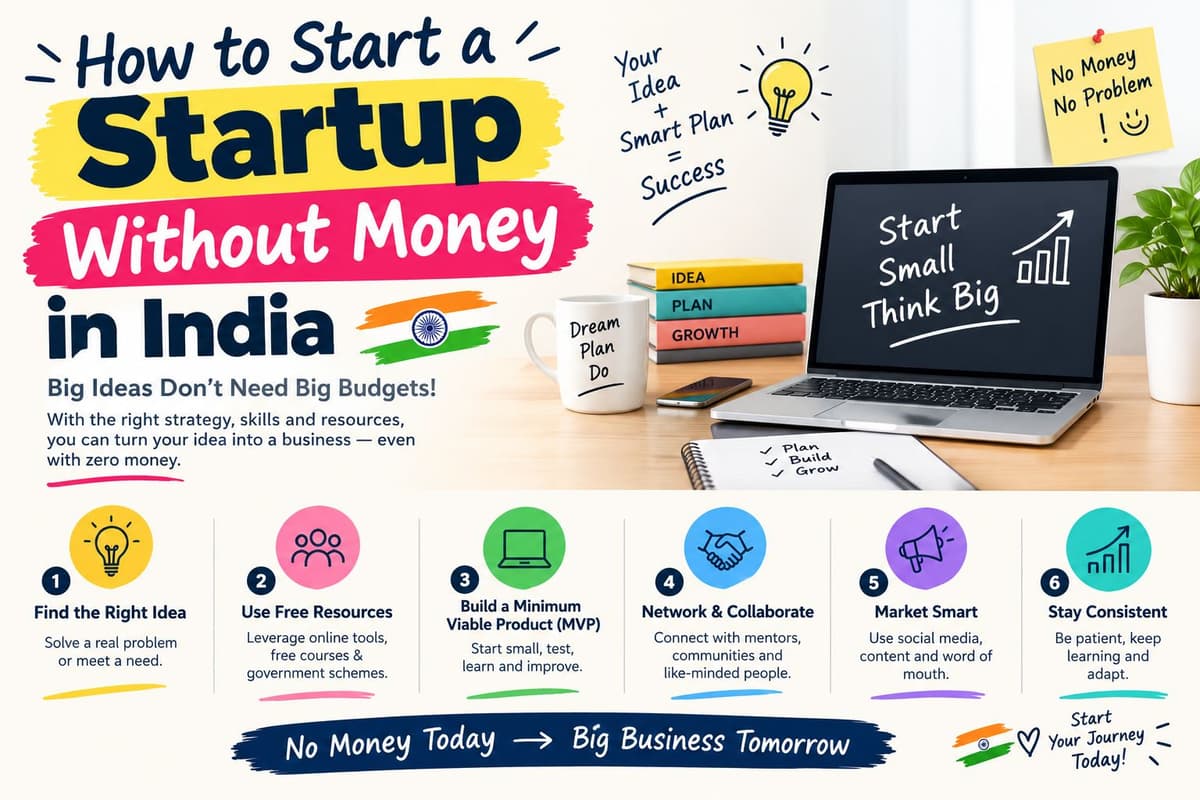
Starting a business does not always require a large investment. With the right business idea, proper planning, and a focus on solving real customer problems, you can start a startup with little or no money. Many successful businesses begin with basic resources, personal skills, and a small group of customers.
If you are wondering how to start a startup without money, the first step is to choose a business model that does not require expensive equipment, office space, or a large team. You can begin with a service-based business, freelancing, digital services, consulting, or an online business and gradually invest your earnings in growth.
In India, aspiring entrepreneurs can also explore startup support programmes, incubators, mentorship, and eligible funding opportunities. However, funding is not guaranteed, and the best starting point is often to validate your business idea before spending money.
In this guide, FirstStartup.in explains how to start a startup without money, choose a profitable business idea, find your first customers, and build a business step by step.
Can You Start a Startup Without Money?
Yes, you can start certain types of businesses with little or no initial investment. However, completely zero-cost business operations are not always realistic. You may need to spend money on internet access, transportation, registration, software, packaging, or other business requirements.
The key is to start small, avoid unnecessary expenses, and earn revenue before making major investments.
For example, if you have graphic design, writing, marketing, accounting, coding, or consulting skills, you can begin by offering services to customers. You can use free digital tools, work from home, and reinvest your earnings as your customer base grows.
A business that starts with limited resources can grow into a larger company if it consistently delivers value and manages its finances carefully.
10 Steps to Start a Startup Without Money
1. Choose a Low-Investment Business Idea
The first step is to choose a business idea that matches your skills, interests, and market demand. Avoid ideas that require expensive machinery, large inventory, or rented premises when you have no starting capital.
Some low-investment startup ideas include:
Digital marketing services
Website design and development
Freelancing and content writing
Social media management
Online tutoring and coaching
Business consulting
Graphic design services
Virtual assistance
Affiliate marketing
Online reselling, subject to the required costs and compliance
Choose an idea that solves a real problem and has customers willing to pay for the solution.
2. Identify a Problem You Can Solve
Successful startups are built around customer needs rather than ideas alone. Research the problems faced by your potential customers and determine whether they would pay for your solution.
For example, small businesses may need help with website development, social media marketing, bookkeeping, or customer support. You can offer one specific service instead of launching a complicated business with multiple expenses.
Speak with potential customers, review competitor offerings, and test your idea before investing heavily.
3. Start With Your Existing Skills
Your knowledge and experience can be valuable business assets. Starting with skills you already possess reduces the need to spend money on training, equipment, or hiring.
For example, a person with accounting knowledge may offer bookkeeping services, while someone with technical skills may develop websites for local businesses.
If you lack the necessary skills, use free educational resources to learn the basics and practise before charging customers.
4. Create a Simple Business Plan
You do not need an expensive business plan to begin. Start with a simple document outlining:
Your business idea
Target customers
The problem you solve
Your product or service
Competitors and pricing
How you will reach customers
Expected expenses and revenue
Your plan for the first three months
A basic business plan helps you identify unnecessary expenses and focus on activities that can generate revenue.
5. Validate Your Business Idea Before Investing
Before spending money on a website, office, inventory, or advertising, check whether people actually want your product or service.
You can validate your idea by speaking to potential customers, offering a trial service, collecting enquiries, or obtaining your first paid order.
For a service business, try to secure one or two paying customers before hiring employees or purchasing expensive software.
For a product business, consider customer interviews, pre-orders where appropriate, or a small test batch instead of purchasing large quantities of inventory.
6. Use Free Tools to Launch Your Business
Many digital tools offer free plans that can help you begin operations.
| Business requirement | Low-cost starting option |
|---|---|
| Communication | Email and messaging apps |
| Design | Free graphic design tools |
| Website | Free website builders or a basic landing page |
| Marketing | Organic social media content |
| Project management | Free task management tools |
| Accounting | Spreadsheets or suitable free accounting tools |
| Customer research | Online forms and direct conversations |
Free plans may have limitations, and some business activities require paid services. Choose tools according to your actual needs rather than purchasing multiple subscriptions immediately.
7. Find Your First Customers Without Paid Advertising
You do not need a large advertising budget to get your first customers. Start with methods that rely on relationships, useful content, and direct outreach.
Use your existing network: Tell friends, former colleagues, and professional contacts what service you offer.
Promote your expertise on social media: Share practical tips, examples of your work, and answers to common customer questions.
Contact potential customers: Reach out to relevant businesses with a clear explanation of how your service can help them.
Build partnerships: Work with complementary service providers who may refer customers to you.
Collect testimonials: Ask satisfied customers for honest feedback and permission to share it.
Focus on trust and the quality of your work instead of trying to reach everyone at once.
8. Start From Home and Avoid Unnecessary Expenses
Renting an office, hiring a large team, and purchasing expensive equipment can put pressure on a new startup's finances.
Where practical, work from home, use remote communication, and hire freelancers for specialised tasks only when needed. Keep personal and business expenses organised, and avoid taking on recurring costs before revenue becomes predictable.
For businesses that require premises, equipment, inventory, or licences, calculate the minimum viable starting budget rather than assuming the business can operate entirely for free.
9. Explore Government Support and Startup Funding
If your business needs funding to grow, explore relevant support programmes and eligibility requirements.
Potential options include:
Startup India: Resources, recognition information, and connections to the startup ecosystem.
Incubators and accelerators: Mentorship, networking, workspace, and potential access to funding opportunities.
Government-supported financing schemes: Depending on the scheme, eligible entrepreneurs may be able to apply for loans or other support.
Business competitions and grants: Some institutions offer financial support for selected ideas or eligible projects.
Angel investors: Potential investors may consider businesses with strong growth prospects, a capable team, and evidence of customer demand.
These options have different eligibility criteria. A loan must generally be repaid, and grants or investments are not guaranteed. Check official programme conditions before applying.
You can explore information through the official Startup India website.
10. Register Your Business When Appropriate
You can begin validating many business ideas before establishing a complex legal structure. However, the appropriate registration, licences, and tax compliance depend on your business activity and applicable law.
Common business structures in India include:
Sole proprietorship
Partnership firm
Limited Liability Partnership (LLP)
One Person Company (OPC)
Private Limited Company
A sole proprietorship may be suitable for some small businesses, while an LLP or private limited company may be more appropriate for businesses with co-founders, external investment plans, or other requirements.
Depending on your activity, you may also need GST registration, local licences, or other approvals. Udyam/MSME registration and Startup India recognition have their own eligibility conditions and are not substitutes for every required business registration.
Choose your structure after considering costs, liability, compliance, ownership, and future plans.
Best Startup Ideas You Can Start Without Money in India
Here are some business models that can often be tested with minimal upfront investment.
| Startup idea | How you can start | Potential customers |
|---|---|---|
| Freelance writing | Create samples and offer writing services | Businesses, agencies, bloggers |
| Digital marketing | Manage social media or content campaigns | Local shops, startups, service providers |
| Website development | Build sample projects and approach businesses | Small businesses, professionals |
| Online tutoring | Teach a subject or skill remotely | Students and working professionals |
| Graphic design | Create sample designs and build a portfolio | Brands, creators, small businesses |
| Virtual assistance | Provide administrative support remotely | Consultants, entrepreneurs |
| Business consulting | Offer advice based on relevant expertise | Small companies and founders |
| Content creation | Publish useful content and develop an audience | Brands and potential clients |
These ideas are not guaranteed to generate income. Your results depend on your skills, demand, pricing, competition, and ability to attract customers.
How to Fund a Startup Without Personal Savings
If you need money to develop your business, consider the following approaches.
Bootstrapping
Start with the resources you already have and use business revenue to cover operating costs and fund growth.
Customer-Funded Growth
Where appropriate, collect advance payments or deposits under clear, fair terms. This can help finance delivery, but you must fulfil your commitments and comply with applicable laws.
Partnerships
A suitable business partner may contribute skills, resources, or capital. Clearly document responsibilities, ownership, decision-making, and profit-sharing arrangements.
Incubation Support
Eligible startups may receive mentoring, workspace, technical support, or access to funding opportunities through incubators. Availability varies by programme.
Loans and Other Financing
Eligible entrepreneurs can investigate suitable business loans or other financing options. Compare interest rates, repayment obligations, collateral requirements, and risks before borrowing.
Common Mistakes to Avoid When Starting Without Money
Avoid these mistakes when building your startup:
Spending too much on branding before validating demand
Renting an office before it is necessary
Hiring employees before revenue can support them
Borrowing money without a realistic repayment plan
Ignoring required licences, registrations, or taxes
Offering services without clear pricing and payment terms
Trying to serve every type of customer
Assuming government funding is guaranteed
Failing to track business income and expenses
A lean startup approach helps you preserve cash while learning what customers actually value.
How FirstStartup.in Can Help You Start a Business
Starting a business involves more than selecting an idea. Depending on your plans, you may need help choosing a legal structure, completing company registration, obtaining GST registration, or managing ongoing compliance.
FirstStartup.in provides professional assistance with:
Private Limited Company Registration
LLP and OPC Registration
GST Registration and Compliance
MSME/Udyam Registration
Startup India Registration Assistance
Trademark Registration
Accounting and Bookkeeping Services
Income Tax Return Filing
ROC Compliance Services
Our team can help you understand the registration process and applicable compliance requirements so you can focus on developing your business.
Visit www.firststartup.in or contact +91 63956 22281 for assistance.
Frequently Asked Questions (FAQs)
1. How can I start a startup without money?
Choose a low-investment business idea, use your existing skills, validate customer demand, and start with free tools. Generate revenue through your first customers before making major investments.
2. Which startup can I start with zero investment?
Service-based businesses such as freelance writing, tutoring, consulting, and some digital services can often be started with minimal upfront spending. However, internet access, equipment, and other operating expenses may still apply.
3. Can I start a startup without taking a loan?
Yes. You can bootstrap your business, earn through customer projects, reinvest revenue, or explore suitable partnerships and incubation opportunities instead of borrowing money.
4. How can I get government funding for a startup in India?
Explore relevant government programmes, incubators, and eligible financing schemes through official sources. Each programme has specific eligibility criteria, and funding is not guaranteed.
5. Is company registration necessary to start a startup?
The requirement depends on your business structure, activity, and legal obligations. You may be able to validate an idea before incorporating a company, but certain registrations and licences may be required before or during operations.
6. Can I register a company without money?
Company incorporation generally involves government fees and may involve professional or other costs. You should verify the current charges and mandatory requirements for your chosen structure before applying.
7. Is Startup India registration the same as company registration?
No. Incorporation or other business establishment requirements are separate from Startup India recognition. Recognition is subject to the programme's eligibility conditions.
8. How long does it take to make a startup profitable?
There is no fixed timeline. Profitability depends on customer demand, pricing, operating expenses, competition, and how effectively the business manages cash flow.
9. Can students start a startup without money?
Yes. Students can explore skill-based services, tutoring, digital projects, and other low-investment ideas while studying. They should consider their available time, contractual commitments, and any applicable legal requirements.
10. What is the first step in starting a startup?
Start by identifying a problem that people are willing to pay to solve. Research the market, speak with potential customers, and test a simple solution before investing significant money.
Conclusion
Starting a startup without money is possible when you choose the right business model, focus on customer needs, and control your expenses. You do not need to begin with a large office, an expensive website, or a big team. You need a practical idea, useful skills, a clear plan, and the willingness to learn from customers.
Start small, validate your idea, earn your first revenue, and reinvest carefully. As your business grows, make sure you meet the registration, licensing, tax, and compliance requirements that apply to your activities.
For assistance with company registration, GST registration, and business compliance in India, connect with FirstStartup.in.