
How to Start a Small Startup in a Small City in India
First Startup
Nov 13, 2026
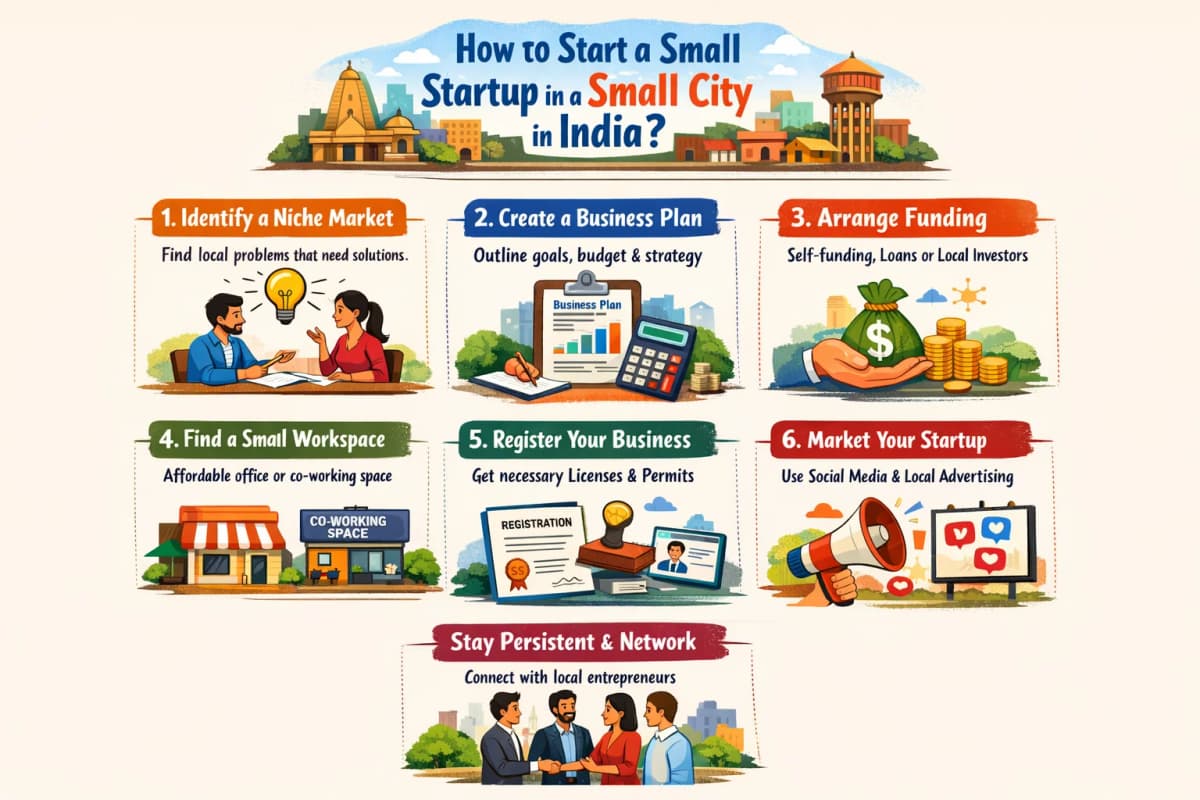
Starting a business in India does not always require a large investment, an office in a metro city or a big team. In fact, small cities offer excellent opportunities for entrepreneurs who want to start a business with limited capital and grow gradually.
Cities such as Meerut, Agra, Jaipur, Dehradun, Gorakhpur, Kota, Varanasi, Jodhpur and many other tier-2 and tier-3 locations have growing markets, increasing internet access and rising demand for quality products and services.
If you are planning to become an entrepreneur, this guide explains how to start a small startup in a small city in India, including business ideas, investment requirements, registration, marketing and growth strategies.
1. Understand the Local Market Before Starting
The first step is to identify what people in your city actually need. A business can have a great idea but still struggle if there is insufficient local demand.
Before investing money, research:
Which products or services are in high demand?
What businesses are already operating in your area?
What problems do local customers face?
How much are customers willing to pay?
Can you provide better quality, pricing or convenience?
For example, if your city has many students, a coaching centre, stationery store, affordable food outlet or digital service agency may have good potential.
Tip: Talk to at least 20–30 potential customers before launching. Their feedback can help you improve your business idea.
2. Choose a Low-Investment Startup Idea
You do not need to begin with a complicated business. Choose an idea that matches your skills, budget and local demand.
Here are some small startup ideas suitable for Indian cities.
1. Digital Marketing Agency
Local shops, restaurants, coaching centres and service providers increasingly need websites, social media management, SEO and online advertising.
You can start from home with a laptop, internet connection and digital marketing skills.
2. Food Business or Cloud Kitchen
A home-based food business, tiffin service, bakery or cloud kitchen can serve students, working professionals and families.
Start with a limited menu and expand after understanding customer preferences. Check the applicable FSSAI registration or licensing requirements before starting food operations.
3. E-commerce and Online Reselling
You can sell clothing, handicrafts, home decor, organic products, regional specialties or other products through your own website and online marketplaces.
Start with a small inventory or a suitable supplier arrangement to control investment.
4. Computer Training or Coaching Centre
Small cities have demand for computer education, spoken English, competitive exam preparation and professional skill development.
If you have teaching experience, this can be a suitable service-based startup.
5. Accounting and Business Support Services
Small businesses often need bookkeeping, GST return assistance, payroll support and business compliance services.
People with relevant qualifications and professional expertise can build a service business by targeting local traders, startups and small companies. Regulated professional services must be provided by appropriately qualified and authorised professionals.
6. Boutique or Clothing Business
A small clothing store, tailoring unit, boutique or online fashion business can serve local customers.
You can begin with selected products and use Instagram and WhatsApp to generate orders.
7. Repair and Maintenance Services
Mobile repair, computer repair, electrical services, appliance maintenance and vehicle servicing can be practical businesses where local demand exists.
8. Organic and Local Products Business
You can sell regional food products, spices, pickles, traditional sweets, handicrafts or agricultural products.
Focus on product quality, packaging, customer trust and suitable licences.
3. Prepare a Simple Business Plan
A business plan helps you understand how much money you need, who your customers are and how your startup will generate revenue.
Your business plan should include:
Business name and concept
Products or services
Target customers
Local competitors
Initial investment
Monthly operating expenses
Pricing strategy
Marketing plan
Expected sales and revenue
Future expansion plans
Example: Small Digital Marketing Startup
| Expense | Estimated cost |
|---|---|
| Laptop and basic equipment | ₹35,000 |
| Website and domain | ₹3,000 |
| Software and tools | ₹5,000 |
| Initial marketing | ₹7,000 |
| Miscellaneous expenses | ₹5,000 |
| Estimated total | ₹55,000 |
These are illustrative estimates, not fixed market prices. Your actual investment will depend on equipment, location and business requirements.
4. Arrange Funds for Your Startup
One advantage of starting a small business in a smaller city is that you may be able to reduce expenses by operating from home or using a small commercial space.
Common funding options include:
Personal savings: Suitable for businesses that can start with a small budget.
Family and friends: You may arrange initial capital through people you trust, with clear written terms.
Bank loans: Banks offer different business loan products subject to eligibility, credit assessment and documentation.
Government schemes: Eligible entrepreneurs may explore schemes such as PM MUDRA Yojana and the Prime Minister's Employment Generation Programme (PMEGP). Benefits and eligibility depend on the scheme guidelines.
Business partnerships: A suitable partner can contribute capital, skills or operational support. Put the roles, investment and profit-sharing terms in writing.
Avoid taking a large loan before validating your business idea.
5. Select the Right Business Structure
Choosing an appropriate legal structure is an important step when starting a business in India.
Depending on your business model, investment and future plans, you can consider:
Sole Proprietorship
A suitable option for an individual running a small business. It has relatively simple compliance requirements, but the proprietor and business are not separate legal entities.
Partnership Firm
Suitable when two or more people want to operate a business together under a partnership agreement.
Limited Liability Partnership (LLP)
An LLP offers a separate legal identity and limited liability for its partners, subject to applicable law. It can be useful for professional and service-based businesses.
Private Limited Company
A Private Limited Company may be suitable if you plan to expand operations, bring in investors or build a scalable business.
One Person Company (OPC)
An OPC allows a single person to establish a company with a separate legal identity, subject to the Companies Act and applicable rules.
Choose your business structure after considering liability, ownership, taxation, compliance and growth plans.
6. Complete the Required Business Registrations
After selecting your business structure, identify the registrations and licences applicable to your activity.
Common registrations include:
Company Registration: Incorporation of a Private Limited Company, LLP or OPC, where applicable.
GST Registration: Required when the business crosses applicable turnover thresholds or falls under compulsory registration provisions. Rules and thresholds depend on the nature of supply and location.
MSME / Udyam Registration: Eligible micro, small and medium enterprises can register through the official Udyam portal.
FSSAI Registration or Licence: Applicable food businesses must obtain the appropriate FSSAI registration or licence.
Shop and Establishment Registration: Requirements depend on the relevant state or union territory.
Trademark Registration: Helps protect a brand name or logo under trademark law.
Other Industry Licences: Certain businesses may need local municipal permissions, professional licences or sector-specific approvals.
Not every startup needs every registration. Requirements depend on business activity, location, legal structure and applicable regulations.
7. Choose an Affordable Business Location
You do not need an expensive commercial office from day one.
Consider these options:
Start from home if your business permits it.
Rent a small office or shop in an affordable market.
Use a coworking space.
Operate online and serve customers across multiple cities.
Consider a shared workspace for meetings and professional activities.
Before selecting a location, check customer accessibility, rent, transport, competition and local permissions.
8. Build Your Brand and Online Presence
Even a small startup needs a professional identity. Customers should be able to find your business, understand your services and contact you easily.
Start with:
Business name and logo: Choose a memorable name that suits your products or services. Check name and trademark availability before finalising it.
Website: Create a mobile-friendly website explaining your products, services, contact details and business location.
Google Business Profile: Eligible local businesses can create a profile to improve their visibility in Google Search and Maps.
Social media: Use Instagram, Facebook and WhatsApp Business to showcase products, share updates and communicate with customers.
Customer reviews: Request genuine feedback from customers and use it to improve your service.
9. Promote Your Startup Locally
Marketing does not always require a large budget. Focus on channels that help you reach your target customers.
Some practical strategies include:
Run local social media campaigns.
Distribute flyers in relevant neighbourhoods.
Build relationships with nearby businesses.
Offer introductory packages or limited-time discounts.
Create useful videos and posts about your products.
List eligible services on local directories.
Encourage customer referrals.
Publish SEO-friendly website content targeting your city.
For example, a digital marketing agency in a small city can target searches such as "digital marketing services in [City Name]" and "website development company in [City Name]".
10. Manage Your Business Finances Properly
Many startups face difficulties because they do not maintain proper financial records.
From the beginning:
Maintain separate business and personal finances.
Record every sale and expense.
Track customer payments and outstanding invoices.
Prepare monthly income and expense reports.
Maintain invoices and supporting documents.
File applicable GST and income tax returns on time.
Keep sufficient funds for operating expenses.
Good accounting practices help you understand profitability and make better business decisions.
11. Common Mistakes to Avoid
Avoid these mistakes when starting a small business in a small city:
Starting without researching customer demand.
Investing too much money before testing the idea.
Ignoring registrations and applicable licences.
Choosing a business only because someone else is doing well.
Spending heavily on office space and decoration.
Mixing personal and business expenses.
Ignoring online marketing.
Offering products without checking profit margins.
Failing to maintain proper accounts.
Expanding before building a stable customer base.
Start small, monitor results and improve your business based on customer feedback.
12. How Much Money Is Required to Start a Small Startup in India?
The investment depends on the business category, location, equipment, inventory and operating model.
Here are illustrative starting ranges:
| Business type | Possible initial investment |
|---|---|
| Freelancing or digital services | ₹10,000–₹50,000 |
| Home-based food business | ₹25,000–₹1,00,000 |
| Online reselling | ₹20,000–₹1,00,000 |
| Small boutique | ₹50,000–₹2,00,000 |
| Computer training centre | ₹1,00,000–₹3,00,000 |
| Small retail shop | ₹1,00,000–₹5,00,000 |
These are broad planning estimates, not guaranteed startup costs. Rent deposits, staff salaries, inventory and licences can increase the investment.
13. Government Support for Small Startups in India
Entrepreneurs can explore government initiatives that support small businesses and startups.
Some options include:
Udyam Registration: Official MSME registration for eligible businesses.
Startup India: Provides information about startup recognition and eligible benefits for qualifying entities.
PM MUDRA Yojana: Offers loans through participating financial institutions for eligible micro and small business activities.
PMEGP: A credit-linked subsidy programme for eligible new micro-enterprises, subject to scheme conditions.
State Startup Policies: Many states offer their own startup support programmes, incentives and incubation facilities.
Always check the latest eligibility, application process and scheme conditions through official government portals before applying.
14. How First Startup Can Help You Start Your Business
Starting a business involves more than selecting a name and launching a product. You may also need help choosing a suitable business structure, completing registrations and understanding ongoing compliance requirements.
First Startup provides professional business registration and compliance support to entrepreneurs and small businesses in India.
Our services include:
Private Limited Company Registration
LLP Registration
OPC Registration
Partnership Firm Registration
GST Registration and Compliance
MSME / Udyam Registration
Trademark Registration
FSSAI Registration and Licensing
Accounting and Bookkeeping
Income Tax Return Filing
ROC Compliance
Our team helps entrepreneurs understand the applicable process and documentation so they can focus on developing their businesses.
Start your business journey with First Startup.
Website: https://www.firststartup.in/
Phone: +91 63956 22281
Email: [email protected]
Frequently Asked Questions (FAQs)
1. How can I start a small startup in a small city in India?
Start by researching local demand, selecting a low-investment business idea, preparing a business plan, arranging funds and choosing the appropriate legal structure. Complete the registrations and licences applicable to your business before starting operations.
2. Which startup is best for a small city in India?
Digital marketing agencies, coaching centres, food businesses, boutiques, repair services, online reselling and accounting support services can be suitable options. The best choice depends on local demand, competition, skills and available investment.
3. Can I start a business with ₹50,000 in India?
Yes. Some service-based, freelancing, online reselling and home-based businesses may be started with approximately ₹50,000. Actual costs depend on equipment, marketing, inventory and other requirements.
4. Do I need to register my small startup?
The legal requirements depend on the business structure and activity. Some businesses can operate as proprietorships with applicable registrations, while companies and LLPs must complete their respective incorporation processes. Sector-specific licences may also be necessary.
5. Is GST registration compulsory for every small business?
No. GST registration depends on applicable turnover thresholds, the nature of supplies, the state and compulsory registration provisions. Check the rules applicable to your particular business.
6. Can I start a startup from home?
Yes. Many service-based, consulting, online and home-based businesses can operate from home, provided the activity is permitted and applicable local, tax and licensing requirements are met.
7. What is the cheapest business to start in a small city?
Freelancing, tutoring, digital marketing, online services and certain home-based businesses can have relatively low initial costs because they may not require a commercial shop or large inventory.
8. How can First Startup help new entrepreneurs?
First Startup assists entrepreneurs with business registration, GST, MSME, trademark, FSSAI, accounting and compliance-related services, depending on the requirements of the business.
Conclusion
Starting a small startup in a small city in India can be a practical opportunity for people who want to become entrepreneurs without taking on the high expenses of a large metro-based business.
The key is to understand your local market, select the right business idea, manage your investment carefully and build customer trust. Complete the registrations applicable to your business and maintain proper financial records from the beginning.
You do not need to build a large company on the first day. Start with a clear plan, serve your customers well and grow step by step.
Need help with company registration, GST or business compliance? Contact First Startup and take the next step towards starting your business.