
How to Start a Milk Startup in India: Complete Business Guide
First Startup
Nov 12, 2026
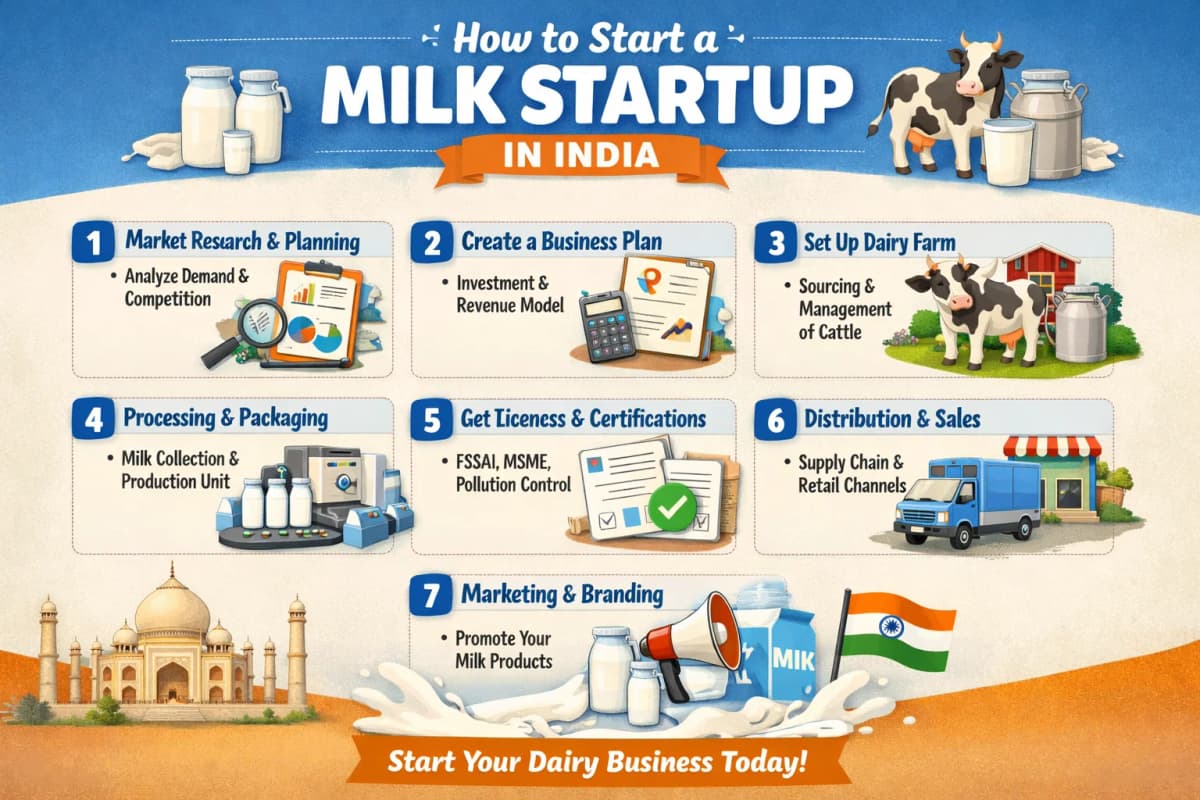
Starting a milk business in India can be a promising opportunity for entrepreneurs interested in the dairy and food industry. Milk is a regularly consumed product, and businesses can build revenue through fresh milk delivery, dairy product manufacturing, milk distribution and value-added products.
From local milk supply and dairy farms to packaged milk brands, paneer, curd, ghee and flavoured milk, there are several ways to enter the dairy market.
However, starting a milk startup requires proper planning, reliable milk procurement, hygienic processing, cold storage, packaging, distribution and food safety compliance.
If you are planning to enter the dairy industry, this guide explains how to start a milk startup in India, including business models, investment planning, equipment, FSSAI registration, marketing and other important requirements.
1. Understand the Milk Business Opportunities in India
Before starting your business, identify which segment of the dairy industry you want to enter.
Some popular milk business models include:
A. Fresh Milk Supply Business
You can procure fresh milk directly from dairy farmers and supply it to households, restaurants, hotels and local retailers.
This business model generally requires:
Reliable milk suppliers.
Milk collection arrangements.
Food-grade containers.
Appropriate chilling and storage facilities.
Transportation arrangements.
Regular quality checks.
B. Packaged Milk Business
You can establish a dairy processing business that collects, processes, packs and distributes milk under your own brand.
Products may include:
Full cream milk.
Toned milk.
Double toned milk.
Standardised milk.
Skimmed milk.
This model requires suitable processing equipment, packaging facilities, quality control and applicable FSSAI licensing.
C. Dairy Products Manufacturing
Instead of selling only liquid milk, you can manufacture value-added dairy products.
Some popular options include:
Paneer.
Curd.
Ghee.
Butter.
Cream.
Cheese.
Flavoured milk.
Lassi.
Buttermilk.
Milk powder.
Value-added products can help businesses serve different customer segments, but each product requires appropriate manufacturing processes and compliance.
D. Milk Subscription and Home Delivery Business
A milk delivery startup can provide daily or scheduled milk deliveries to households.
You can operate through:
Monthly subscriptions.
Daily delivery plans.
Mobile applications.
WhatsApp ordering.
Website-based orders.
Local delivery partners.
This model can be started on a relatively small scale, subject to the applicable licensing, sourcing, hygiene and storage requirements.
E. Dairy Farming Business
Entrepreneurs can also establish their own dairy farm by maintaining cows or buffaloes and supplying milk to customers, retailers or processing businesses.
This model requires investment in livestock, animal healthcare, feed, farm infrastructure, labour and milk handling facilities.
2. Prepare a Milk Startup Business Plan
A business plan helps you understand the operational and financial requirements before investing money.
Your milk startup business plan should cover:
Business Model: Decide whether you want to operate a dairy farm, milk distribution business, packaged milk brand or dairy products manufacturing unit.
Target Customers: Identify your potential customers, such as households, restaurants, hotels, grocery stores, supermarkets and institutional buyers.
Milk Procurement: Decide whether milk will come from your own dairy farm, independent farmers, cooperatives or other authorised suppliers.
Production Capacity: Estimate how much milk you plan to collect, process, store and distribute daily.
Pricing Strategy: Calculate procurement, processing, packaging, storage, transportation and marketing expenses before fixing the selling price.
Distribution Plan: Decide how products will reach customers while maintaining appropriate temperature and hygiene conditions.
Financial Planning: Estimate setup costs, working capital, recurring expenses and expected sales.
A detailed business plan can help you avoid unnecessary expenses and identify operational challenges early.
3. Choose a Suitable Business Structure
Before starting operations, select an appropriate legal structure for your milk startup.
Common options include:
Private Limited Company
A Private Limited Company may be suitable if you plan to build a scalable dairy brand, raise investment, appoint directors or expand operations across multiple locations.
Limited Liability Partnership (LLP)
An LLP may be appropriate for entrepreneurs starting a dairy business with one or more partners who want a separate legal entity with limited liability.
Partnership Firm
A partnership firm can be considered when two or more individuals plan to operate a milk supply or dairy distribution business together.
Proprietorship
A proprietorship may be suitable for a small, individually operated milk delivery or retail business.
The appropriate structure depends on ownership, investment, liability, expansion plans and business requirements.
4. Estimate the Investment Required to Start a Milk Startup
The investment depends on your selected business model, daily capacity, equipment, premises and distribution network.
The following are important expense categories:
| Investment Category | Purpose |
|---|---|
| Business registration | Legal establishment of the business |
| FSSAI compliance | Applicable food registration or licence |
| Premises | Dairy unit, shop or processing facility |
| Milk procurement | Purchase of raw milk |
| Equipment | Milk testing, chilling and processing |
| Packaging | Bottles, pouches and containers |
| Cold storage | Refrigeration and temperature control |
| Transportation | Milk collection and delivery |
| Employees | Production, quality and delivery staff |
| Marketing | Branding, advertising and customer acquisition |
| Working capital | Daily operating expenses |
Small Milk Delivery Business
A small milk delivery startup may focus on sourcing milk from reliable suppliers and supplying customers within a limited area.
Its main expenses may include procurement, food-grade containers, refrigeration where required, delivery arrangements and customer management.
Medium-Sized Dairy Processing Business
A processing unit may require additional investment in milk chilling, pasteurisation, packaging machinery, testing facilities, premises and distribution.
Large Dairy Manufacturing Business
A large dairy business may require a dedicated processing plant, bulk milk collection network, automated machinery, laboratory facilities, refrigerated transportation and a wider distribution network.
There is no single fixed investment amount for every milk startup. Prepare a project report and equipment quotation before finalising your budget.
5. Arrange Reliable Milk Procurement
Milk quality is one of the most important factors in a dairy business.
You can arrange milk procurement through:
Local dairy farmers.
Farmer Producer Organisations.
Dairy cooperatives.
Milk collection centres.
Your own dairy farm.
Established milk suppliers.
Before entering into procurement agreements, establish clear conditions regarding milk quality, quantity, pricing, delivery timing and payment.
Maintain procurement records and conduct appropriate quality checks.
Important quality parameters may include:
Fat content.
Solids-not-fat (SNF).
Acidity.
Microbiological quality.
Adulterant screening.
Temperature and freshness.
Use suitable testing methods and qualified personnel to maintain product quality.
6. Arrange Dairy Equipment and Machinery
The equipment required depends on whether you are selling raw milk, processing packaged milk or manufacturing dairy products.
Common equipment includes:
Milk Collection Equipment
Stainless steel milk cans.
Milk collection tanks.
Weighing equipment.
Milk sampling containers.
Milk Testing Equipment
Milk analyser.
Fat testing equipment.
Lactometer, where appropriate.
Acidity testing equipment.
Laboratory testing supplies.
Milk Processing Equipment
Bulk milk cooler.
Milk storage tanks.
Pasteurisation equipment.
Homogeniser, where required.
Cream separator, where required.
Milk transfer pumps.
Packaging Equipment
Milk pouch packing machine.
Bottle filling equipment.
Sealing machinery.
Batch coding machine.
Labelling equipment.
Storage Equipment
Refrigerators.
Cold rooms.
Temperature monitoring equipment.
Refrigerated transport, where required.
Select equipment based on your production capacity, product category and applicable food safety standards.
7. Set Up a Hygienic Milk Processing Unit
If you are planning to manufacture or process milk, your facility should be designed to maintain food safety and hygiene.
Important considerations include:
Clean and washable floors and surfaces.
Adequate drainage.
Safe water supply.
Proper ventilation.
Hygienic milk handling areas.
Separate storage arrangements.
Cleaning and sanitisation facilities.
Pest control.
Waste disposal arrangements.
Temperature monitoring.
FSSAI's Schedule 4 includes specific hygienic and sanitary requirements for businesses involved in manufacturing, processing, storing and selling milk and milk products.
A documented Food Safety Management System (FSMS) should also be prepared where required under the applicable licensing conditions.
8. Obtain FSSAI Registration or Licence for Your Milk Business
FSSAI registration or licensing is one of the most important compliance requirements for a milk startup.
Under Section 31 of the Food Safety and Standards Act, 2006, food business operators must obtain the applicable FSSAI registration or licence before carrying out regulated food business activities.
Milk producers, milk vendors, dairy processing units and milk collection or chilling centres must assess their applicable requirements.
Latest FSSAI Requirement for Milk Producers and Vendors
In its advisory dated 11 March 2026, FSSAI clarified that milk producers who are not registered members of a dairy cooperative society supplying their entire milk to that society, as well as milk vendors, must obtain the applicable FSSAI registration or licence before commencing or continuing operations.
The advisory also highlights the importance of proper milk chilling and storage conditions.
FSSAI Eligibility for Dairy Units
The revised FoSCoS eligibility document updated on 1 April 2026 provides the following general turnover-based categories for dairy units:
| Annual Turnover | General FSSAI Category |
|---|---|
| Up to ₹1.5 crore | Registration |
| More than ₹1.5 crore to ₹50 crore | State Licence |
| More than ₹50 crore | Central Licence |
Petty milkmen and milk vendors are subject to the specific registration provisions applicable to them. The applicable category must be checked against the current FoSCoS eligibility criteria and business activity.
Documents Required for FSSAI Registration or Licence
Common documents and information may include:
PAN card of the applicant or business.
Aadhaar or other identity proof.
Business address proof.
Photograph of the applicant or authorised signatory.
Business constitution documents.
Partnership deed or incorporation certificate, where applicable.
Layout plan of the processing unit.
List of machinery and equipment.
Production capacity details.
Milk procurement source or procurement plan.
Water testing report, where applicable.
Details of directors or partners, where applicable.
Authorisation documents, where required.
The final document list depends on the type of dairy activity and licence category.
How to Apply for FSSAI Registration Online
Follow these steps:
Visit the official FoSCoS portal at https://foscos.fssai.gov.in/.
Select the option to apply for a new registration or licence.
Choose the relevant state and kind of food business.
Select the appropriate dairy-related activity.
Enter the applicant and business details.
Upload the required documents.
Pay the applicable government fee.
Submit the application.
Track the application status using the reference number.
Complete any inspection or clarification requirements.
Dairy manufacturing and processing applications may be subject to pre-licence inspection, depending on the applicable requirements.
9. Follow Milk Quality, Processing and Packaging Standards
A milk startup must follow the applicable FSSAI product standards and hygiene requirements.
For example, milk sold under a specific category must meet the prescribed fat and solids-not-fat requirements.
Some important examples of FSSAI milk standards include:
| Milk Category | Minimum Fat | Minimum SNF |
|---|---|---|
| Cow Milk | 3.2% | 8.3% |
| Buffalo Milk | 5.0% | 9.0% |
| Toned Milk | 3.0% | 8.5% |
| Double Toned Milk | 1.3% | 9.0% |
| Full Cream Milk | 6.0% | 9.0% |
These are specified standards under the relevant FSSAI regulations. Check the current product standard and amendments before manufacturing or labelling a product.
Milk Pasteurisation
Pasteurisation is a heat-treatment process used to reduce harmful microorganisms in milk.
FSSAI's prescribed pasteurisation standard includes heating every particle of milk to at least 63°C for 30 minutes or at least 71.5°C for 15 seconds, or using an approved equivalent time-temperature combination that meets the required phosphatase test.
Pasteurised milk must be cooled immediately to 10°C or below under the prescribed standard.
The actual processing plant should use validated equipment and procedures to ensure compliance.
Milk Packaging
Packaging should protect milk from contamination and maintain its quality during storage and distribution.
Common packaging options include:
Food-grade milk pouches.
Food-grade plastic bottles.
Suitable sealed containers.
Other permitted food-contact packaging materials.
Labels must contain applicable declarations, including the product category, heat treatment, manufacturer details, FSSAI licence information and other mandatory particulars.
10. Build Your Milk Startup Brand
Branding is important when launching a packaged milk or dairy product business.
Choose a brand name that is easy to pronounce, memorable and suitable for your target market.
Important branding activities include:
Selecting a business name.
Creating a logo.
Designing milk packaging.
Developing a product range.
Creating a website.
Building social media profiles.
Registering your trademark.
Before using a brand name, conduct a trademark search to identify potentially conflicting marks.
A registered trademark can help protect your brand identity under applicable trademark law.
11. Develop a Milk Distribution and Marketing Strategy
Milk is a product that requires regular delivery and careful handling. Your distribution network should be planned before starting sales.
Local Home Delivery
You can build a customer base by offering daily or scheduled milk deliveries in residential areas.
Retail Stores
Approach grocery shops, supermarkets and local retailers to distribute packaged milk and dairy products.
Hotels and Restaurants
Restaurants, cafes, bakeries and hotels can become regular business customers.
Online Marketing
Use digital marketing to promote your milk startup.
Useful channels include:
Google Business Profile.
Search engine optimisation.
Facebook and Instagram.
WhatsApp Business.
Local advertising.
Your business website.
Subscription Model
A subscription model can help you manage recurring customer orders and plan daily procurement and deliveries.
Clearly communicate delivery schedules, product details, pricing and customer service policies.
12. Other Registrations and Compliance for a Milk Startup
Apart from FSSAI, your dairy business may need other registrations depending on its size, activities and location.
These may include:
Company or Business Registration: Register a proprietorship, partnership, LLP or Private Limited Company as appropriate.
GST Registration: Assess GST applicability based on your products, transactions and business circumstances. Fresh milk and certain dairy products may have different GST treatment, so check the relevant classification and current tax notifications.
MSME/Udyam Registration: Eligible micro, small and medium enterprises may apply for Udyam Registration through the official government portal.
Trademark Registration: Protect your dairy brand name and logo.
Local Trade Permissions: Check municipal, local and premises-related permissions.
Environmental and Factory Approvals: Larger processing facilities may need applicable pollution control, factory, fire safety and other local approvals.
Not every registration applies to every milk startup. Requirements depend on the actual business model and location.
13. Common Mistakes to Avoid When Starting a Milk Startup
Entrepreneurs should avoid these common mistakes:
Starting operations without the required FSSAI registration or licence.
Purchasing milk without checking quality.
Ignoring proper chilling and cold-chain arrangements.
Using unsuitable milk storage containers.
Failing to maintain procurement records.
Not following prescribed milk standards.
Choosing packaging that is unsuitable for food contact.
Ignoring distribution and delivery costs.
Setting prices without calculating operating expenses.
Making unsupported claims about milk quality or purity.
A strong focus on quality, hygiene and customer trust can help build a sustainable dairy business.
Start Your Milk Startup with First Startup
Planning to launch a milk delivery business, dairy farm, packaged milk brand or dairy products manufacturing unit?
First Startup provides professional assistance with business registration and food-related compliance services.
Our services include:
Private Limited Company Registration.
LLP Registration.
Partnership Firm Registration.
FSSAI Registration and Licensing.
GST Registration.
MSME Registration.
Trademark Registration.
Business Compliance Assistance.
Our team can help you understand the registrations and business compliance requirements relevant to your dairy startup.
Contact First Startup
Phone: +91 63956 22281
Email: [email protected]
Website: https://www.firststartup.in/
Frequently Asked Questions (FAQs)
1. How to start a milk startup in India?
To start a milk startup, select a business model, prepare a business plan, arrange reliable milk procurement, set up storage or processing facilities, obtain the applicable FSSAI registration or licence and develop a distribution network.
2. Is FSSAI registration mandatory for a milk business?
Yes. Milk producers and milk vendors must obtain the applicable FSSAI registration or licence, subject to specific exemptions under the law. FSSAI issued an advisory on 11 March 2026 clarifying registration and licensing requirements for milk producers outside specified cooperative arrangements and milk vendors.
3. How much investment is required to start a milk business?
Investment depends on whether you are starting a milk delivery service, dairy farm, milk collection centre or processing plant. Equipment, premises, milk procurement, packaging and transportation are major cost factors.
4. Can I start a milk business from home?
You may be able to operate a small milk supply business from a suitable premises, subject to applicable food safety, hygiene, storage, local and FSSAI requirements. Processing and manufacturing activities may require additional facilities and approvals.
5. What equipment is required for a milk business?
Depending on your business model, equipment may include milk collection cans, testing equipment, bulk milk coolers, storage tanks, pasteurisation equipment, packaging machines, refrigerators and temperature monitoring devices.
6. What is the FSSAI licence category for a dairy unit?
Under the revised FoSCoS eligibility document dated 1 April 2026, dairy units generally fall under registration up to ₹1.5 crore annual turnover, State Licence above ₹1.5 crore up to ₹50 crore and Central Licence above ₹50 crore. Specific activity and eligibility conditions must be checked.
7. Can I sell milk under my own brand?
Yes. You can develop your own milk brand after meeting applicable food safety, manufacturing, labelling and licensing requirements.
8. Is GST registration required for a milk startup?
GST applicability depends on the type of milk or dairy product, taxable supplies, turnover and other provisions. Fresh milk and processed dairy products may receive different GST treatment.
9. Can I start a dairy business without owning cows or buffaloes?
Yes. You can operate a milk procurement, distribution, delivery or processing business by sourcing milk from farmers and other suppliers, subject to applicable FSSAI and food safety requirements.
10. Is trademark registration useful for a milk startup?
Yes. Trademark registration can help protect your dairy brand name and logo and reduce the risk of brand conflicts.
11. Can I manufacture paneer, curd and ghee in the same dairy business?
Yes, subject to the applicable product standards, manufacturing facilities, food safety requirements and FSSAI licence scope for each activity.
12. Where can I apply for an FSSAI licence for a milk business?
You can apply online through the official Food Safety Compliance System (FoSCoS) portal at https://foscos.fssai.gov.in/.