
How to Start a Biogas Plant Startup in India – Business Plan, Investment, Licences & Profit
First Startup
Nov 12, 2026
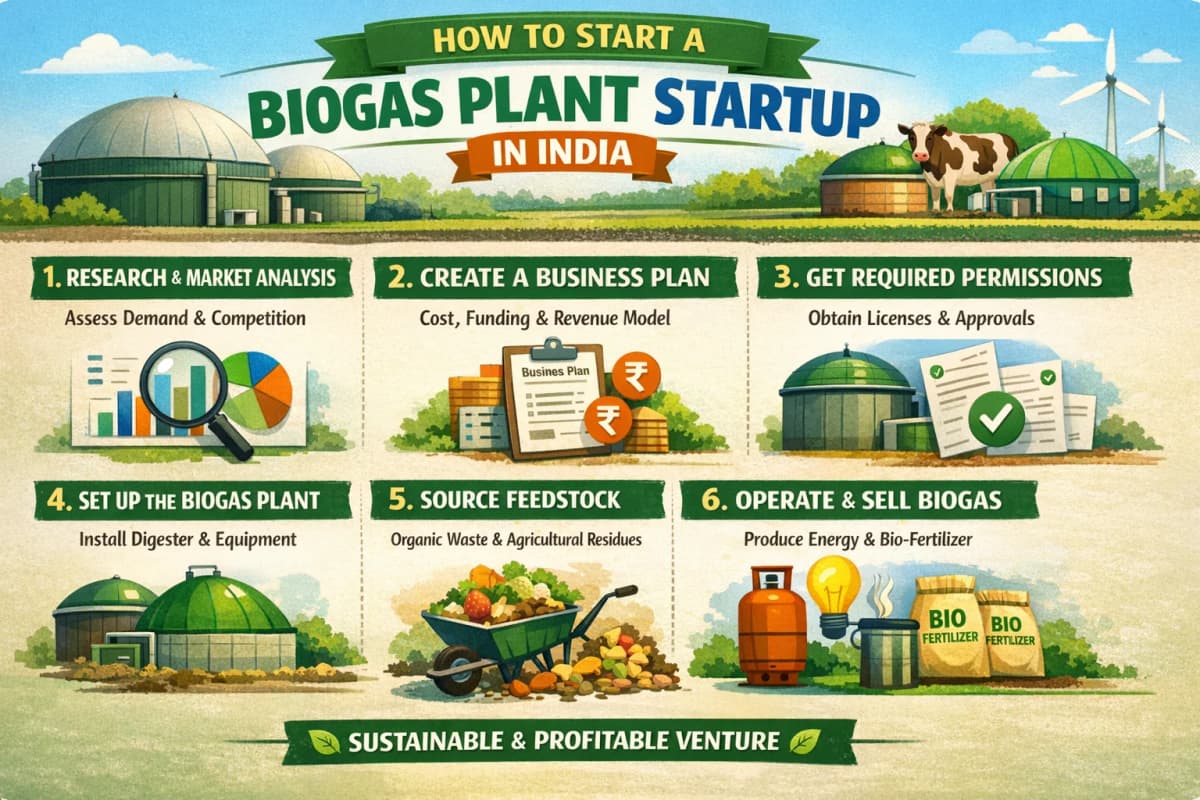
Starting a biogas plant startup in India can be a promising business opportunity for entrepreneurs interested in renewable energy, waste management, and sustainable development. Biogas is produced from organic waste such as cow dung, agricultural residue, food waste, and other biodegradable materials. It can be used for cooking, heating, electricity generation, and, after suitable purification, compressed biogas (CBG) production.
India has opportunities for biogas businesses because agricultural activities, dairy farms, food processing units, hotels, and markets generate organic waste that can be used as feedstock.
However, starting a biogas plant requires proper planning, technical knowledge, investment, suitable land, reliable raw material, and necessary government approvals.
In this blog, we explain how to start a biogas plant startup in India, including business models, registration, investment, licences, government schemes, and revenue opportunities.
1. What Is a Biogas Plant Business?
A biogas plant business involves processing biodegradable organic materials through anaerobic digestion. This process takes place in an oxygen-free environment, where microorganisms break down organic matter and produce biogas.
Biogas mainly contains methane and carbon dioxide. The gas can be used directly in suitable applications or processed further to improve its quality.
A commercial biogas business can generate revenue through:
Biogas production and supply
Electricity generation
Compressed Biogas (CBG) production
Organic waste processing services
Sale of suitable processed digestate products
The business model depends on plant capacity, feedstock availability, technology, location, and customer demand.
2. Why Start a Biogas Plant Startup in India?
Biogas projects can support renewable energy generation and organic waste management. They also create opportunities for entrepreneurs in rural and urban markets.
Growing Renewable Energy Opportunities
Businesses and institutions are exploring alternative energy sources to meet their energy requirements. Biogas can be used in suitable applications as an alternative fuel.
Availability of Organic Waste
India has several potential sources of organic feedstock, including:
Dairy farms
Cattle farms
Agricultural businesses
Vegetable markets
Hotels and restaurants
Food processing industries
Poultry farms
Organic municipal waste collection systems
Waste Management Solutions
A biogas plant can convert suitable biodegradable waste into useful energy and digestate, helping businesses manage organic waste.
Multiple Revenue Opportunities
Entrepreneurs can explore income from gas sales, electricity generation, waste processing, and eligible digestate-based products.
Rural Business Development
Biogas plants can be established near agricultural areas, dairy farms, and food-processing facilities where suitable raw materials are available.
3. Different Types of Biogas Plant Businesses
Before investing, select the plant type according to your budget, feedstock, and target customers.
Small-Scale Biogas Plant
Small-scale plants are generally used by households, farms, and small institutions.
Suitable for:
Individual farmers
Small dairy farms
Rural households
Community facilities
Commercial Biogas Plant
Commercial plants process larger quantities of organic waste and produce biogas for business and institutional use.
Suitable for:
Dairy farms
Food processing units
Hotels and restaurants
Commercial establishments
Industrial facilities
Compressed Biogas (CBG) Plant
A CBG plant upgrades raw biogas by removing unwanted components and increasing methane concentration. The upgraded gas is then compressed for suitable applications.
Suitable for:
Renewable energy businesses
Industrial fuel suppliers
Eligible transport-fuel applications
Large-scale organic waste projects
Agricultural Waste-Based Biogas Plant
These plants use suitable agricultural residues and other organic materials to produce biogas.
Suitable for:
Farmers
Agricultural entrepreneurs
Farmer Producer Organisations
Agro-processing businesses
4. How to Start a Biogas Plant Startup in India?
Starting a biogas plant requires a step-by-step business and technical planning process.
Step 1: Conduct Market Research
Before investing, understand the demand for biogas and related products in your target location.
Identify potential customers such as:
Dairy farms
Hotels and restaurants
Food processing businesses
Factories
Commercial kitchens
Agricultural businesses
Industrial fuel consumers
Study competitors, existing plants, local energy demand, and potential buyers.
Step 2: Select Your Business Model
Choose how your biogas business will generate revenue.
Common business models include:
Biogas Production: Produce and supply biogas to suitable customers.
Electricity Generation: Use biogas to operate generators and produce electricity under suitable arrangements.
CBG Production: Upgrade biogas into compressed biogas for eligible buyers.
Organic Waste Processing: Collect and process biodegradable waste for commercial customers.
Digestate Products: Process suitable digestate for agricultural use, subject to quality and regulatory requirements.
Step 3: Arrange Raw Materials
Raw material availability is one of the most important factors in a biogas project.
Common feedstocks include:
Cow dung
Buffalo dung
Food waste
Vegetable waste
Agricultural residue
Suitable biodegradable industrial waste
Estimate the daily quantity, quality, seasonal availability, and transportation cost of the feedstock.
You can establish supply arrangements with dairy farms, farmers, food processing units, vegetable markets, and other waste generators.
Step 4: Prepare a Detailed Business Plan
A business plan helps you understand the project's financial and operational requirements.
Your business plan should include:
Business objectives
Plant capacity
Feedstock availability
Technology selection
Land requirements
Machinery and equipment
Construction expenses
Employee requirements
Operating costs
Expected gas production
Customer details
Revenue projections
Risk management strategy
A technical and financial feasibility study should be completed before making a major investment.
Step 5: Select Suitable Land
Choose a location that provides easy access to raw materials, transportation, water, electricity, and potential customers.
Consider the following factors:
Land availability
Site suitability
Road connectivity
Feedstock transportation
Water availability
Electricity supply
Environmental requirements
Digestate storage and handling
Safety arrangements
Check land-use permissions and local authority requirements before starting construction.
Step 6: Select Biogas Plant Technology
The technology depends on the feedstock, plant capacity, gas utilisation, and project design.
Important equipment may include:
Feedstock collection system
Waste segregation equipment
Shredder or mixer, where required
Anaerobic digester
Gas storage system
Gas cleaning equipment
Moisture removal system
Gas pipeline and valves
Safety instruments
Biogas generator, if required
Gas upgrading and compression equipment for CBG projects
Digestate handling system
Choose reliable technology and experienced suppliers who can provide installation, maintenance, and technical support.
Step 7: Arrange Business Finance
After preparing your project report, estimate the total investment required.
Potential funding sources include:
Personal investment
Bank loans
Business loans
Private investors
Strategic partnerships
Eligible government schemes
Institutional financing
A detailed project report can help when approaching banks, investors, and financial institutions.
5. How to Register a Biogas Company in India?
If you want to operate a commercial biogas business, you should select an appropriate legal structure.
Private Limited Company Registration
A Private Limited Company can be suitable for entrepreneurs planning to raise investment, operate large-scale projects, or expand their renewable energy business.
LLP Registration
A Limited Liability Partnership may be suitable for two or more partners starting a biogas consulting, installation, or plant-management business.
Partnership Firm Registration
A partnership firm can be established by two or more individuals who agree to operate a business and share profits according to their partnership agreement.
Sole Proprietorship Registration
A sole proprietorship may be suitable for an individual operating a small-scale biogas service or related business.
The right structure depends on ownership, investment, liability, operational requirements, and future expansion plans.
6. Documents Required for Biogas Company Registration
The documents depend on the selected business structure.
Common documents include:
PAN Card of directors or proprietors
Aadhaar Card or accepted identity proof
Address proof
Passport-size photographs
Mobile number and email address
Registered office address proof
Rent agreement, if applicable
Property owner's NOC, where required
Partnership deed, if applicable
Incorporation documents, where applicable
Additional documents may be required depending on the legal structure and the nature of the project.
7. Licences and Registrations Required for a Biogas Plant in India
The registrations and approvals depend on plant capacity, location, feedstock, technology, and intended use of the gas.
Important requirements to evaluate include:
1. Company Registration
Register your business as a Private Limited Company, LLP, partnership firm, or another suitable structure.
2. GST Registration
GST registration may be required depending on turnover, taxable supplies, interstate transactions, and other applicable conditions.
3. MSME Registration
Eligible businesses can apply for Udyam Registration under the MSME framework.
4. Pollution Control Board Approval
Depending on the project and applicable state requirements, consent or other approvals from the State Pollution Control Board or Pollution Control Committee may be necessary.
5. Local Authority Permissions
Building approvals, land-use permissions, trade licences, and other local permissions may apply depending on the location and nature of the project.
6. Factory Licence
A factory licence may be required if the facility falls within the applicable statutory definition and conditions.
7. Fire and Safety Approvals
Biogas plants should follow applicable fire safety, gas-handling, electrical, and occupational safety requirements.
8. PESO Approval, Where Applicable
Projects involving regulated compressed gas storage, cylinders, pressure vessels, or related installations should assess the applicable Petroleum and Explosives Safety Organisation (PESO) requirements.
9. Environmental Compliance
Businesses should assess applicable environmental, waste management, water, and pollution control requirements.
Not every biogas plant requires every approval listed above. The applicable permissions should be confirmed with the relevant authorities before construction and commercial operation.
8. Investment Required to Start a Biogas Plant in India
The investment depends on the plant's capacity, land, technology, machinery, construction, feedstock handling, and gas utilisation model.
Major investment components include:
| Investment Component | Purpose |
|---|---|
| Land | Purchase or lease of project site |
| Civil Construction | Digester, foundation, buildings and storage |
| Machinery | Feedstock handling and processing |
| Digester System | Anaerobic digestion |
| Gas Storage | Collection and storage of biogas |
| Gas Cleaning | Removal of unwanted impurities |
| Generator | Electricity production, if applicable |
| Gas Upgrading | CBG production, if applicable |
| Labour | Plant operation and maintenance |
| Transportation | Feedstock and product movement |
| Compliance | Approvals, testing and professional services |
There is no single fixed investment amount for every biogas project. Prepare a project-specific estimate after selecting the plant capacity and technology.
9. How Does a Biogas Plant Make Money?
A biogas plant can generate revenue through multiple business activities.
Sale of Biogas
Biogas can be supplied to suitable customers for cooking, heating, and industrial applications.
Electricity Generation
Biogas can be used to generate electricity through suitable generators. Commercial supply arrangements must follow applicable requirements.
Compressed Biogas Production
CBG can be produced by upgrading and compressing biogas. Revenue depends on production quality, buyer agreements, transportation, and market conditions.
Waste Processing Services
A biogas plant may charge businesses or institutions for processing suitable organic waste.
Sale of Digestate-Based Products
Processed digestate may provide an additional revenue opportunity when it meets the applicable quality and regulatory standards.
10. Government Schemes for Biogas Plant Businesses
Entrepreneurs can explore government programmes and financial support for eligible biogas and renewable energy projects.
Some initiatives include:
MNRE Biogas Programme: Supports eligible biogas-related activities under the applicable programme guidelines.
SATAT Initiative: Promotes the development of Compressed Bio-Gas as an alternative fuel.
GOBARdhan Initiative: Encourages the conversion of organic waste, including cattle dung and agricultural waste, into biogas and other useful products.
MSME Schemes: Eligible businesses may explore applicable MSME support programmes.
Bank Financing: Entrepreneurs can approach banks and financial institutions for suitable business or project loans.
Scheme eligibility, funding limits, and application procedures can change. Always verify the latest official guidelines before making financial decisions.
11. Challenges in Starting a Biogas Plant Startup
Before starting a biogas business, understand the common challenges.
Raw Material Availability
A plant needs a consistent supply of suitable organic waste. Feedstock shortages can affect production.
High Initial Investment
Commercial plants require investment in land, machinery, civil construction, and safety systems.
Technical Knowledge
Biogas production requires proper control of feedstock composition, temperature, pH, and other operating conditions.
Transportation Costs
Collecting waste and delivering gas or CBG can increase operating expenses.
Regulatory Requirements
Businesses must identify applicable environmental, safety, tax, and local compliance requirements.
Finding Buyers
A startup needs reliable customers and commercial agreements to sell biogas, electricity, or CBG.
12. Expert Tips for a Successful Biogas Startup
Follow these tips before launching your biogas business:
Conduct a detailed feasibility study.
Select plant capacity based on actual feedstock availability.
Establish reliable raw material supply agreements.
Choose suitable technology for the feedstock.
Identify potential customers before starting production.
Maintain accurate accounting records.
Follow applicable safety and environmental requirements.
Monitor production and operating expenses.
Explore eligible government support and finance.
Take professional assistance for company registration and compliance.
13. How First Startup Can Help You Register a Biogas Company
Starting a biogas plant involves business registration, financial planning, taxation, and statutory compliance.
First Startup provides professional business registration and compliance services for entrepreneurs and growing businesses.
Our services include:
Private Limited Company Registration
LLP Registration
OPC Registration
Partnership Firm Registration
GST Registration
MSME Registration
Trademark Registration
Accounting and Bookkeeping
ROC Compliance
ITR Filing
TDS Return Filing
Business Compliance Assistance
Our team can help you understand the registration process and identify the applicable business compliance requirements.
Contact First Startup
Website: https://www.firststartup.in/
Phone: +91 63956 22281
Email: [email protected]
Conclusion
Starting a biogas plant startup in India requires proper market research, reliable feedstock, suitable technology, investment planning, and regulatory compliance.
Entrepreneurs should begin by identifying potential customers, selecting a suitable business model, preparing a detailed project report, and arranging the required registrations and permissions.
With careful planning and professional guidance, a biogas business can create opportunities in renewable energy, waste management, and sustainable agriculture.
Frequently Asked Questions (FAQs)
1. How to start a biogas plant startup in India?
Conduct market research, select a business model, arrange organic waste, prepare a feasibility report, select suitable land and technology, arrange finance, and obtain applicable registrations and approvals.
2. Is a biogas plant business profitable in India?
Profitability depends on feedstock availability, plant capacity, gas production, operating expenses, customer demand, and revenue arrangements. A feasibility study is essential.
3. How much investment is required for a biogas plant?
Investment depends on plant capacity, land, technology, machinery, construction, storage, and operating requirements. A project-specific estimate should be prepared.
4. Which raw materials are used in a biogas plant?
Common raw materials include cow dung, buffalo dung, food waste, vegetable waste, agricultural residue, and other suitable biodegradable organic materials.
5. Which company structure is best for a biogas startup?
A Private Limited Company may be suitable for businesses planning expansion or investment. LLP, partnership, and proprietorship structures may also be appropriate depending on business requirements.
6. Is GST registration required for a biogas business?
GST registration depends on applicable turnover limits, taxable supplies, interstate transactions, and other conditions under GST law.
7. Can I start a biogas plant using cow dung?
Yes. Cow dung is commonly used for biogas production. The plant design should consider the quantity, quality, and regular availability of the material.
8. Are government subsidies available for biogas plants?
Eligible projects may be able to access support under relevant government programmes. Availability and eligibility depend on current scheme guidelines.
9. What is the difference between biogas and CBG?
Biogas is produced through anaerobic digestion and contains methane and carbon dioxide. CBG is produced by upgrading biogas to increase methane concentration and compressing it for suitable applications.
10. Can First Startup help with biogas company registration?
Yes. First Startup provides company registration, LLP registration, GST registration, MSME registration, trademark registration, accounting, and business compliance assistance.