
How to Register a Software Company in India – Complete Step-by-Step Guide
First Startup
Nov 12, 2026
India has become one of the fastest-growing destinations for the software and information technology industry. With increasing demand for software development, mobile applications, web development, cloud computing, artificial intelligence and IT solutions, many entrepreneurs are planning to start their own software companies.
If you want to establish a software development company, IT consulting firm, SaaS business or technology startup, registering your business is an important first step.
However, before starting operations, you need to understand the legal requirements, business structure, registration process, documents, taxation and other compliance requirements.
In this guide, we will explain how to register a software company in India, including company registration, GST registration, MSME registration, trademark registration and other important formalities.
1. What Is a Software Company?
A software company is a business that develops, designs, sells, maintains or provides software-related products and services to individuals, businesses and organisations.
Software companies operate in different technology segments, including:
Software Development Services.
Mobile Application Development.
Website Development.
Web Application Development.
SaaS (Software as a Service).
Cloud Computing Solutions.
Artificial Intelligence and Machine Learning.
IT Consulting Services.
Cybersecurity Services.
ERP and CRM Software Development.
Software Testing and Maintenance.
Digital Transformation Services.
Before registering your company, identify the software services or products you want to offer.
2. Choose the Right Business Structure for Your Software Company
The first step in registering a software company in India is selecting an appropriate business structure.
You can choose from the following business structures:
A. Private Limited Company Registration
A Private Limited Company is a popular business structure for technology startups and software development businesses.
It is suitable for entrepreneurs who want to build a scalable software company, bring in investors and expand their operations.
Benefits:
Separate legal identity.
Limited liability protection.
Easier equity-based investment.
Better business credibility.
Suitable for startup funding.
Perpetual succession.
A Private Limited Company generally requires at least two directors and two shareholders, with at least one director meeting the applicable Indian residency requirement.
B. Limited Liability Partnership (LLP)
An LLP is suitable for software companies started by two or more partners who want limited liability and operational flexibility.
Benefits:
Separate legal identity.
Limited liability protection.
Flexible management structure.
Fewer ongoing ROC compliance requirements compared with a Private Limited Company.
Suitable for software consulting and development businesses.
An LLP requires at least two partners and two designated partners.
C. One Person Company (OPC)
An OPC is suitable for an individual entrepreneur who wants to establish a company with a separate legal identity.
Benefits:
Single-member ownership.
Limited liability protection.
Separate legal identity.
Structured business operations.
Suitable for individual software entrepreneurs.
D. Sole Proprietorship
A sole proprietorship is suitable for individuals who want to start a small software development or IT consulting business.
It has a simpler setup, but the proprietor and business are not separate legal entities, and personal liability is generally unlimited.
Which structure is best?
If you want to build a scalable software startup, attract investors or develop a large technology business, a Private Limited Company is often a suitable option.
3. Select a Unique Name for Your Software Company
Choosing a unique and professional business name is an important step.
Your company name should reflect your software services, technology expertise and brand identity.
Before selecting a name, consider the following points:
Choose a distinctive and professional name.
Avoid names similar to existing companies.
Check trademark availability.
Select a name that is easy to remember.
Check domain name availability.
Avoid restricted or prohibited words.
For Private Limited Company registration, name approval is obtained through the Ministry of Corporate Affairs (MCA) process.
You can also conduct a trademark search to check whether a similar brand name already exists.
4. Documents Required for Software Company Registration in India
Before starting the company registration process, arrange the required documents of directors, shareholders and the registered office.
Documents Required for Directors and Shareholders:
PAN Card.
Aadhaar Card or other identity proof.
Passport-size photograph.
Email address.
Mobile number.
Address proof, such as a bank statement or utility bill.
Documents Required for Registered Office:
Electricity bill or other utility bill.
Rent agreement, if applicable.
Ownership proof, where applicable.
No Objection Certificate (NOC) from the property owner.
Registered office address details.
For foreign directors or shareholders, additional documents and legalisation requirements may apply.
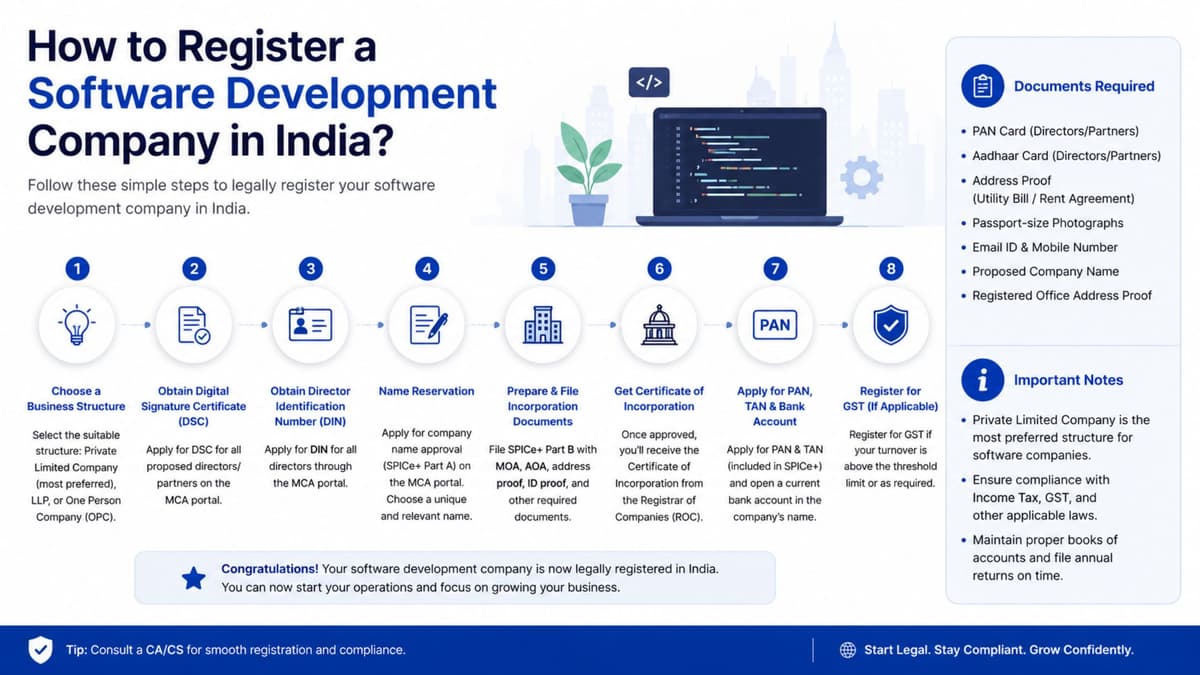
5. Step-by-Step Process to Register a Software Company in India
The company registration process is conducted through the Ministry of Corporate Affairs (MCA).
Here are the major steps involved.
Step 1: Obtain Digital Signature Certificate (DSC)
The proposed directors and subscribers who need to digitally sign incorporation documents must obtain a Digital Signature Certificate.
DSC is used to sign electronic documents submitted through the MCA portal.
Step 2: Apply for Director Identification Number (DIN)
DIN is a unique identification number allotted to an individual who intends to become a director of a company.
For new company incorporations, DIN can generally be applied for through the SPICe+ incorporation process.
Step 3: Apply for Company Name Approval
Select a unique name for your software company and submit the name application through the applicable MCA process.
The proposed name must comply with the Companies Act, 2013 and relevant naming rules.
Step 4: Prepare MOA and AOA
The Memorandum of Association (MOA) defines the company's objectives and scope of activities.
The Articles of Association (AOA) contain the internal rules and regulations governing the company.
For a software company, the object clause should appropriately cover the proposed software development, IT consulting or technology-related activities.
Step 5: File the SPICe+ Incorporation Form
Submit the required incorporation application through the MCA portal.
The SPICe+ process is used for company incorporation and related registrations.
Step 6: Obtain Certificate of Incorporation
After successful verification and approval by the Registrar of Companies (ROC), the Certificate of Incorporation is issued.
The company receives its Corporate Identity Number (CIN).
PAN and TAN are also allotted through the applicable incorporation process.
Step 7: Open a Current Bank Account
After incorporation, open a current bank account in the company's name.
Banks generally require the Certificate of Incorporation, PAN, company documents and KYC details.
6. What Is the Cost of Registering a Software Company in India?
The cost of registering a software company depends on the business structure, authorised share capital, state-specific stamp duty, DSC requirements and professional fees.
The main cost components may include:
Particulars | Cost Details |
|---|---|
Digital Signature Certificate | Depends on provider |
Government Filing Fees | As applicable |
Stamp Duty | Depends on state and capital |
Name Approval | As applicable |
Professional Fees | Depends on service provider |
Additional Registrations | As applicable |
For an accurate estimate, check the latest MCA fee structure and applicable state stamp duty.
7. Obtain GST Registration for Your Software Company
GST Registration is an important compliance requirement for software companies depending on their turnover, services and applicable GST provisions.
You may need GST registration if your business meets the applicable registration requirements.
Software companies providing services such as software development, IT consulting, application development and SaaS may need to understand the GST implications of their services.
Benefits of GST Registration:
Legal GST compliance.
Ability to issue GST tax invoices.
Input Tax Credit eligibility, subject to conditions.
Better business documentation.
Support for eligible interstate and export transactions.
GST registration can be applied for through the official GST portal.
8. Register Your Software Company Under MSME (Udyam Registration)
MSME registration, also known as Udyam Registration, can be beneficial for eligible software startups and IT service businesses.
The registration is available online through the official Udyam Registration portal.
Benefits may include:
Access to eligible government schemes.
Support under applicable credit schemes.
Benefits under applicable delayed payment provisions.
Participation in certain government procurement programmes.
Business recognition as an MSME.
MSME classification depends on the applicable investment and turnover criteria.
9. Apply for Trademark Registration for Your Software Company
Your company name, software product name and brand identity are important business assets.
Trademark registration helps protect your distinctive brand identity.
For software companies, the relevant trademark classes may include:
Trademark Class | Description |
|---|---|
Class 9 | Downloadable software and computer programmes |
Class 42 | Software development, SaaS and technology services |
Class 35 | Advertising and business management services |
Class 38 | Telecommunications services |
The correct class depends on the nature of your software products and services.
Trademark registration can help prevent unauthorised use of your registered brand identity.
10. Other Registrations and Compliance for Software Companies
Apart from company incorporation, software companies may need additional registrations depending on their business activities.
A. Startup India Registration
Eligible startups can apply for recognition under the Startup India initiative through DPIIT.
B. Shops and Establishments Registration
Depending on the state and business location, registration under the applicable Shops and Establishments law may be required.
C. Professional Tax Registration
Professional Tax registration may be applicable depending on the state and nature of employment or business operations.
D. Import Export Code (IEC)
If your software business undertakes activities requiring IEC under applicable foreign trade regulations, you may need to obtain it from the Directorate General of Foreign Trade (DGFT).
E. Employee Provident Fund (EPF) and ESIC
Applicable labour law registrations may be required depending on employee strength, establishment category and other statutory conditions.
11. Annual Compliance Requirements for a Software Company
After registering your software company, you must maintain regular statutory and financial compliance.
Important compliance requirements include:
Filing of Annual ROC Returns.
Financial Statement Filing.
Income Tax Return Filing.
GST Returns, if registered.
TDS Returns, where applicable.
Maintenance of Books of Accounts.
Board Meetings and Annual General Meetings, as applicable.
Statutory Audit, where required.
Director KYC Compliance.
Maintenance of statutory registers and records.
Timely compliance helps avoid penalties and maintain the legal status of your company.
12. Can You Register a Software Company from Home?
Yes. You can register a software company using a residential address as its registered office, provided the premises and documentation satisfy the applicable legal requirements.
Generally, you may need:
Address proof.
Utility bill.
Ownership proof or rent agreement.
NOC from the property owner, where applicable.
A dedicated commercial office is not necessarily required for every software company.
13. Why Choose First Startup for Software Company Registration?
Starting a software company requires proper planning, legal registration and ongoing compliance management.
First Startup provides professional business registration and compliance services to entrepreneurs, technology startups and growing businesses.
Our services include:
Private Limited Company Registration.
LLP Registration.
OPC Registration.
GST Registration.
MSME / Udyam Registration.
Trademark Registration.
Startup India Registration.
Accounting and Bookkeeping.
Payroll Services.
TDS Return Filing.
ROC Annual Compliance.
Income Tax Return Filing.
Our team helps entrepreneurs complete business registration formalities and understand their ongoing compliance responsibilities.
Conclusion
Registering a software company in India is an important step towards building a professional technology business. Whether you want to start a software development company, SaaS startup, mobile application development business or IT consulting firm, selecting the right business structure and completing the necessary registrations can help establish a strong foundation.
Start by selecting a suitable business structure, choosing a unique company name, arranging the required documents and completing the MCA incorporation process.
After registration, consider GST, MSME, trademark and other applicable registrations to support your business operations.
Planning to start your own software company in India? Contact First Startup for professional company registration and compliance services.
Contact First Startup
Website: https://www.firststartup.in/
Phone: +91 63956 22281
Email: [email protected]
Frequently Asked Questions (FAQs)
1. How can I register a software company in India?
You can register a software company by selecting a business structure, obtaining the required DSC, applying for name approval, preparing MOA and AOA, filing the incorporation application through MCA and obtaining the Certificate of Incorporation.
2. Which company structure is best for a software startup?
A Private Limited Company is often suitable for software startups planning to raise investment, expand operations and build a scalable business.
3. How much does it cost to register a software company in India?
The registration cost depends on the company structure, state stamp duty, share capital, DSC and professional fees.
4. Is GST registration mandatory for a software company?
GST registration depends on applicable turnover thresholds, business activities and other provisions under GST law.
5. Can I start a software company from home?
Yes. A software company can generally use a residential address as its registered office if applicable legal and documentation requirements are satisfied.
6. Is MSME registration beneficial for software companies?
Yes. Eligible software companies can obtain Udyam Registration and access applicable MSME schemes and benefits.
7. Which trademark class is applicable to software companies?
Class 9 generally covers downloadable software, while Class 42 covers software development and SaaS-related services. Additional classes may apply depending on business activities.
8. Can a single person register a software company in India?
Yes. An individual can establish an OPC or operate a sole proprietorship, subject to the respective legal requirements.
9. What is the role of MCA in software company registration?
The Ministry of Corporate Affairs administers company incorporation and corporate regulatory compliance under the Companies Act, 2013.
10. Does a software company need annual compliance?
Yes. Companies must complete applicable ROC filings, financial statements, income tax returns, statutory audit and other compliance requirements.