
How to Register an IT Company in India? – Complete Step-by-Step Guide (2026)
First Startup
Jun 06, 2026
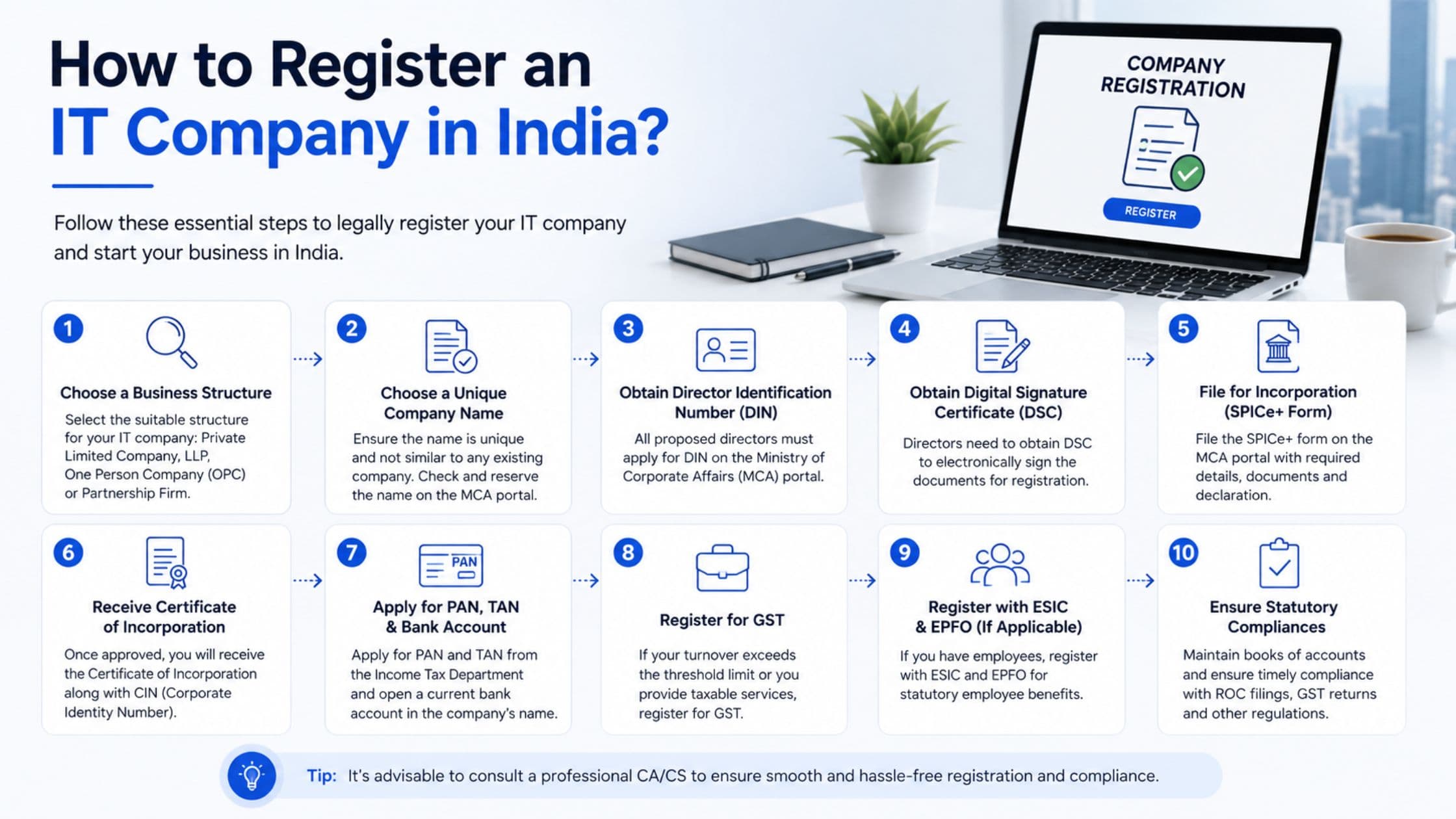
Starting an Information Technology (IT) company in India is one of the most profitable business opportunities in today's digital economy. Whether you plan to offer software development, web development, mobile app development, digital marketing, cloud services, AI solutions, cybersecurity, or IT consulting, registering your company legally is the first step toward building a successful business.
This guide explains how to register an IT company in India, the required documents, registration process, costs, and compliance requirements.
What is an IT Company?
An IT (Information Technology) company provides technology-based services and solutions to businesses and individuals. Common IT services include:
Software Development
Website Development
Mobile App Development
IT Consulting
Digital Marketing Services
Cloud Computing Solutions
Cyber Security Services
Artificial Intelligence Solutions
Data Analytics
SaaS Products
An IT business can be started by individuals, startups, or teams looking to serve domestic or international clients.
Best Business Structure for an IT Company
Before registering your IT company, you must choose a suitable business structure.
1. Private Limited Company
A Private Limited Company is the most preferred structure for IT startups.
Benefits:
Limited liability protection
Separate legal identity
Easy fundraising from investors
Better credibility with clients
Eligible for Startup India benefits
2. Limited Liability Partnership (LLP)
Suitable for small IT consulting firms.
Benefits:
Lower compliance requirements
Limited liability protection
Easy management
3. One Person Company (OPC)
Ideal for solo IT entrepreneurs.
Benefits:
Single owner control
Limited liability
Corporate status
4. Sole Proprietorship
Suitable for freelancers and small service providers.
Benefits:
Easy setup
Minimal compliance
Low cost
Documents Required for IT Company Registration
For Directors/Partners
PAN Card
Aadhaar Card
Passport Size Photograph
Mobile Number
Email ID
Bank Statement or Utility Bill (Address Proof)
Registered Office Address Proof
Electricity Bill or Water Bill
Rent Agreement (if rented)
No Objection Certificate (NOC) from Owner
Step-by-Step Process to Register an IT Company in India
Step 1: Choose a Unique Company Name
Select a unique business name that reflects your IT services and complies with MCA naming guidelines.
Examples:
TechNova Solutions Private Limited
DigitalEdge Technologies Private Limited
CloudMatrix IT Solutions Private Limited
Step 2: Obtain Digital Signature Certificate (DSC)
All directors must obtain a Digital Signature Certificate for filing online forms with the Ministry of Corporate Affairs (MCA).
Step 3: Apply for Director Identification Number (DIN)
DIN is mandatory for every proposed director of the company.
Step 4: Company Name Approval
The proposed company name is submitted to MCA for approval.
The name should:
Be unique
Not resemble existing companies
Not violate trademarks
Step 5: File Incorporation Application
The incorporation application is filed through the SPICe+ Form with MCA.
This includes:
Company registration
PAN allotment
TAN allotment
DIN generation
GST application (optional)
Step 6: Receive Certificate of Incorporation
After successful verification, MCA issues the Certificate of Incorporation (COI).
The company officially comes into existence from this date.
Step 7: Open a Current Bank Account
Open a current account in the company's name using:
Certificate of Incorporation
PAN Card
MOA and AOA
Board Resolution
IT Company Registration Cost in India
The registration cost depends on:
Business structure selected
Number of directors
Professional fees
Government fees
Approximate Costs:
- Pvt Ltd Company Registration Fees: ₹8,750/–
- LLP Registration Fees: ₹7,500/-
- OPC Registration Fees: ₹7,500/-
- Proprietorship/Partnership Fees: ₹3,540/-
Government fees and stamp duty are additional.
GST Registration for IT Companies
GST registration becomes mandatory if:
Annual turnover exceeds the prescribed threshold.
Services are provided through e-commerce platforms.
Inter-state taxable services are supplied.
Clients require GST invoices.
Benefits of GST Registration:
Input Tax Credit
Increased business credibility
Compliance with government regulations
Startup India Registration for IT Startups
IT startups can apply for Startup India recognition to enjoy several benefits:
Tax exemptions
Easier compliance
Funding opportunities
Government support programs
Intellectual Property benefits
Startups involved in innovation, software development, AI, SaaS, and technology solutions often qualify for Startup India recognition.
Licenses Required for an IT Company
Generally, IT companies do not require special licenses. However, depending on the nature of services, additional registrations may be required:
GST Registration
Import Export Code (IEC)
Trademark Registration
Startup India Registration
Shops and Establishment Registration (State-specific)
Professional Tax Registration (where applicable)
Benefits of Registering an IT Company
Legal Recognition
A registered company gains legal status and credibility.
Limited Liability
Owners' personal assets remain protected from business liabilities.
Better Business Opportunities
Large clients prefer dealing with registered companies.
Easier Funding
Investors and venture capital firms usually invest in registered entities.
Brand Protection
The business name can be protected through trademark registration.
Global Expansion
A registered company can easily serve international clients and receive foreign payments.
Compliance Requirements After Registration
After registering an IT company, certain compliance requirements must be fulfilled:
Annual MCA Filings
Income Tax Returns
GST Returns (if registered)
Accounting and Bookkeeping
Director KYC Compliance
Board Meetings (for companies)
Maintaining compliance helps avoid penalties and legal issues.
Why IT Businesses Prefer Private Limited Company Registration?
Most technology startups choose Private Limited Company registration because:
Suitable for software startups
Easy equity distribution
Attractive to investors
Better market reputation
Scalable business structure
Supports future fundraising
For startups planning rapid growth, a Private Limited Company is often the most suitable option.
Conclusion
Registering an IT company in India is a straightforward process when proper documentation and legal procedures are followed. Entrepreneurs can choose from Private Limited Company, LLP, OPC, or Proprietorship structures based on their business goals. For most startups and technology ventures, Private Limited Company registration offers the best combination of credibility, scalability, and investor attractiveness.
If you are planning to launch a software company, web development agency, SaaS startup, digital marketing agency, or IT consulting business, completing the registration process is the first step toward building a successful and legally compliant enterprise.
FAQs
1. Can I start an IT company from home in India?
Yes, an IT company can be started from a residential address with proper address proof and NOC if required.
2. Which registration is best for an IT startup?
A Private Limited Company is generally considered the best option for growing IT startups.
3. Is GST mandatory for IT companies?
GST may be mandatory depending on turnover, service nature, and client requirements.
4. How long does IT company registration take?
Typically, registration takes 7–15 working days, depending on approvals and document verification.
5. Can a single person register an IT company?
Yes, a single entrepreneur can register an OPC or Proprietorship.
6. Do IT companies need special government approval?
Most IT companies do not require special licenses beyond standard business registrations and tax compliances.
7. What is the minimum capital required to start an IT company?
There is no minimum capital requirement for registering a Private Limited Company in India. You can start with a small investment based on your business needs.
8. Can a student register an IT company in India?
Yes, students above 18 years of age with valid PAN and Aadhaar can register an IT company and operate it legally.
9. Can I register an IT company without an office?
Yes, you can use your residential address as the registered office by providing valid address proof and owner's NOC if required.
10. How many directors are required for an IT company?
A Private Limited Company requires a minimum of two directors, while an OPC requires only one director.
11. Can a foreign citizen start an IT company in India?
Yes, foreign nationals can register a company in India subject to Foreign Direct Investment (FDI) regulations and applicable laws.
12. Is trademark registration necessary for an IT company?
Trademark registration is not mandatory but highly recommended to protect your company name, logo, and brand identity.
13. Can an IT company receive payments from foreign clients?
Yes, a registered IT company can receive international payments through authorized banking channels and payment gateways.
14. What is the difference between an IT company and a software company?
An IT company may provide a wide range of technology services, while a software company primarily focuses on software development and related products.
15. Can freelancers convert their business into an IT company?
Yes, freelancers can upgrade from a sole proprietorship to an LLP, OPC, or Private Limited Company as their business grows.
16. Is Startup India registration mandatory for IT startups?
No, Startup India registration is optional, but it offers various benefits such as tax exemptions, funding opportunities, and government recognition.
17. Do IT companies need GST registration from day one?
Not always. GST registration depends on turnover, business activities, and client requirements. Many IT businesses voluntarily register for GST to improve credibility.
18. Can an IT company provide multiple services under one registration?
Yes, an IT company can offer services such as software development, web design, app development, digital marketing, cloud solutions, and IT consulting under the same entity.
19. What is the MCA in company registration?
The Ministry of Corporate Affairs (MCA) is the government authority responsible for company incorporation and corporate compliance in India.
20. Can I change my IT company's name later?
Yes, a company name can be changed after incorporation by following the MCA approval process and filing the required forms.