
How to Register a Software Development Company in India?
First Startup
Jun 08, 2026
The software development industry in India is growing rapidly due to increasing demand for web development, mobile applications, cloud computing, AI solutions, SaaS products, and IT consulting services. If you are planning to start a software development business, registering your company is one of the most important steps to build credibility, attract clients, and scale your operations legally.
Whether you are a freelancer transitioning into a business or a team of developers launching a startup, this guide explains everything you need to know about software development company registration in India.
Why Register a Software Development Company?
Registering your software business provides several benefits:
Creates a legal business identity
Builds trust among clients and investors
Helps open a business bank account
Enables GST registration and invoicing
Makes it easier to raise funding
Protects the company name
Offers limited liability protection
Improves chances of getting government tenders and contracts
A registered company is generally preferred by corporate clients, international customers, and investors.
Types of Business Structures for Software Companies
Before registration, you must choose the right business structure.
1. Private Limited Company
A Private Limited Company is the most preferred structure for software startups.
Benefits:
Limited liability protection
Separate legal entity
Easy fundraising opportunities
Better business credibility
Suitable for scaling operations
Recommended For:
SaaS startups
App development companies
IT service providers
Technology startups
2. LLP (Limited Liability Partnership)
An LLP combines flexibility with limited liability.
Benefits:
Lower compliance requirements
Limited liability protection
Suitable for service-based businesses
Recommended For:
Small software agencies
IT consulting firms
Technology partnerships
3. One Person Company (OPC)
OPC is ideal for solo entrepreneurs who want a corporate structure.
Benefits:
Single owner control
Limited liability
Better credibility than proprietorship
4. Sole Proprietorship
A Sole Proprietorship is the easiest business structure to start.
Benefits:
Minimal compliance
Easy setup
Low cost
Limitations:
Unlimited liability
Difficult to raise investment
Lower business credibility
Documents Required for Software Development Company Registration
For Directors or Partners
PAN Card
Aadhaar Card
Passport-size photograph
Mobile number
Email ID
Address proof
Bank statement or utility bill
Registered Office Documents
Electricity bill or utility bill
Rent agreement (if rented)
No Objection Certificate (NOC) from the owner
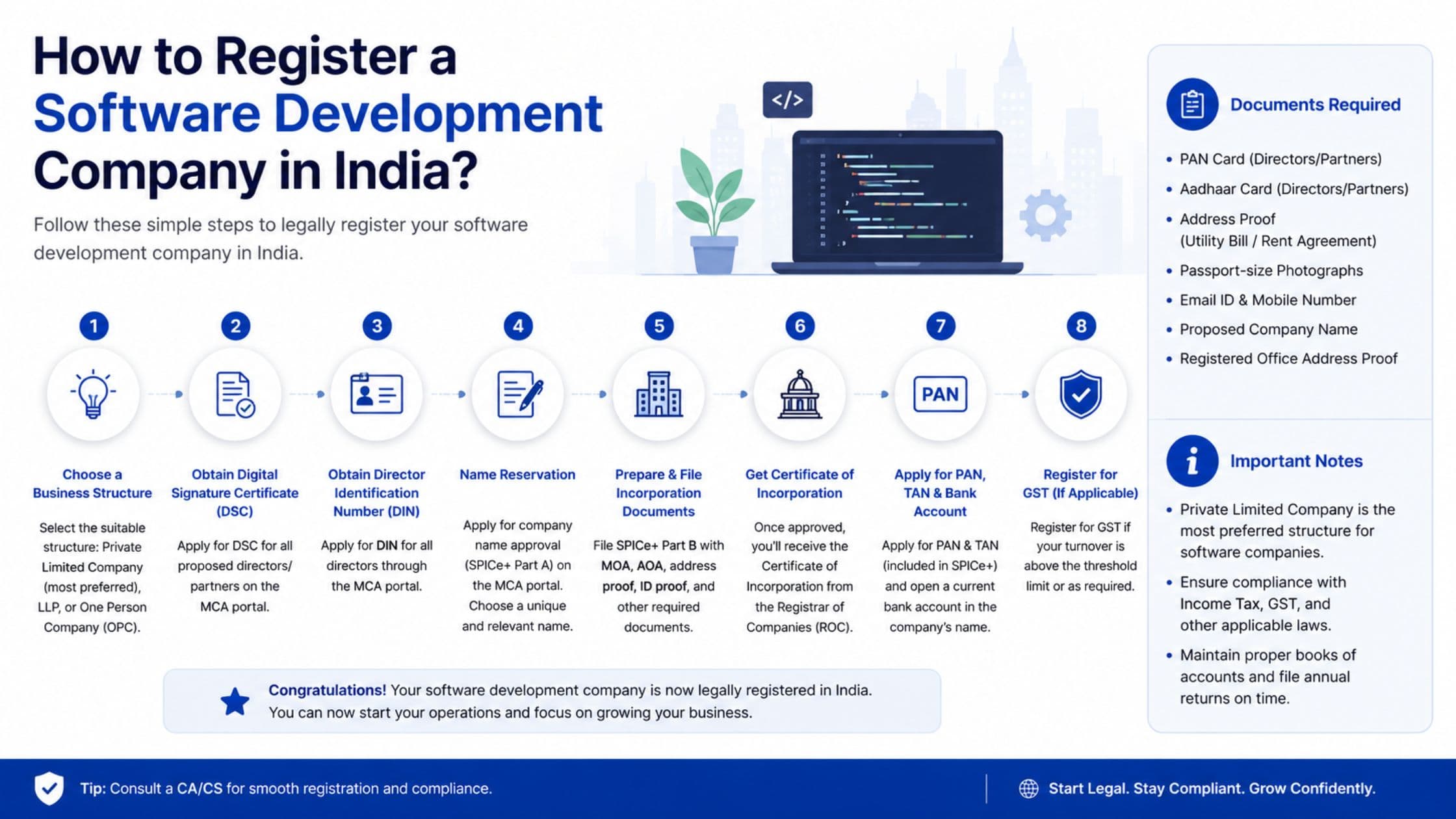
Step-by-Step Process to Register a Software Development Company
Step 1: Choose a Business Structure
Decide whether you want to register as:
Private Limited Company
LLP
OPC
Proprietorship
Most software startups choose a Private Limited Company due to its growth potential.
Step 2: Obtain Digital Signature Certificate (DSC)
A Digital Signature Certificate is required for online filing of company registration forms with the Ministry of Corporate Affairs (MCA).
Step 3: Apply for Director Identification Number (DIN)
Every proposed director of a company must obtain a DIN.
Step 4: Reserve the Company Name
Choose a unique company name related to software development, IT services, technology, or digital solutions.
Examples:
ABC Software Solutions Private Limited
XYZ Technologies Private Limited
Innovate Tech Solutions Private Limited
The name should comply with MCA guidelines.
Step 5: File Incorporation Application
The incorporation application is submitted through the MCA portal along with required documents and declarations.
Step 6: Receive Certificate of Incorporation
Once approved, the Registrar of Companies (ROC) issues the Certificate of Incorporation.
This certificate confirms that your software company is legally registered.
Step 7: Apply for PAN and TAN
PAN and TAN are generally issued along with company incorporation.
These are required for taxation and financial transactions.
Step 8: Open a Business Bank Account
Open a current account in the company’s name to manage business finances professionally.
GST Registration for Software Development Companies
GST registration becomes mandatory if:
Annual turnover exceeds the prescribed threshold
You provide interstate services
You sell software products online
You export software services and need GST compliance
Benefits of GST registration include:
Input tax credit
Professional invoicing
Better business credibility
Compliance with corporate client requirements
Startup India Registration for Software Startups
Software businesses can also apply for Startup India recognition.
Benefits Include:
Tax benefits
Easier funding opportunities
Government support programs
Startup networking opportunities
Intellectual property support
Technology-based businesses often qualify under Startup India guidelines.
Licenses and Registrations Required
Depending on your business model, you may need:
Company Registration
GST Registration
Startup India Registration
Trademark Registration
Import Export Code (IEC) (for international business)
Professional Tax Registration (where applicable)
Shop and Establishment Registration
Cost of Software Development Company Registration
The registration cost depends on:
Business structure
Number of directors
State of registration
Professional fees
Government filing fees
Private Limited Company registration generally costs more than LLP or Proprietorship registration because of additional compliance requirements.
Compliance Requirements After Registration
Once your software company is registered, you must comply with statutory requirements.
Private Limited Company Compliance
Annual ROC filing
Income tax return filing
Maintenance of accounting records
Board meetings
GST return filing (if applicable)
LLP Compliance
Annual return filing
Income tax return filing
Statement of accounts
Proper compliance helps avoid penalties and maintains the company's legal status.
How First Startup Can Help in Software Company Registration?
Starting a software development company involves multiple legal and regulatory steps. First Startup can assist entrepreneurs throughout the registration process by providing:
Business structure consultation
Company name approval assistance
Private Limited Company registration
LLP registration
OPC registration
GST registration
Startup India registration
Trademark registration
Compliance and annual filing support
With professional guidance, software entrepreneurs can focus on product development and business growth while ensuring legal compliance.
Conclusion
Registering a software development company in India is a crucial step for building a professional and scalable technology business. Choosing the right business structure, completing company registration, obtaining GST registration, and ensuring compliance can help establish a strong foundation for long-term success.
Whether you are launching a software startup, web development agency, mobile app development company, or SaaS platform, proper registration improves credibility, attracts clients, and creates opportunities for future growth.
Frequently Asked Questions (FAQs)
1. Which business structure is best for a software development company?
A Private Limited Company is generally considered the best option for software startups due to limited liability and fundraising opportunities.
2. Can a single person register a software company?
Yes, a single person can register an OPC or Sole Proprietorship.
3. Is GST mandatory for software companies?
GST may be mandatory depending on turnover, business activities, and interstate services.
4. How long does software company registration take?
Typically, registration can take 7–15 working days, depending on documentation and approvals.
5. Can software companies apply for Startup India recognition?
Yes, eligible software startups can apply for Startup India registration.
6. Is a physical office required for company registration?
A registered office address is required, which can be owned or rented.
7. Can foreign clients hire a registered software company in India?
Yes, registered software companies can legally provide services to international clients.
8. Is trademark registration necessary for a software company?
Trademark registration is not mandatory but is highly recommended to protect your brand identity.
9. Can freelancers convert into a software company later?
Yes, freelancers can upgrade their business structure to LLP or Private Limited Company.
10. What documents are required for software company registration?
PAN card, Aadhaar card, photograph, address proof, office address proof, and related incorporation documents are commonly required.