
GST on Beauty Products in India: HSN Codes, GST Rates and Registration Guide
First Startup
Oct 27, 2026
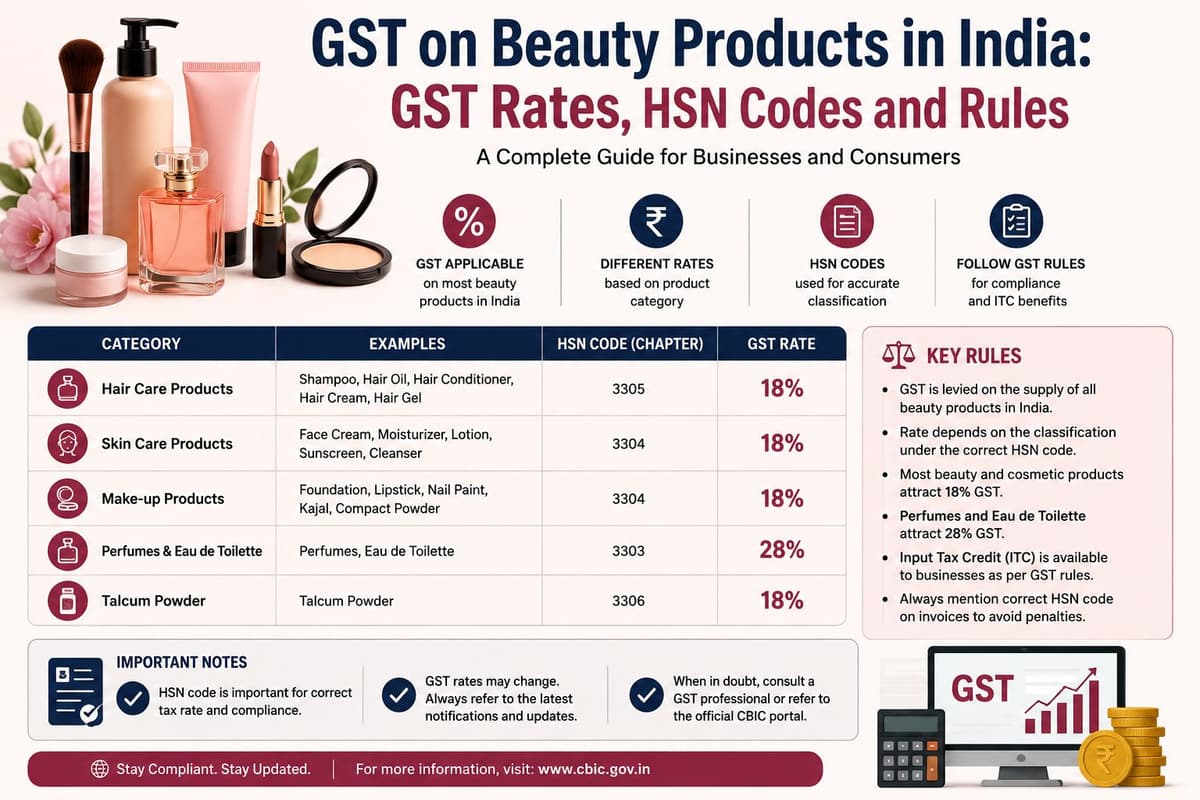
The beauty and cosmetics industry in India includes skincare products, makeup, haircare products, perfumes, personal care items and beauty accessories. If you manufacture, import, distribute or sell beauty products, understanding GST on beauty products is important for correct invoicing, pricing and tax compliance.
The applicable Goods and Services Tax (GST) rate depends on the product's classification, HSN code and current GST notifications. Following the GST rate changes effective from 22 September 2025, many everyday personal care products attract 5% GST, while several makeup, skincare and fragrance products attract 18%. Certain products have different treatment.
In this guide, First Startup explains GST rates on beauty products, common HSN codes, GST registration requirements, input tax credit and frequently asked questions for beauty product businesses in India.
What Is GST on Beauty Products?
GST on beauty products is the indirect tax charged on the supply of taxable cosmetic, skincare, haircare and personal care products.
Businesses selling beauty products must identify the correct HSN classification and charge the applicable GST rate. The tax treatment can differ between products that appear similar but have different ingredients, uses or classifications.
For example, lipstick and moisturising cream generally fall under a different GST rate category from talcum powder and shampoo under the applicable post-September 2025 rate schedule.
GST Rates on Beauty Products in India
The following table provides a practical overview of common beauty and personal care products. These are general classifications; confirm the precise HSN code and rate before issuing invoices.
| Beauty product | Common HSN heading | Indicative GST rate |
|---|---|---|
| Lipstick and lip makeup | 3304 | 18% |
| Foundation and makeup products | 3304 | 18% |
| Face creams and moisturisers | 3304 | 18% |
| Sunscreen preparations | 3304 | 18% |
| Nail polish | 3304 | 18% |
| Talcum powder | 3304 | 5% |
| Face powder | 3304 | 5% |
| Shampoo | 3305 | 5% |
| Hair oil | 3305 | 5% |
| Hair dye and hair colour | 3305 | 18% |
| Perfumes and toilet waters | 3303 | 18% |
| Deodorants and antiperspirants | 3307 | 18% |
| Shaving cream and preparations | 3307 | 5% |
| Toothpaste | 3306 | 5% |
| Toilet soap | 3401 | 5% |
The rates above reflect the general product entries reported for the GST rate changes effective 22 September 2025. Product descriptions, exclusions and tariff classifications matter, so check the latest applicable CBIC notification before relying on a rate.
HSN Codes for Beauty Products
HSN stands for Harmonised System of Nomenclature. It is used to classify goods for taxation and other trade purposes.
Common HSN headings relevant to beauty and personal care businesses include:
1. HSN 3303 – Perfumes
This heading covers perfumes and toilet waters. Many products under this heading generally attract 18% GST.
2. HSN 3304 – Cosmetics and Skincare
This heading covers beauty or makeup preparations and preparations for skin care, including sunscreen and manicure or pedicure products, subject to the relevant exclusions.
Examples include lipstick, foundation, moisturising lotion, face creams and nail polish. Some products under this heading have different GST rates, so the exact tariff entry must be checked.
3. HSN 3305 – Haircare Products
This heading covers preparations for use on hair, including shampoos, hair dyes and certain hair treatments. Hair oil and shampoo may attract a different rate from hair dye or other hair preparations.
4. HSN 3306 – Oral and Dental Hygiene Products
This heading covers preparations for oral or dental hygiene, including toothpaste and other specified products. Different entries may have different rates.
5. HSN 3307 – Other Personal Care Products
This heading includes specified shaving preparations, personal deodorants, bath preparations and other perfumery or toilet preparations not classified elsewhere.
Important: An HSN heading does not mean that every product under it has the same GST rate. Always verify the applicable tariff entry and current notification.
How to Calculate GST on Beauty Products
GST is generally calculated on the applicable taxable value of the supply.
Formula:
GST amount = Taxable value × Applicable GST rate ÷ 100
For example, suppose a cosmetic product has a taxable value of ₹1,000 and attracts 18% GST.
Taxable value: ₹1,000
GST rate: 18%
GST amount: ₹180
Total invoice value: ₹1,180
If the supply is within the same state, GST is generally split into CGST and SGST at equal rates. For an interstate taxable supply, IGST generally applies.
The example is illustrative. Use the actual rate applicable to the specific product.
GST Registration for Beauty Product Businesses
GST registration requirements depend on the nature of the business, turnover, type of supply and applicable registration provisions.
Beauty product businesses that may need to evaluate GST registration include:
Cosmetic manufacturers.
Beauty product wholesalers and distributors.
Retail cosmetic shops.
Skincare and haircare brands.
Online beauty product sellers.
Importers of cosmetics.
Businesses selling through marketplaces.
Private-label beauty product businesses.
The registration threshold and exceptions depend on the circumstances. Interstate sales, e-commerce arrangements and other special provisions may affect the requirement. Do not assume that every online seller has the same registration obligations.
Businesses should assess their specific situation under the current GST law before starting taxable sales.
Documents Required for GST Registration
The documents generally required for GST registration may include:
PAN of the applicant or business.
Aadhaar and identity details, as applicable.
Proof of business address.
Photograph of the proprietor or authorised signatory, where required.
Bank account details or supporting proof, where required.
Incorporation or constitution documents for companies, LLPs and other entities.
Authorisation documents for the authorised signatory, where applicable.
Additional details may be required depending on the business constitution and registration application.
GST on Beauty Products Sold Online
Businesses selling beauty products through their own websites or e-commerce marketplaces should understand their GST obligations before listing products.
Important considerations include:
Product classification: Select the correct HSN code and applicable GST rate.
Tax invoices: Issue invoices with the required product, tax and supplier details.
Marketplace requirements: Check the platform's seller documentation and tax requirements.
Returns and refunds: Account for eligible sales returns and credit notes correctly.
GST returns: File the applicable returns according to the business's registration and filing obligations.
Input tax credit: Maintain eligible purchase invoices and supporting records.
Marketplace-specific requirements can vary. Confirm the current rules for the particular platform and seller arrangement.
Input Tax Credit on Beauty Products
Input tax credit (ITC) allows eligible registered businesses to claim credit for GST paid on qualifying business purchases, subject to the conditions and restrictions under GST law.
For example, a registered beauty product retailer may incur GST on eligible purchases of stock, packaging materials or other business inputs. The retailer may be able to claim eligible ITC when the statutory conditions are met.
Businesses should maintain valid tax invoices, reconcile purchase records and ensure that credit is claimed only where permitted.
ITC is not automatic for every expense. Restrictions, documentation requirements and other statutory conditions apply.
GST Compliance for Beauty Product Manufacturers and Sellers
Beauty product businesses should maintain a consistent compliance process to reduce errors and avoid tax disputes.
Recommended practices include:
Verify the HSN classification for every product.
Confirm GST rates using current official notifications.
Maintain purchase and sales invoices.
Reconcile accounting records with GST returns.
Review input tax credit eligibility.
Issue credit notes where permitted and required.
Track filing deadlines and tax payments.
Keep product descriptions consistent across invoices and inventory records.
Manufacturers and importers may also have separate regulatory obligations relating to cosmetics, product labelling, import procedures and applicable product safety requirements. GST registration does not replace those requirements.
Common GST Mistakes in the Beauty Industry
Beauty businesses should avoid these common mistakes:
Applying one GST rate to all cosmetics.
Using an incorrect HSN code.
Charging an outdated GST rate.
Claiming ineligible input tax credit.
Issuing invoices without required tax details.
Failing to reconcile marketplace sales with accounting records.
Missing GST return deadlines.
Assuming that every seller must register under the same conditions.
A periodic review of product classification and GST compliance can help businesses identify errors before they become larger issues.
Frequently Asked Questions About GST on Beauty Products
1. What is the GST rate on beauty products in India?
The GST rate depends on the product. Many makeup, skincare and perfume products generally attract 18%, while certain everyday personal care products, such as shampoo, hair oil, talcum powder and toilet soap, generally attract 5% under the applicable post-September 2025 schedule. Verify the exact classification and current notification.
2. What is the HSN code for cosmetics?
Many cosmetic and skincare preparations fall under HSN heading 3304. Haircare products, perfumes and other personal care products may fall under headings 3305, 3303 or 3307, depending on their classification.
3. What is the GST rate on lipstick?
Lipstick generally falls under HSN heading 3304 and attracts 18% GST under the applicable rate schedule. Confirm the current entry before invoicing.
4. What is the GST rate on shampoo?
Shampoo generally falls under HSN heading 3305 and attracts 5% GST under the applicable post-September 2025 schedule.
5. What is the GST rate on perfume?
Perfumes and toilet waters generally fall under HSN heading 3303 and attract 18% GST under the applicable rate schedule.
6. Is GST registration mandatory for online beauty product sellers?
Not in every situation. Registration depends on turnover, supply type, marketplace arrangements and applicable statutory provisions. Sellers should check the rules that apply to their business.
7. Can a beauty product seller claim input tax credit?
A registered seller may claim eligible ITC on qualifying business purchases if the conditions under GST law are satisfied. Documentation and statutory restrictions must be considered.
8. How can I find the correct GST rate for a cosmetic product?
Identify the product's precise HSN classification and check the latest CBIC GST rate schedule and applicable notifications. Product names alone may not be sufficient to determine the correct rate.
Conclusion
Understanding GST on beauty products is important for cosmetic manufacturers, retailers, wholesalers, importers and online sellers. The applicable rate depends on the product classification, HSN code and current GST notifications.
Businesses should maintain accurate invoices, review input tax credit eligibility and file the required returns on time. Checking the latest official GST rate schedule is especially important when a product's classification or applicable rate may have changed.
First Startup provides business registration, GST registration, GST return filing and compliance support to eligible businesses. Visit FirstStartup.in to learn more about business and tax compliance services.