
FSSAI License Renewal Fee for 5 Years: Complete Fee Guide 2026
First Startup
Nov 12, 2026
Every food business in India must understand its FSSAI registration or licensing requirements. Whether you operate a restaurant, cloud kitchen, food manufacturing unit, bakery, catering business, grocery store or food delivery business, maintaining valid FSSAI authorisation is an important part of legal compliance.
One common question among food business operators is: What is the FSSAI license renewal fee for 5 years?
The answer has an important update in 2026. FSSAI introduced a perpetual validity system for licences and registrations. Under the revised framework, food businesses no longer need to renew their licences periodically in the traditional way. However, the applicable annual fee continues, and businesses can choose to pay fees for multiple years together.
In this guide, we explain the FSSAI fee for five years, Basic Registration, State Licence, Central Licence, the latest 2026 rules, payment process and important compliance requirements.
1. FSSAI License Fee for 5 Years in India
The government fee depends on the category of FSSAI registration or licence issued to your food business.
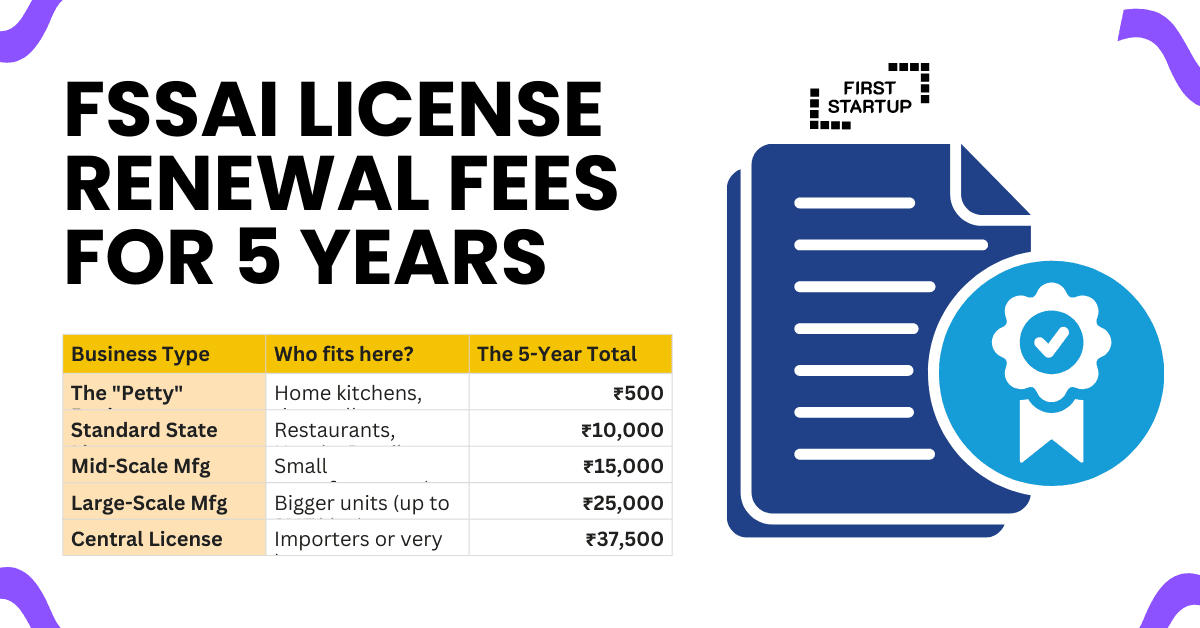
The following table shows the indicative five-year fee calculated using the applicable annual government fee rates.
| FSSAI Category | Annual Government Fee | Fee for 5 Years |
|---|---|---|
| Basic Registration | ₹100 | ₹500 |
| State Licence – ₹2,000 category | ₹2,000 | ₹10,000 |
| State Licence – ₹3,000 category | ₹3,000 | ₹15,000 |
| State Licence – ₹5,000 category | ₹5,000 | ₹25,000 |
| Central Licence | ₹7,500 | ₹37,500 |
Important: These amounts are government fee calculations for five annual fee periods, not the price of a five-year-expiry licence. The State Licence fee depends on the type and scale of food business. The amount payable should be checked on the official FoSCoS portal.
Professional or consultant charges, if any, are separate from government fees.
2. Important FSSAI Rule Change in 2026: Perpetual Validity
FSSAI introduced significant changes through the Food Safety and Standards (Licensing and Registration of Food Businesses) Amendment Regulations, 2026.
The new framework provides perpetual validity for FSSAI licences and registrations, subject to suspension, cancellation or surrender.
This means:
Licences and registrations are not required to be renewed periodically under the new framework.
The applicable annual fee continues to be payable.
Food businesses can select fees for multiple years at once.
Food safety, hygiene and other statutory requirements continue to apply.
Failure to comply with applicable fee and statutory requirements can affect the status of the authorisation.
According to FSSAI's FAQ dated 27 March 2026, food business operators can choose the fee for any number of years and pay it at any time of the year.
For businesses applying for new licences or registrations from 1 April 2026, the new perpetual-validity framework applies.
If you already hold an older FSSAI licence, check its current status and payment requirements on FoSCoS rather than assuming that an old expiry date or renewal procedure still applies.
3. Types of FSSAI Registration and Licence
FSSAI authorisation is generally divided into three categories based on the applicable eligibility criteria and food business activity.
A. Basic FSSAI Registration
Basic Registration is intended for eligible small food businesses.
Under the revised turnover thresholds effective from 1 April 2026, the general registration category covers eligible food businesses with annual turnover up to ₹1.5 crore.
Examples may include:
Small food retailers.
Petty food manufacturers.
Small restaurants and food outlets.
Small food processing businesses.
Eligible home-based food businesses.
Small food vendors.
Government fee: ₹100 per year.
Indicative five-year fee: ₹500.
B. State FSSAI Licence
A State Licence generally applies to eligible food businesses with annual turnover above ₹1.5 crore and up to ₹50 crore under the revised turnover framework.
The applicable fee depends on the business category and activity.
Examples may include:
Restaurants and food service businesses.
Food manufacturing units.
Distributors and wholesalers.
Food storage businesses.
Other eligible food businesses requiring State licensing.
Government fee: Generally ₹2,000, ₹3,000 or ₹5,000 per year, depending on the category.
Indicative five-year fee: ₹10,000, ₹15,000 or ₹25,000, respectively.
C. Central FSSAI Licence
A Central Licence generally applies to eligible food businesses with annual turnover above ₹50 crore, along with specified categories of businesses that require Central licensing under the applicable rules.
Examples of businesses that may require Central licensing include:
Importers of food products.
Certain large food manufacturers.
Food businesses operating in specified Central Licence categories.
Certain businesses operating across multiple locations under applicable licensing rules.
Other activities specifically covered by Central Licence eligibility criteria.
Government fee: ₹7,500 per year.
Indicative five-year fee: ₹37,500.
The correct licence category must be determined using the business activity and eligibility criteria on FoSCoS, not turnover alone.
4. How Is the FSSAI Fee for Five Years Calculated?
The five-year fee is calculated by multiplying the applicable annual government fee by five.
For example:
Example 1: Basic FSSAI Registration
Annual fee = ₹100
Five-year calculation:
₹100 × 5 = ₹500
Example 2: State FSSAI Licence
If your business falls under the ₹2,000 annual fee category:
₹2,000 × 5 = ₹10,000
Example 3: Central FSSAI Licence
Annual fee = ₹7,500
Five-year calculation:
₹7,500 × 5 = ₹37,500
These are illustrative calculations. Your actual payable amount will depend on the category and fee displayed by FoSCoS.
5. How to Pay the FSSAI Fee Through FoSCoS?
Food business operators can access the official Food Safety Compliance System (FoSCoS) to manage their FSSAI registration and licensing requirements.
Follow these general steps:
Step 1: Visit the Official FoSCoS Website
Open:
Step 2: Log In to Your Account
Use your registered login credentials to access your food business account.
Step 3: Select the Relevant Licence or Registration
Open the applicable licence or registration details and check its current status.
Step 4: Check the Applicable Fee
Review the annual fee, category and available payment period displayed by the portal.
Step 5: Select the Number of Years
Where the multi-year payment facility is available, select the number of years for which you want to pay the applicable fee.
Step 6: Make Online Payment
Complete the payment using the available payment options.
Step 7: Save the Payment Receipt
Keep the payment confirmation and updated licence or registration details for your business records.
Note: The exact portal options may vary according to your licence category and current account status.
6. Documents Required for FSSAI Licence Renewal or Fee Payment
The documents required depend on whether you are making a fee payment, modifying an existing licence or applying for a new registration.
For a new application or relevant modification, commonly required documents may include:
Applicant's identity proof.
PAN Card.
Passport-size photograph, where required.
Business address proof.
Rent agreement or ownership proof, where applicable.
Electricity bill or other accepted premises proof.
Business constitution documents.
Details of food products and business activities.
Manufacturing or processing details, where applicable.
Supporting documents required for the specific food business category.
For an existing licence, keep the FSSAI number, registered mobile number and login details available when checking your account.
7. What Happens If You Do Not Pay the Applicable FSSAI Fee?
Perpetual validity does not mean that food businesses are free from ongoing compliance obligations.
FSSAI's 2026 framework requires businesses to comply with applicable annual fee requirements and food safety regulations.
Non-payment of the applicable fee or failure to meet other statutory requirements can affect the status of the licence or registration.
Food business operators should:
Check their FoSCoS account regularly.
Pay applicable annual fees.
Maintain hygiene and sanitation standards.
Follow food safety and storage requirements.
Maintain required business records.
Submit applicable returns.
Cooperate with inspections and food safety audits where required.
Do not ignore portal notifications or compliance requirements simply because your licence has perpetual validity.
8. FSSAI Licence Modification: When Is It Required?
An FSSAI licence or registration contains important information about the food business.
If certain business details change, you may need to apply for modification through FoSCoS.
Common examples include:
Change in business address.
Change in business name.
Change in food business activity.
Addition or deletion of food products.
Change in authorised person.
Changes in manufacturing or processing details.
A modification is different from renewal or payment of the annual fee. The applicable process and fee should be checked according to the type of modification.
9. Benefits of Maintaining FSSAI Registration and Compliance
FSSAI registration or licensing helps establish that a food business is operating under the applicable food safety regulatory framework.
Some important benefits include:
Legal Compliance
It helps food businesses meet applicable requirements under the Food Safety and Standards Act, 2006.
Customer Confidence
Customers may feel more confident when a food business maintains appropriate food safety documentation and standards.
Business Expansion
Proper registration and licensing documentation can support business relationships with distributors, retailers and other commercial partners.
Online Food Business Operations
Food businesses selling through online platforms must also understand the applicable FSSAI requirements for their activities.
Better Food Safety Practices
Maintaining compliance encourages food businesses to follow hygiene, storage, handling and food safety procedures.
10. How First Startup Can Help with FSSAI Registration and Compliance
Managing FSSAI registration, licence modifications and other business compliance requirements can be challenging for new entrepreneurs and existing food business owners.
First Startup provides professional assistance for food businesses across India.
Our services include:
FSSAI Basic Registration.
FSSAI State Licence.
FSSAI Central Licence.
FSSAI Licence Modification.
FSSAI Compliance Assistance.
Company Registration.
GST Registration.
MSME/Udyam Registration.
Trademark Registration.
Accounting and Bookkeeping.
Income Tax Return Filing.
Whether you operate a restaurant, cloud kitchen, food manufacturing unit, bakery, catering business or packaged food brand, our team can help you understand the applicable registration and compliance requirements.
Conclusion
The FSSAI license renewal fee for 5 years depends on the category of food business and its applicable annual government fee.
For indicative calculations, Basic Registration costs ₹500 for five annual fee periods, State Licence fees range from ₹10,000 to ₹25,000 for the listed annual fee categories, and a Central Licence costs ₹37,500.
However, an important change took effect in 2026: FSSAI introduced perpetual validity for licences and registrations. Food businesses can pay the applicable fees for multiple years together, but they are no longer required to follow the old periodic renewal system under the new framework.
Before making payment, check your licence category, current status and payable amount on the official FoSCoS portal.
Need help with FSSAI registration, licence modification or compliance? Contact First Startup today.
Website: https://www.firststartup.in/
Phone: +91 63956 22281
Email: [email protected]
Frequently Asked Questions (FAQs)
1. What is the FSSAI license renewal fee for 5 years?
The indicative five-year government fee calculation is ₹500 for Basic Registration, ₹10,000 to ₹25,000 for the listed State Licence categories and ₹37,500 for a Central Licence. The actual fee depends on the applicable category.
2. Is FSSAI licence renewal required in 2026?
FSSAI introduced perpetual validity for licences and registrations under the 2026 amendment framework. Therefore, periodic renewal is no longer required under the new system, but applicable annual fees and other compliance obligations continue.
3. Can I pay the FSSAI fee for five years at once?
Yes. According to FSSAI's FAQ dated 27 March 2026, food business operators can select the fee for any number of years and pay it at once.
4. What is the Basic FSSAI Registration fee for five years?
The annual government fee for Basic Registration is ₹100. The indicative fee for five annual fee periods is ₹500.
5. What is the State FSSAI Licence fee for five years?
The State Licence fee depends on the type of food business. The listed annual categories of ₹2,000, ₹3,000 and ₹5,000 result in five-year fee calculations of ₹10,000, ₹15,000 and ₹25,000, respectively.
6. What is the Central FSSAI Licence fee for five years?
The Central Licence government fee is ₹7,500 per year. The indicative fee for five annual fee periods is ₹37,500.
7. Does FSSAI perpetual validity mean there are no annual fees?
No. Perpetual validity removes periodic renewal of the licence or registration, but the applicable annual fee and other food safety compliance obligations continue.
8. How can I check my FSSAI licence status?
Visit the official FoSCoS portal at https://foscos.fssai.gov.in/ and use the relevant licence or registration status service.
9. What is the new FSSAI registration turnover limit in 2026?
From 1 April 2026, the general revised turnover categories are registration up to ₹1.5 crore, State Licence above ₹1.5 crore and up to ₹50 crore, and Central Licence above ₹50 crore. Specific business activities may have additional eligibility criteria.
10. Can First Startup help with FSSAI licence renewal and compliance?
Yes. First Startup can assist with FSSAI registration, licence modification, applicable fee and compliance guidance, along with GST, company registration and other business services.