
How Can I Change the Name of My Private Limited Company? – Step-by-Step Guide
First Startup
Oct 20, 2026
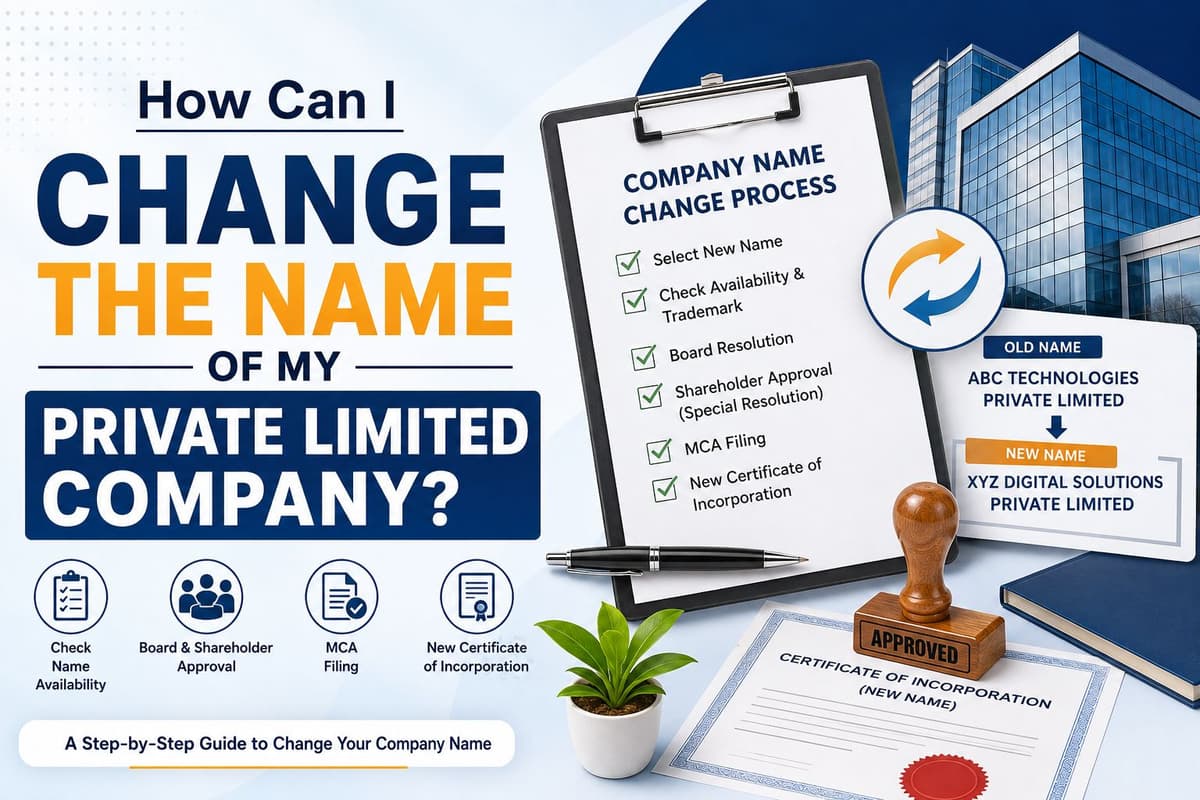
Changing the name of a Private Limited Company in India is a legal process that requires approval from shareholders and the Registrar of Companies (ROC). Businesses may decide to change their registered name because of rebranding, business expansion, a change in business activities, a merger, or a new marketing strategy.
The good news is that an existing Private Limited Company can change its registered name without incorporating an entirely new company. However, the company must follow the prescribed procedure under the Companies Act, 2013 and complete the necessary filings with the Ministry of Corporate Affairs (MCA).
In this guide, First Startup explains how to change the name of a Private Limited Company, the documents required, the applicable MCA forms, estimated costs, timelines, and post-name-change compliance requirements.
What Is a Company Name Change?
A company name change is the legal process of replacing the existing registered name of a company with a new approved name.
For example:
Existing Name: ABC Technologies Private Limited
Proposed Name: XYZ Digital Solutions Private Limited
Once the proposed name is approved and the prescribed procedure is completed, the company receives a fresh Certificate of Incorporation reflecting its new name.
The company generally retains its existing Corporate Identity Number (CIN), legal history, assets, liabilities, and contractual obligations.
Why Change the Name of a Private Limited Company?
There are several reasons why a business may want to change its registered company name.
1. Business Rebranding
A company may want a more modern, memorable, or professional name to strengthen its brand identity.
2. Expansion Into New Business Activities
If a company expands into new products, services, or industries, its existing name may no longer represent its business accurately.
3. Better Market Positioning
A suitable company name can help communicate the business's objectives and create a consistent brand identity.
4. Trademark or Branding Considerations
A company may consider a name change to address branding concerns. However, changing the registered company name does not automatically resolve trademark disputes or provide trademark protection.
5. Merger or Business Restructuring
A business may change its name following restructuring, a strategic business decision, or a change in ownership or management.
Can a Private Limited Company Change Its Name?
Yes. Under Section 13 of the Companies Act, 2013, a company can generally change its name by following the prescribed procedure, including obtaining the required shareholder approval and approval from the competent authority.
The process generally involves reserving the proposed name through the MCA's RUN service, passing a Special Resolution, filing Form MGT-14, and submitting Form INC-24 for approval.
The change becomes legally effective when the fresh Certificate of Incorporation is issued by the Registrar of Companies.
Step-by-Step Process to Change the Name of a Private Limited Company
Step 1: Select a Suitable New Company Name
The first step is to select a name that represents your business and complies with MCA naming requirements.
Before finalising the name, check:
Whether the proposed name is available.
Whether it resembles an existing company or LLP name.
Whether it conflicts with an existing registered trademark.
Whether it complies with applicable naming rules.
Whether it is appropriate for the company's proposed business activities.
It is advisable to shortlist alternative names in case the preferred option is rejected.
Step 2: Hold a Board Meeting
The company's Board of Directors should consider the proposed name change and pass the necessary Board Resolution.
The meeting generally covers:
Approval of the proposed name.
Authorisation to apply for name reservation.
Approval to convene an Extraordinary General Meeting (EGM).
Approval of the draft notice and explanatory statement for shareholders.
The company should maintain the required meeting records and resolutions.
Step 3: Apply for Name Reservation Through MCA
After the Board approves the proposal, the company can apply to reserve the proposed name through the MCA's RUN (Reserve Unique Name) service.
The Registrar examines the proposed name for compliance with applicable rules.
If approved, the name is reserved for the prescribed period. For an existing company changing its name, the reservation is generally valid for 60 days, subject to the applicable rules.
Name reservation does not, by itself, complete the company's legal name change.
Step 4: Hold an Extraordinary General Meeting
The company must obtain the required shareholder approval for the proposed name change.
An EGM is generally convened for shareholders to consider and pass a Special Resolution approving the change of the company's name and the related amendment to its Memorandum of Association (MOA).
The company must follow the applicable requirements for meeting notices, voting, and record-keeping.
Step 5: File Form MGT-14
After the Special Resolution is passed, the company must file Form MGT-14 with the ROC within the prescribed period, generally 30 days from the date of passing the resolution.
The filing records the Special Resolution and the relevant corporate approvals.
Common supporting documents include:
Certified copy of the Special Resolution.
Notice of the general meeting.
Explanatory statement.
Altered MOA and other applicable documents.
The exact attachments should be checked against the current MCA form requirements.
Step 6: File Form INC-24
The company must then submit Form INC-24 to seek approval for the name change.
This application generally refers to the approved RUN name reservation and the SRN of the MGT-14 filing.
The company should provide the required information and supporting documents and ensure that the application satisfies the applicable legal requirements.
Before filing, it is important to check whether the company has any outstanding statutory filings or defaults that could prevent approval.
Step 7: Receive the Fresh Certificate of Incorporation
Once the ROC approves the application, it issues a fresh Certificate of Incorporation reflecting the new company name.
This certificate is the official evidence of the registered name change.
Until the new certificate is issued, the company should continue using its existing registered name for legal and official purposes.
Documents Required for a Company Name Change
The documents required may vary depending on the company's circumstances and MCA filing requirements.
Common documents include:
Existing Certificate of Incorporation.
Memorandum of Association (MOA).
Articles of Association (AOA).
Board Resolution approving the proposed name change.
Special Resolution passed by shareholders.
Notice of the EGM and explanatory statement.
Minutes of the general meeting.
RUN name reservation approval details.
MGT-14 filing acknowledgement.
Altered MOA and other applicable documents.
Details and authorisation of the person filing the application.
The company should also ensure that its authorised signatory has the necessary Digital Signature Certificate (DSC) and MCA portal access.
How Much Does It Cost to Change a Private Limited Company Name?
The total cost depends on the company's authorised share capital, applicable government filing fees, professional charges, and other requirements.
| Expense | What It Covers |
|---|---|
| Name reservation | MCA RUN application fee |
| MGT-14 filing | Filing the Special Resolution |
| INC-24 filing | Application for name-change approval |
| Professional fees | Preparation, filing, and compliance assistance |
| Additional expenses | Applicable stamp duty or other charges, where relevant |
The RUN application fee is commonly ₹1,000, but fees and applicable rules should be verified on the MCA portal before filing. The total cost will depend on the company's specific circumstances.
For an accurate estimate, consult a professional who can review the company's records and applicable government fees.
How Long Does It Take to Change a Company Name?
The timeline depends on name availability, shareholder meeting arrangements, accuracy of documents, MCA processing time, and whether the application requires resubmission.
The main stages are:
Name selection and availability checks.
Board approval and name reservation.
Shareholder approval through a Special Resolution.
Filing of MGT-14 and INC-24.
ROC approval and issue of the fresh certificate.
A straightforward application may take a few weeks, but there is no guaranteed completion time. Delays can occur if the name is rejected, documents are incomplete, or statutory compliance issues remain unresolved.
What Should You Update After the Company Name Changes?
After receiving the fresh Certificate of Incorporation, the company should update its records and notify relevant stakeholders.
1. PAN and TAN Records
Review the company's tax records and complete the required updates to reflect its new name.
2. GST Registration
Update the legal name in the GST registration as applicable. The company's PAN and legal identity generally remain the same for a simple name change, so the process differs from transferring a business to a separate legal entity.
3. Bank Accounts
Submit the fresh Certificate of Incorporation and other documents requested by the bank to update the company's account name.
4. Invoices and Letterheads
Update invoices, quotations, purchase orders, letterheads, email signatures, and other official business documents.
5. Business Licences and Registrations
Review applicable registrations, including Udyam/MSME, FSSAI, IEC, trade licences, and industry-specific licences. Update each registration as required.
6. Contracts and Agreements
Review customer contracts, vendor agreements, leases, employment documents, loan agreements, and other legal records.
7. Website and Branding
Update the website, social media profiles, business listings, email addresses where appropriate, marketing materials, and other brand assets.
Important Legal Points to Remember
Before applying for a company name change, keep these points in mind:
Name approval is not the final approval: The name reservation must be followed by the prescribed corporate approvals and ROC filings.
Trademark rights are separate: An approved company name does not automatically grant trademark rights.
Compliance matters: Outstanding annual filings or other statutory defaults may affect eligibility for the name-change process.
Existing obligations continue: A name change does not automatically cancel the company's debts, contracts, or legal responsibilities.
CIN generally remains unchanged: A simple registered name change normally does not create a new legal entity.
Use the new name only after approval: The new registered name becomes effective when the fresh Certificate of Incorporation is issued.
Frequently Asked Questions
1. Can I change the name of my Private Limited Company online?
Yes. The process is generally completed through the MCA portal using the applicable name reservation and company name-change forms, along with the required Board and shareholder approvals.
2. Is shareholder approval required to change a company name?
Yes. A Special Resolution is generally required to approve the name change, subject to the applicable provisions and exceptions under company law.
3. Which forms are required to change a Private Limited Company name?
The principal filings generally include RUN for name reservation, MGT-14 for filing the Special Resolution, and INC-24 for approval of the name change.
4. Does the CIN change after changing the company name?
No. In a straightforward name change, the existing CIN generally remains the same because the legal entity continues to exist.
5. Can I change my company name without changing its business activities?
Yes. A company may change its registered name for branding or other legitimate reasons without necessarily changing its business activities. The proposed name must still comply with applicable naming requirements.
6. Can a company name change application be rejected?
Yes. The proposed name may be rejected if it does not comply with naming rules, conflicts with existing names or trademarks, or the application has other deficiencies.
7. Do I need to update GST after changing my company name?
Yes. The company should update its GST registration details as applicable and follow the relevant GST procedure.
8. Does changing the company name affect existing contracts?
Generally, a simple name change does not automatically terminate existing contracts. However, counterparties should be informed, and relevant records or agreements should be updated where necessary.
9. Can I use the old company name after the change?
Once the new name becomes legally effective, official documents should reflect the registered name as required by law. The company should also follow any applicable requirements concerning display of its former name.
10. Can First Startup help with changing a Private Limited Company name?
First Startup provides business registration and compliance assistance. You can seek professional guidance for name availability checks, documentation, MCA filings, and post-approval compliance requirements.
Conclusion
Changing the name of a Private Limited Company in India can help a business establish a stronger brand identity, reflect its evolving objectives, and support its growth plans.
However, the process requires more than changing a logo or website. Companies must follow the applicable MCA procedure, obtain shareholder approval, file the required forms, and receive a fresh Certificate of Incorporation before the new name becomes legally effective.
After approval, businesses should also update their tax records, bank accounts, licences, contracts, and other official documents.
Planning to change your company's name? First Startup can help you understand the process, prepare the required documentation, and navigate the applicable company compliance requirements.
Visit https://www.firststartup.in/ to explore business registration and compliance services.