
Automotive E-commerce Startup in India: Complete Business Guide for 2026
First Startup
Nov 12, 2026
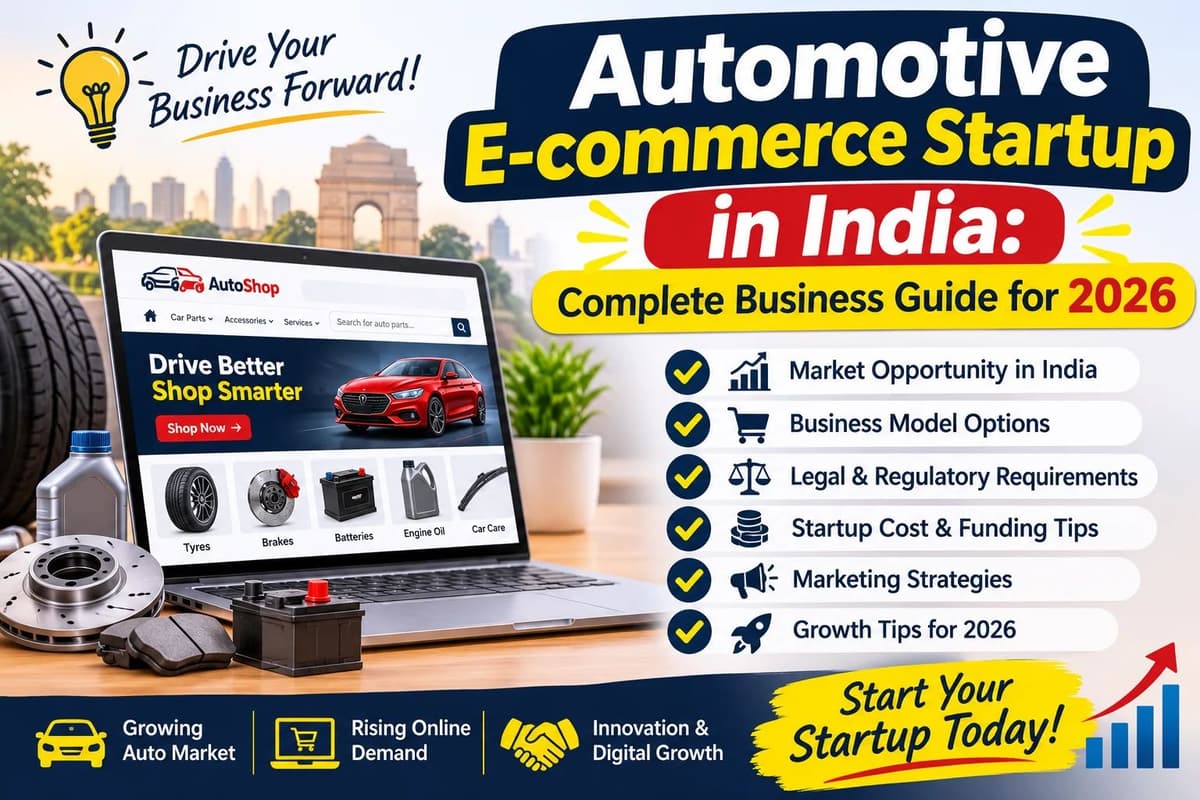
The Indian automobile industry is creating new opportunities for entrepreneurs, particularly in the online automotive spare parts and accessories market. Customers increasingly prefer searching, comparing and purchasing automotive products online instead of visiting multiple physical stores.
An automotive e-commerce startup in India can sell products such as car spare parts, bike accessories, tyres, batteries, lubricants, helmets, seat covers, lighting systems, tools and vehicle maintenance products through a website or mobile application.
With the right business model, reliable suppliers, product information and customer service, entrepreneurs can build an online automotive business serving individual vehicle owners, mechanics, workshops, garages and automobile dealers.
This guide explains how to start an automotive e-commerce startup in India in 2026, including business models, company registration, GST, legal compliance, website development, investment planning and marketing strategies.
1. Understand the Automotive E-commerce Business Model
Before launching your business, decide what type of automotive products you want to sell and who your target customers will be.
Some popular automotive e-commerce business models include:
A. Online Automotive Spare Parts Store
You can sell replacement parts for cars, motorcycles, scooters and commercial vehicles. Products may include brake pads, filters, clutch components, engine parts, mirrors and other replacement accessories.
B. Car and Bike Accessories Store
This model focuses on vehicle accessories such as seat covers, floor mats, mobile holders, car chargers, helmets, LED lights and cleaning products.
C. Automotive Marketplace
You can create a marketplace where multiple manufacturers, wholesalers and retailers list their automotive products. Customers can compare products and purchase directly through your platform.
D. Tyres and Battery E-commerce Business
You can sell tyres, vehicle batteries and related products online. You may also partner with local installation centres to provide fitting and delivery services.
E. B2B Automotive E-commerce Platform
A B2B platform can connect spare parts manufacturers, distributors, mechanics, workshops and retailers. You can generate revenue through product sales, commissions or subscription plans.
Choosing a specific business model will help you manage inventory, suppliers, pricing and marketing more effectively.
2. Conduct Market Research and Select Your Niche
The automotive industry includes thousands of products. Instead of selling everything from the beginning, select a product category that matches your budget, supplier network and customer demand.
Consider researching:
Popular car and motorcycle spare parts.
Demand for vehicle accessories.
Products with repeat-purchase potential.
Local garages and mechanic requirements.
Competitor pricing and delivery services.
Product availability and supplier margins.
Demand for genuine and compatible replacement parts.
You should also identify your target audience. For example, a business selling motorcycle accessories may target individual riders, while a B2B spare parts platform may focus on garages, mechanics and retailers.
3. Prepare a Business Plan
A business plan provides direction for your automotive e-commerce startup. It should explain how your business will operate, earn revenue and acquire customers.
Your business plan should include:
Business objectives: Define the products, customers and geographical areas you want to serve.
Revenue model: Decide whether you will earn through product margins, marketplace commissions, subscriptions or additional services.
Supplier strategy: Identify manufacturers, authorised distributors, wholesalers and verified vendors.
Inventory management: Decide whether you will maintain your own stock or operate through supplier fulfilment.
Marketing strategy: Plan SEO, paid advertising, social media and B2B partnerships.
Financial planning: Estimate website development, inventory, packaging, shipping, salaries, advertising and operational expenses.
A practical business plan helps you understand the financial requirements before investing in the business.
4. Register Your Automotive E-commerce Company
Choosing the appropriate legal structure is an important step when starting an automotive e-commerce business in India.
You can consider the following business structures:
Private Limited Company
A Private Limited Company is suitable for entrepreneurs planning to build a scalable e-commerce platform, work with investors, appoint directors and expand operations.
Limited Liability Partnership (LLP)
An LLP may be suitable for two or more partners who want a formal business structure with limited liability.
One Person Company (OPC)
An OPC can be considered by a single entrepreneur who wants to establish a company with a separate legal identity.
Partnership Firm
A partnership firm may be suitable for a business operated by two or more partners under a partnership agreement.
The appropriate structure depends on ownership, investment plans, business activities and future expansion.
First Startup can assist entrepreneurs with company registration and related business compliance services.
5. Obtain GST Registration
GST compliance is an important consideration for an automotive e-commerce startup.
If you sell automotive products online, you should evaluate GST registration requirements according to your business model and applicable provisions of the GST law.
Important considerations include:
Whether you sell products through your own website.
Whether you operate a marketplace for third-party sellers.
Whether you purchase and resell products under your own billing.
Whether you collect payments on behalf of other sellers.
Whether you sell products across state borders.
Whether you are required to collect Tax Collected at Source (TCS).
GST registration requirements can differ between an inventory-based business and a marketplace operator. Under the GST framework, electronic commerce operators covered by the applicable provisions may have mandatory registration and TCS responsibilities. Sellers using certain e-commerce operators may also have specific registration requirements.
Maintain proper purchase invoices, sales invoices, GST records and applicable returns. Consult a GST professional to determine the correct treatment for your business model.
6. Understand Other Legal Registrations and Compliance
Apart from company registration and GST, an automotive e-commerce startup may need to consider additional registrations and regulatory requirements.
Udyam Registration
Eligible micro, small and medium enterprises can obtain Udyam Registration to receive formal MSME recognition and access applicable government benefits, subject to eligibility.
Trademark Registration
A trademark helps protect your business name, logo and brand identity. Consider registering your automotive e-commerce brand to establish stronger brand protection.
Import Export Code (IEC)
If you plan to import automotive products or export products from India, check whether an Import Export Code and other applicable import-export permissions are required.
Legal Metrology Compliance
If you sell pre-packaged automotive products, applicable Legal Metrology requirements should be considered. Mandatory package declarations may also need to be displayed on online product listings.
BIS and Product-Specific Standards
Certain automotive products may be subject to applicable BIS standards, compulsory certification requirements or other product-specific regulations. Check the requirements for each product category before sourcing, importing or selling it.
Consumer Protection and E-commerce Rules
Your website or marketplace should provide transparent product information, pricing, seller details where applicable, payment terms, delivery information, return policies and grievance-redressal information.
The Consumer Protection (E-Commerce) Rules, 2020 provide the regulatory framework for e-commerce businesses. The 2026 amendments are scheduled to come into force on 1 January 2027, so startups launching in 2026 should prepare for the upcoming requirements as well.
7. Find Reliable Automotive Product Suppliers
Your suppliers play an important role in the success of your automotive e-commerce business.
You can source products from:
Automotive spare parts manufacturers.
Authorised distributors.
Wholesale automobile markets.
Vehicle accessory manufacturers.
Tyre and battery distributors.
Verified importers and suppliers.
Before finalising suppliers, check product quality, pricing, delivery timelines, return policies and documentation.
For automotive spare parts, compatibility is particularly important. A product should clearly mention the applicable vehicle brand, model, variant, manufacturing year or other relevant specifications.
Avoid selling counterfeit, unsafe or falsely advertised products. Build a process to verify product authenticity and supplier credentials.
8. Build an Automotive E-commerce Website
Your website is the main platform through which customers will discover and purchase your products.
A professional automotive e-commerce website should include the following features:
Product Categories
Organise products into categories such as car accessories, bike accessories, spare parts, tyres, batteries, tools and vehicle maintenance products.
Vehicle Compatibility Search
Allow customers to search products using vehicle brand, model, variant and other relevant details. This can reduce incorrect purchases and product returns.
Product Pages
Every product page should include:
Product name and images.
Product description.
Price and applicable taxes.
Brand and manufacturer details.
Compatibility information.
Available stock.
Warranty details, where applicable.
Shipping and return information.
Payment Gateway
Integrate secure online payment options such as UPI, debit cards, credit cards and net banking through a suitable payment gateway.
Order and Inventory Management
Use an inventory management system to monitor stock, process orders, update product availability and manage returns.
Mobile-Friendly Design
Ensure that your website works properly on smartphones, tablets and desktops. Many customers browse and shop using mobile devices.
9. Plan Investment and Operational Costs
The investment required for an automotive e-commerce startup depends on its business model, product category, inventory size and technology requirements.
Common startup expenses include:
| Expense Category | Purpose |
|---|---|
| Business registration | Legal establishment and documentation |
| Website development | Online store or marketplace |
| Domain and hosting | Website infrastructure |
| Initial inventory | Purchasing automotive products |
| Packaging | Product packing and protection |
| Logistics | Shipping and delivery |
| Payment gateway | Online payment processing |
| Marketing | SEO, advertising and promotions |
| Staff and operations | Customer support and order management |
An inventory-based business may require more initial working capital because products must be purchased and stored. A marketplace model may have different technology, seller onboarding and operational expenses.
Prepare a financial plan based on actual supplier quotations and business requirements rather than relying on a fixed investment estimate.
10. Create a Strong Digital Marketing Strategy
Launching a website is not enough. You need a marketing strategy to attract customers and generate consistent sales.
Search Engine Optimisation (SEO)
Create useful website pages targeting keywords such as:
Buy car spare parts online in India.
Bike accessories online.
Car accessories online.
Automotive spare parts supplier.
Genuine car spare parts.
Online automobile parts store.
Publish informative blogs, product guides and vehicle compatibility content to improve organic visibility.
Google Ads
Use Google Search and Shopping campaigns, where eligible, to reach customers searching for specific automotive products.
Social Media Marketing
Use Instagram, Facebook and YouTube to publish product demonstrations, installation guides, customer testimonials and promotional content.
B2B Marketing
Contact local garages, workshops, mechanics and automobile retailers to build long-term business relationships.
Customer Retention
Use customer support, order updates, loyalty programmes and relevant product recommendations to encourage repeat purchases.
11. Common Challenges in Automotive E-commerce
An automotive e-commerce startup may face several operational challenges.
Product compatibility: Incorrect product selection can result in returns and customer dissatisfaction. Provide accurate vehicle compatibility details.
Supplier reliability: Delayed deliveries and inconsistent product quality can affect customer trust. Work with verified suppliers.
Inventory management: Overstocking or stock shortages can increase operating costs. Use inventory tracking tools.
Product authenticity: Counterfeit or substandard parts can create safety and legal risks. Verify suppliers and product documentation.
Logistics: Automotive products may differ in size, weight and packaging requirements. Select suitable delivery partners.
Customer trust: Display clear product information, transparent pricing, warranty details and accessible customer support.
Addressing these challenges from the beginning can help create a reliable online automotive business.
12. How First Startup Can Help You Start Your Business
Starting an automotive e-commerce business involves several legal and financial decisions. Choosing the correct business structure and completing applicable registrations can help establish a strong foundation.
First Startup provides professional assistance for entrepreneurs planning to launch and operate businesses in India.
Our services include:
Private Limited Company Registration.
LLP and OPC Registration.
GST Registration.
MSME/Udyam Registration.
Trademark Registration.
Accounting and Bookkeeping.
Income Tax Return Filing.
ROC Compliance.
Other business registration and compliance services.
Our team can help you understand the registration and compliance requirements relevant to your proposed business.
Conclusion
Starting an automotive e-commerce startup in India in 2026 can be an opportunity for entrepreneurs interested in automobile spare parts, accessories, vehicle products and digital retail.
Begin by selecting a focused product category, researching customer demand, preparing a business plan and choosing a suitable business structure. Build a user-friendly website, work with reliable suppliers and maintain accurate product information.
Most importantly, understand GST, consumer protection, Legal Metrology and product-specific compliance requirements before starting sales. With proper planning and consistent execution, you can build a trusted automotive e-commerce brand in India.
Planning to start your automotive e-commerce business? Contact First Startup for company registration, GST registration, trademark and business compliance assistance.
Website: https://www.firststartup.in/
Phone: +91 63956 22281
Email: [email protected]
Frequently Asked Questions (FAQs)
1. How can I start an automotive e-commerce startup in India?
Start by selecting an automotive product category, researching the market, preparing a business plan, registering your business, understanding GST and other applicable compliance requirements, sourcing products and launching an e-commerce website.
2. Which business structure is suitable for an automotive e-commerce startup?
A Private Limited Company is often considered by entrepreneurs planning to scale their business or seek investment. LLP, OPC and partnership structures may also be suitable depending on ownership and business requirements.
3. Is GST registration required for an automotive e-commerce business?
GST registration depends on the business model and applicable GST provisions. Marketplace operators and sellers using certain e-commerce platforms may have specific registration requirements. Take professional advice before starting operations.
4. Can I sell car and bike spare parts online?
Yes. You can sell car and bike spare parts online through your own e-commerce website or an eligible marketplace, subject to applicable tax, consumer protection and product-specific compliance requirements.
5. Is trademark registration necessary for an automotive e-commerce startup?
Trademark registration is not universally mandatory to start selling products, but it can help protect your business name and logo against unauthorised use.
6. Can I start an automotive e-commerce business without maintaining inventory?
Yes. You may consider a marketplace, supplier-fulfilment or dropshipping model. However, you should establish clear supplier agreements, product quality checks, delivery processes and customer support arrangements.
7. What products can I sell through an automotive e-commerce website?
You can consider car accessories, bike accessories, spare parts, tyres, batteries, helmets, vehicle cleaning products, tools and other automotive products, subject to applicable product regulations.
8. How can First Startup help with automotive e-commerce business registration?
First Startup provides assistance with company registration, GST registration, MSME registration, trademark registration, accounting and other business compliance services.