10 Key Takeaways from PM Modi's Speech
First Startup
Oct 13, 2026
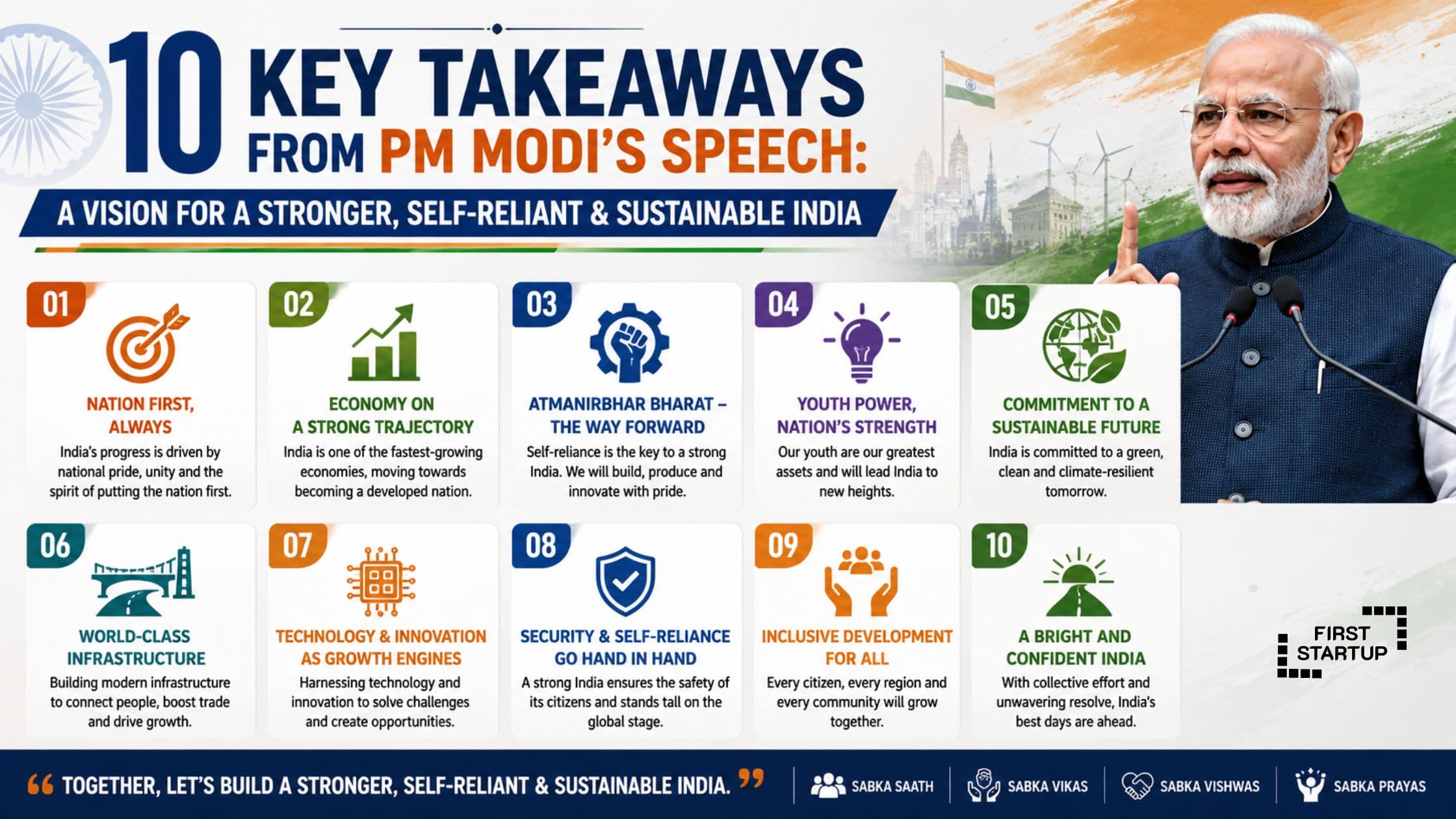
Prime Minister Narendra Modi addressed the Bloomberg New Economy Forum in New Delhi on October 13, 2026, highlighting India's economic progress, technological development, startup ecosystem and role in the global economy. His central message focused on using national strength to create opportunities for people in India and around the world.
The speech highlighted the importance of digital infrastructure, innovation, renewable energy, economic reforms and international cooperation. It also presented India's vision of becoming a stronger, more inclusive and globally connected economy.
Here are the 10 key takeaways from PM Modi's speech and what they mean for businesses, startups and entrepreneurs in India.
1. Power Should Empower People
One of the central themes of PM Modi's speech was the idea of "Power to Empower". He explained that modern sources of power include technology, data, knowledge and innovation. However, their real value lies in how effectively they improve people's lives.
For businesses, this approach highlights the importance of developing products and services that solve real-world problems. Entrepreneurs can create opportunities by using technology to improve customer experiences, simplify processes and make essential services more accessible.
The message also emphasises that economic growth should create opportunities for a wider section of society rather than benefit only a few.
2. Affordable Internet Creates New Opportunities
PM Modi highlighted India's efforts to make mobile data more affordable and expand digital connectivity. Access to the internet has helped students participate in online education, enabled professionals to develop new skills and allowed small businesses to reach customers beyond their local markets.
Digital connectivity is particularly important for entrepreneurs operating in smaller cities and towns. A business can now promote products online, communicate with customers digitally and explore new markets without necessarily opening physical offices in multiple locations.
For startups, affordable internet and digital tools provide an opportunity to compete more effectively in an increasingly connected economy.
3. Digital Payments Support Business Growth
Another important takeaway was the role of India's digital payment infrastructure in making transactions more accessible. Digital payment systems enable businesses of different sizes, from street vendors to established retailers, to accept electronic payments.
For small businesses, digital transactions can simplify collections, improve payment records and make it easier to serve customers who prefer cashless payments.
Entrepreneurs can also combine digital payments with online invoicing, accounting software and customer management tools to improve business operations.
As India's digital economy expands, businesses that adopt secure and convenient digital payment methods can be better positioned to meet changing customer expectations.
4. India's Startup Ecosystem Is Expanding
PM Modi highlighted the expansion of India's startup ecosystem, noting that the country has crossed 2.5 lakh recognised startups. He also pointed to the growing contribution of smaller cities and women entrepreneurs to India's innovation landscape.
This development demonstrates that entrepreneurship is no longer limited to major metropolitan areas. Founders in smaller cities can explore opportunities in e-commerce, food processing, manufacturing, education, technology and professional services.
However, launching a successful business requires more than an idea. Entrepreneurs should conduct market research, prepare a business plan, manage finances and understand the legal requirements associated with their chosen business structure.
Founders planning to formalise their ventures can explore options such as Private Limited Company registration, LLP registration or One Person Company registration, depending on their business goals.
5. Welfare Programmes Should Build Independence
PM Modi stressed that government support should help citizens become more capable and economically independent. He referred to poverty reduction and direct benefit transfers as important elements of this approach.
The broader takeaway is that economic development should focus on creating sustainable opportunities, improving access to essential services and enabling people to participate more actively in the economy.
For entrepreneurs, this highlights the importance of developing businesses that generate employment, improve productivity and provide useful products or services.
Small businesses can contribute to local economic development by hiring workers, purchasing from local suppliers and creating opportunities for people to develop new skills.
6. India's Capabilities Can Support the World
The Prime Minister also discussed India's role in supporting other countries through manufacturing, healthcare, digital infrastructure and skilled professionals.
He referred to India's vaccine supply during the COVID-19 pandemic as an example of how domestic capabilities can be used to support international needs. He also highlighted India's contribution to generic medicines and global business services.
For Indian businesses, this message reinforces the potential of international expansion. Companies that build reliable products, maintain quality standards and understand international regulations can explore opportunities in overseas markets.
Startups should consider export readiness, international certifications, intellectual property protection and regulatory compliance when planning to serve customers outside India.
7. Renewable Energy Is Becoming More Important
Renewable energy was another significant topic in the speech. PM Modi highlighted India's expansion of renewable energy capacity and referred to initiatives such as PM Surya Ghar and PM-KUSUM.
The broader message is that clean energy can play an important role in India's long-term development. Solar power and other renewable technologies may help households, farmers and businesses manage energy requirements while supporting environmental objectives.
For entrepreneurs, the clean-energy sector offers potential opportunities in solar installation, energy efficiency, equipment manufacturing, maintenance services and related technologies.
Businesses considering these opportunities should evaluate local demand, project costs, applicable regulations and available government schemes before investing.
8. Global Cooperation Depends on Trust
PM Modi discussed the challenges created by disruptions in global supply chains, energy markets, mineral supplies, payment systems and technology. He emphasised that trust and reliability are increasingly important in international relationships.
For businesses, these challenges highlight the importance of building resilient supply chains and maintaining dependable relationships with suppliers, customers and business partners.
Companies can improve resilience by assessing supplier risks, maintaining appropriate inventory, documenting contracts and exploring alternative sourcing arrangements where practical.
Indian businesses seeking international partnerships can also benefit from transparent operations, consistent quality and compliance with the requirements of their target markets.
9. Technology and Artificial Intelligence Are Reshaping Industries
The speech highlighted the transformative role of artificial intelligence and other technologies in changing how industries operate.
AI-powered tools can support customer service, data analysis, content workflows, software development and routine administrative tasks. Digital technologies can also help smaller companies automate repetitive work and improve operational efficiency.
However, businesses should adopt these tools responsibly. Data protection, cybersecurity, accuracy and human oversight remain important considerations when introducing AI into business processes.
For startups, the opportunity lies in identifying genuine business problems and using technology to develop practical, scalable solutions rather than adopting new tools without a clear purpose.
10. Economic Reforms Aim to Strengthen India's Business Environment
PM Modi described reforms as a continuing priority and referred to measures including GST, insolvency law changes, labour code consolidation and the decriminalisation of certain minor business-related offences.
These reforms form part of a wider effort to improve the business environment, support economic activity and simplify aspects of regulation. Their practical impact depends on implementation, sector-specific rules and the requirements applicable to individual businesses.
Entrepreneurs should stay informed about changes in tax rules, company law, employment requirements and other compliance obligations.
For a growing business, maintaining proper accounts, filing applicable tax returns and completing annual legal compliances can help reduce avoidable risks and support long-term growth.
What Does PM Modi's Speech Mean for Indian Entrepreneurs?
The speech offers several useful themes for entrepreneurs and business owners:
Adopt digital tools: Use online payments, cloud software and digital marketing to improve business operations.
Explore new markets: Consider customers beyond your city or state, including suitable international markets.
Build innovative products: Focus on solving customer problems and delivering measurable value.
Prepare for technological change: Evaluate AI and automation tools that can improve productivity.
Maintain compliance: Understand applicable business registration, taxation and reporting requirements.
Think sustainably: Explore energy-efficient practices and opportunities in clean technology.
Create employment: Build business models that can grow while generating productive opportunities for others.
For founders starting a new venture, selecting an appropriate legal structure and establishing sound financial and compliance processes are important early steps.
Conclusion
PM Modi's address at the Bloomberg New Economy Forum on October 13, 2026, placed technology, entrepreneurship, economic reforms, renewable energy and international cooperation at the centre of India's development ambitions.
The underlying message was that a country's capabilities should create opportunities for its people and contribute positively to the wider world. For Indian entrepreneurs, these themes highlight the importance of innovation, digital adoption, responsible business practices and long-term planning.
As India's business ecosystem continues to evolve, startups and small businesses can prepare for growth by building strong foundations, understanding regulatory requirements and responding to changing customer needs.
Businesses looking for support with company incorporation, GST registration, tax compliance or other business formalities can explore the relevant services offered by FirstStartup.in.
Frequently Asked Questions (FAQs)
1. What was PM Modi's speech about on October 13, 2026?
PM Modi addressed the Bloomberg New Economy Forum in New Delhi. His speech covered India's economic development, digital infrastructure, startups, technological innovation, renewable energy, reforms and international cooperation.
2. What is the main message of PM Modi's speech?
A central message was "Power to Empower", which emphasises using technology, knowledge, innovation and other capabilities to create opportunities for people and contribute to global progress.
3. What did PM Modi say about India's startup ecosystem?
He highlighted the growth of India's startup ecosystem, including its expansion into smaller cities and the participation of women in startup leadership.
4. Why is digitalisation important for small businesses?
Digital tools can help small businesses reach customers, accept online payments, manage records, automate routine tasks and explore new markets.
5. How can entrepreneurs prepare for India's changing business environment?
Entrepreneurs can focus on innovation, digital adoption, financial planning, suitable business registration, tax compliance and understanding relevant regulatory changes.
6. Where can startups get help with business registration in India?
Startups can consult professional business registration and compliance service providers, such as FirstStartup.in, to understand suitable legal structures and applicable registration requirements.