
Types of Companies in India Under the Companies Act, 2013 – Complete Guide
First Startup
Sep 01, 2026
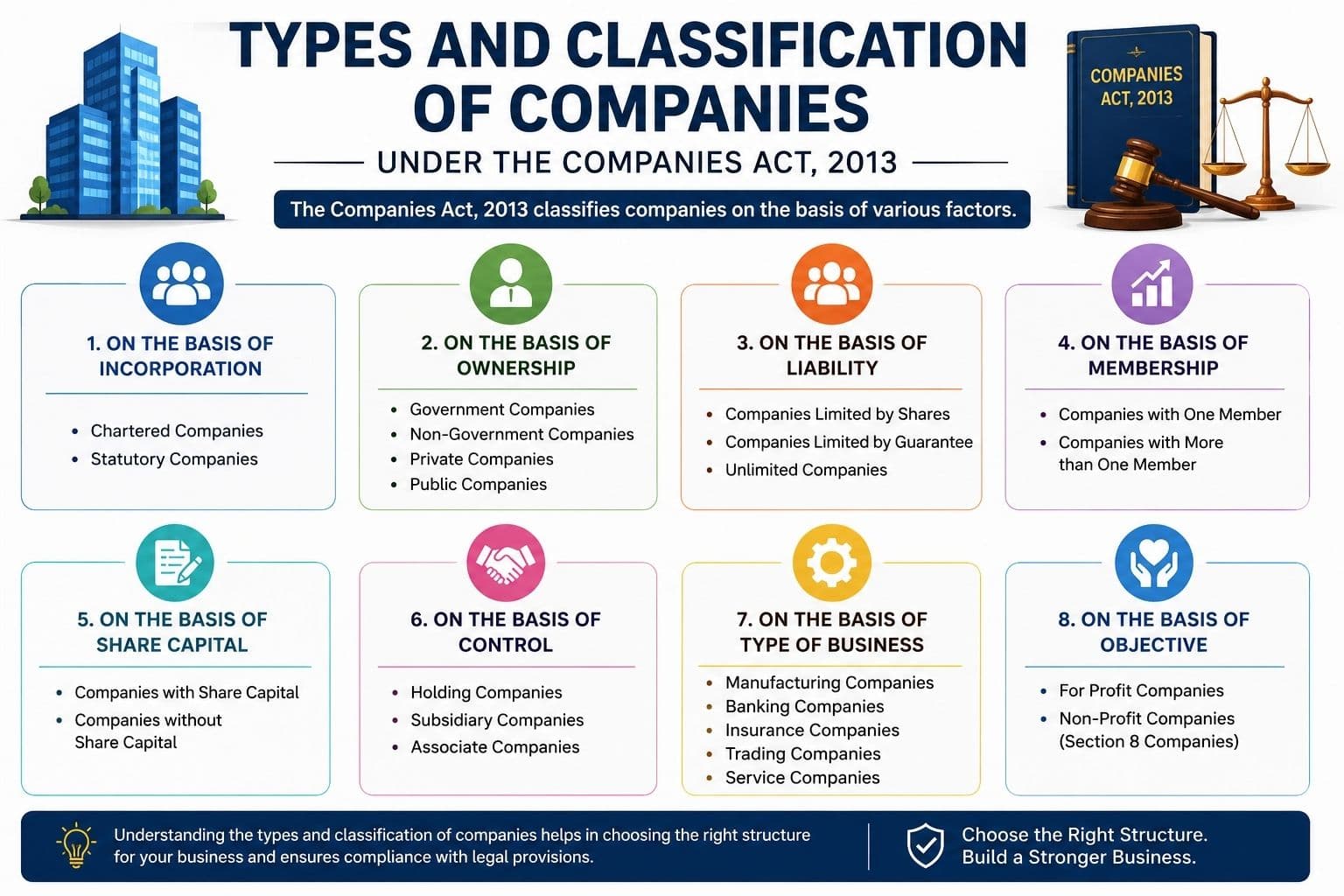
The Companies Act, 2013 provides a comprehensive legal framework for the incorporation, management, regulation, and winding up of companies in India. Depending on factors such as ownership, liability, size, control, and purpose, companies can be classified into different categories.
Understanding the types of companies under the Companies Act, 2013 is important for entrepreneurs, startups, investors, and business owners because choosing the right company structure can affect compliance requirements, taxation, funding opportunities, and the liability of owners.
In this guide, we explain the major types and classification of companies in India under the Companies Act, 2013.
What Is a Company Under the Companies Act, 2013?
Under Section 2(20) of the Companies Act, 2013, a company means a company incorporated under the Companies Act, 2013 or any previous company law.
A company is a separate legal entity from its members. This means that the company can own property, enter into contracts, incur debts, and sue or be sued in its own name.
Depending on the business objectives and requirements, entrepreneurs can choose from different forms of companies.
Classification of Companies Under the Companies Act, 2013
Companies can broadly be classified based on:
Number of members
Liability of members
Ownership and control
Size and financial criteria
Purpose of incorporation
Relationship with other companies
Place of incorporation
Listing status
Let us understand each classification in detail.
1. Private Company
A Private Limited Company is one of the most popular business structures for startups and growing businesses in India.
Under the Companies Act, a private company generally restricts the right to transfer its shares and limits the number of members to the prescribed limit.
A private company can be incorporated with a minimum of two members and two directors, subject to applicable legal requirements.
Key Features of a Private Limited Company
Separate legal identity
Limited liability of shareholders
Minimum two members
Minimum two directors
Perpetual succession
Shares are generally not freely transferable
Suitable for startups and growing businesses
Can raise funds through permitted private investment routes
Who Should Choose a Private Limited Company?
A Private Limited Company can be suitable for entrepreneurs who want limited liability, a formal corporate structure, and opportunities for future investment or expansion.
2. Public Company
A Public Company is generally suitable for businesses that require a larger capital base and may seek to raise funds from the public, subject to applicable securities laws.
A public company generally requires at least seven members and three directors.
Public companies are subject to extensive corporate governance, disclosure, and compliance requirements.
Key Features
Separate legal entity
Limited liability
Minimum seven members
Minimum three directors
Greater ability to raise capital
Shares may be transferable subject to applicable laws
Higher regulatory and compliance requirements
A public company may be listed or unlisted.
3. One Person Company (OPC)
A One Person Company (OPC) allows a single individual to establish a company while enjoying the benefits of a separate legal entity and limited liability.
An OPC has only one member. The law also provides for the appointment of a nominee who can become the member in certain circumstances.
Features of OPC
Single member
Limited liability
Separate legal entity
Minimum one director
Suitable for individual entrepreneurs
Perpetual succession through the nominee mechanism
An OPC can be a useful option for an entrepreneur who wants to operate independently through a corporate structure.
4. Section 8 Company
A Section 8 Company is formed for promoting charitable, social, educational, environmental, scientific, sports, or other specified objectives.
The primary objective of a Section 8 Company is not to distribute profits among its members. Any income or profits are generally applied towards achieving the company's objectives.
Common Objectives
A Section 8 Company may work in areas such as:
Education
Healthcare
Social welfare
Environmental protection
Research
Art and culture
Sports
Skill development
Charity
Section 8 Companies are commonly used by organisations working for social and non-profit purposes.
5. Company Limited by Shares
A company limited by shares is a company where the liability of its members is limited to the amount, if any, unpaid on the shares held by them.
For example, if a shareholder holds shares worth ₹1,00,000 and has already paid ₹80,000, the shareholder's liability may generally be limited to the remaining unpaid amount of ₹20,000, subject to the terms of the shares and applicable law.
This is one of the most common forms of companies in India.
6. Company Limited by Guarantee
In a company limited by guarantee, members agree to contribute a specified amount to the company's assets in the event of winding up.
This type of company is generally used for organisations where members' contribution is based on a guarantee rather than share capital.
It can be used for certain non-profit or membership-based organisations, depending on their objectives and legal structure.
7. Unlimited Company
An unlimited company is a company where the liability of its members is not limited.
Unlike a limited company, members may have unlimited liability in accordance with the applicable provisions of law.
Although legally permitted, unlimited companies are comparatively uncommon because members may face greater financial exposure.
8. Government Company
Under the Companies Act, 2013, a Government Company is a company in which not less than 51% of the paid-up share capital is held by:
The Central Government; or
One or more State Governments; or
Partly by the Central Government and partly by one or more State Governments.
A subsidiary of a Government Company can also fall within the definition as provided under the Act.
Government Companies operate in various sectors and remain subject to the applicable provisions of company law.
9. Foreign Company
A Foreign Company refers to a company or body corporate incorporated outside India which establishes a place of business in India, whether by itself or through an agent, physically or through electronic mode, and conducts business activity in India in accordance with the statutory definition.
Foreign companies carrying out business activities in India must comply with applicable provisions of the Companies Act, 2013 and other relevant laws.
10. Holding Company
A Holding Company is a company of which one or more other companies are subsidiary companies.
The holding company exercises control over its subsidiary or subsidiaries as prescribed under the Companies Act.
For example:
Company A → Holding Company
Company B → Subsidiary Company
Holding structures are commonly used by business groups to manage multiple businesses or investments through separate legal entities.
11. Subsidiary Company
A Subsidiary Company is a company in which the holding company:
Controls the composition of the Board of Directors; or
Exercises or controls more than one-half of the total voting power, either on its own or together with one or more subsidiary companies.
A subsidiary remains a separate legal entity even though it is controlled by another company.
12. Associate Company
An Associate Company is a company in which another company has significant influence but which is not a subsidiary of that company.
Significant influence generally means control of at least 20% of the total voting power, or participation in business decisions under the circumstances prescribed by law.
An associate relationship is commonly relevant in corporate investment and group structures.
13. Small Company
The Companies Act, 2013 provides a special classification for Small Companies, subject to prescribed financial thresholds and exclusions.
The applicable thresholds can be revised by the Government from time to time. Therefore, businesses should verify the latest prescribed limits before determining whether they qualify as a small company.
Small companies may receive certain compliance relaxations under company law.
However, certain companies, such as public companies and specified categories excluded under the Act and rules, may not qualify as small companies even if they meet financial thresholds.
14. Listed Company
A Listed Company is a company that has any of its securities listed on a recognised stock exchange, subject to applicable legal provisions.
Listed companies are subject to additional disclosure, governance, reporting, and securities-market requirements.
They are regulated not only under the Companies Act but also under applicable regulations of the Securities and Exchange Board of India (SEBI) and stock exchange requirements.
15. Unlisted Company
An Unlisted Company is a company whose securities are not listed on a recognised stock exchange.
Many Private Limited Companies and several Public Limited Companies are unlisted.
Being unlisted does not mean that the company is exempt from statutory compliance. The applicable requirements depend on the company's structure, size, activities, and other factors.
16. Nidhi Company
A Nidhi Company is a type of company incorporated with the objective of cultivating the habit of thrift and savings among its members and receiving deposits from, and lending to, its members for their mutual benefit, subject to applicable legal requirements.
Nidhi Companies are governed by specific provisions under the Companies Act, 2013 and applicable rules.
Their activities and operations are subject to prescribed conditions and restrictions.
17. Producer Company
A Producer Company is formed by producers or producer institutions for purposes connected with primary produce and the interests of producers.
Producer Companies may be used by individuals or organisations involved in activities such as:
Agriculture
Farming
Dairy
Handloom
Handicrafts
Food processing
Other primary production activities
The structure is designed to support collective economic activities of producers.
Difference Between Major Types of Companies
| Type of Company | Main Purpose | Minimum Members | Liability |
|---|---|---|---|
| Private Company | Business/startups | 2 | Limited |
| Public Company | Larger business/fund raising | 7 | Limited |
| OPC | Individual business | 1 | Limited |
| Section 8 Company | Non-profit objectives | As prescribed | Limited |
| Company Limited by Shares | Commercial/non-profit activities | As applicable | Limited to unpaid share amount |
| Company Limited by Guarantee | Membership/non-profit activities | As applicable | Limited to guarantee |
| Unlimited Company | Business activities | As applicable | Unlimited |
| Government Company | Government-controlled business | As applicable | Generally limited |
| Foreign Company | Foreign business operating in India | As applicable | Depends on structure |
The exact legal requirements can vary depending on the company category and applicable amendments, rules and regulations.
How to Choose the Right Company Structure?
Selecting the appropriate business structure depends on several factors.
1. Number of Founders
If you are starting alone, an OPC may be considered. If there are two or more founders, a Private Limited Company or another suitable structure may be appropriate.
2. Business Objective
For commercial businesses, structures such as Private Limited or Public Limited Companies may be considered. For charitable objectives, a Section 8 Company may be more appropriate.
3. Funding Requirements
Startups planning to raise external investment often prefer a Private Limited Company because of its corporate structure and ability to issue shares subject to applicable laws.
4. Liability Protection
If protecting personal assets from business liabilities is a priority, a limited-liability corporate structure may be suitable, subject to legal and factual circumstances.
5. Compliance Requirements
Different companies have different compliance obligations. Before incorporation, entrepreneurs should understand annual filings, accounting requirements, audit requirements, board meetings, tax compliance, and other applicable regulations.
Private Limited Company vs OPC
Two structures frequently considered by entrepreneurs are a Private Limited Company and an OPC.
| Feature | Private Limited Company | OPC |
|---|---|---|
| Members | Minimum 2 | 1 |
| Directors | Minimum 2 | Minimum 1 |
| Separate Legal Entity | Yes | Yes |
| Limited Liability | Yes | Yes |
| Suitable For | Multiple founders/startups | Individual entrepreneurs |
| Fundraising | Generally more flexible | Subject to applicable provisions |
| Nominee | Not applicable in the same manner | Required |
The right choice depends on the entrepreneur's business objectives, funding plans, ownership structure, and future expansion.
Why Is Company Classification Important?
Company classification is important because the applicable legal and compliance requirements can depend on the company's category.
Classification can influence:
Incorporation requirements
Minimum members and directors
Share capital and ownership structure
Annual compliance
Financial reporting
Audit requirements
Board and shareholder meetings
Disclosure requirements
Investment and fundraising options
Regulatory obligations
Therefore, selecting the correct structure at the beginning can help entrepreneurs establish a stronger foundation for their business.
Documents Generally Required for Company Incorporation
The documents required may vary depending on the type of company and the circumstances of the applicants. Common documents can include:
PAN and identity proof of proposed directors/members
Address proof
Passport-size photographs
Registered office address proof
Utility bill
NOC from the property owner, where applicable
Digital Signature Certificate (DSC)
Director-related declarations and information
Proposed company name
Details of business activities
Additional documents may be required depending on the business structure and proposed activities.
How FirstStartup Can Help With Company Registration
Choosing the right company structure can sometimes be confusing, especially for first-time entrepreneurs.
FirstStartup can assist businesses with company incorporation and related compliance services, including:
Section 8 Company Registration
Startup Registration
MSME Registration
ROC Compliance
Accounting and Tax Services
Professional assistance can help ensure that the proposed structure and incorporation documents are prepared according to the applicable requirements.
Conclusion
For entrepreneurs, selecting the right company structure is an important decision because it can affect ownership, liability, compliance, taxation, investment, and future growth.
Before incorporating a company, it is advisable to evaluate the business objective, number of founders, investment requirements, expected turnover, compliance responsibilities, and long-term plans.
Looking to register your company in India? Get professional assistance from FirstStartup and choose a business structure that fits your requirements.