
What Is an Eway Bill? How Can a Person Generate an Eway Bill?
First Startup
Sep 01, 2026
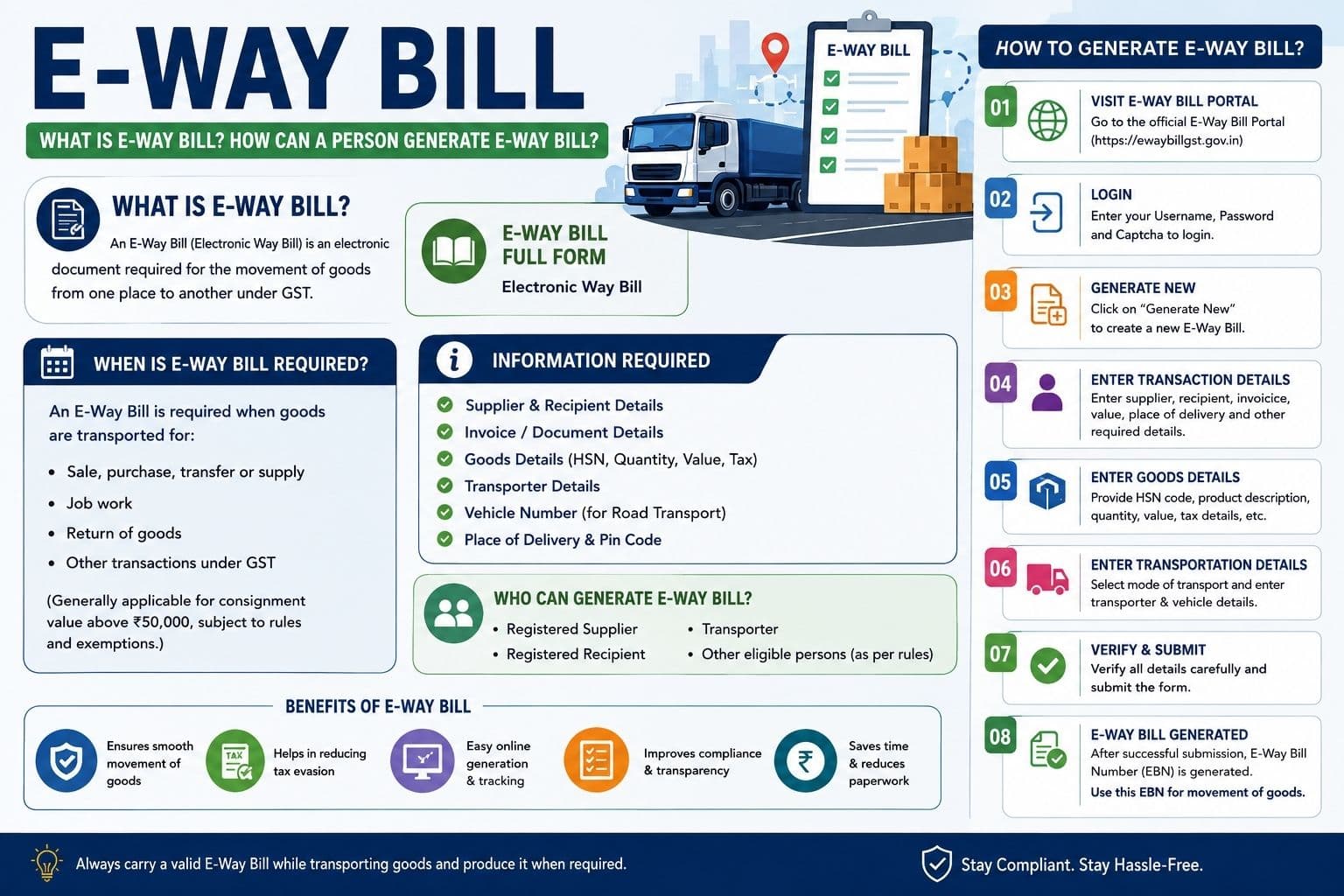
An eway bill is an electronic document required for the movement of goods from one place to another under the Goods and Services Tax (GST) system in India, subject to applicable conditions and exemptions. It helps tax authorities monitor the movement of goods and supports better GST compliance.
The eway bill full form is Electronic Way Bill. It is generated electronically through the GST e-way bill system and contains important information about the supplier, recipient, goods, invoice, and transportation.
What Is an Eway Bill?
An eway bill, also written as e-way bill, is an electronic document generated for the movement of goods when the prescribed GST conditions are applicable.
The eway bill contains important details related to the transportation of goods, including:
Supplier details
Recipient details
Invoice or document details
Value of goods
Description of goods
HSN code
Transporter details
Vehicle details
Place of delivery
After successful generation, the system provides a unique E-Way Bill Number (EBN).
The ewaybill number can be used for verification during the transportation of goods.
Eway Bill Full Form
The eway bill full form is Electronic Way Bill.
It is an electronic document used under India's GST system to facilitate and monitor the movement of goods. The eway bill system helps create a digital record of goods being transported and supports GST compliance.
Businesses involved in the supply and transportation of goods should understand the applicable eway bill requirements before moving goods from one location to another.
Why Is an Eway Bill Required?
The eway bill system was introduced to improve the monitoring of goods transportation under GST.
Some important purposes of an eway bill include:
1. Monitoring Goods Movement
An eway bill provides information about goods being transported from one location to another.
2. Reducing Tax Evasion
The digital system helps tax authorities monitor goods transportation and identify potential cases of tax evasion.
3. Digital Documentation
Businesses can generate and manage eway bills electronically, reducing dependence on physical transportation documents.
4. Better GST Compliance
Maintaining proper eway bill records can help businesses manage their GST compliance more effectively.
5. Easy Verification
Tax authorities can verify the ewaybill details electronically during the transportation of goods.
When Is an Eway Bill Required?
Generally, an eway bill is required when there is a movement of goods in connection with a supply and the applicable GST conditions are satisfied.
The movement of goods may be related to:
Sale of goods
Transfer of goods
Purchase from an unregistered person
Return of goods
Job work
Other transactions covered under GST rules
The commonly applicable threshold for eway bill requirements is ₹50,000, subject to applicable rules, exemptions, and specific circumstances.
Businesses should therefore check the latest applicable GST provisions before generating an eway bill.
Who Can Generate an Eway Bill?
Depending on the nature of the transaction, an eway bill can be generated by:
Registered suppliers
Registered recipients
Transporters
Other eligible persons in applicable circumstances
For example, when a registered business supplies goods to another business and the eway bill conditions are satisfied, the supplier or recipient may generate the eway bill.
A transporter may also generate or update the ewaybill where applicable.
What Information Is Required to Generate an Eway Bill?
Before generating an eway bill, the person should keep the relevant transaction and transportation information ready.
Supplier Details
GSTIN, where applicable
Business name
Address
Recipient Details
GSTIN, where applicable
Name
Delivery address
Invoice Details
Invoice number
Invoice date
Document type
Value of goods
Goods Details
Product description
HSN code
Quantity
Unit
Taxable value
Applicable GST details
Transportation Details
Mode of transportation
Transporter details
Vehicle number, where applicable
Transport document details, where applicable
Correct information is important because the ewaybill may be checked during transportation.
How Can a Person Generate an Eway Bill Online?
A person can generate an eway bill online through the official GST e-way bill system.
The general process is explained below.
Step 1: Visit the Eway Bill Portal
Visit the official GST eway bill portal and log in using the appropriate credentials.
Step 2: Log In
Enter the required:
Username
Password
Captcha
After successful login, the eway bill dashboard will appear.
Step 3: Select "Generate New"
From the dashboard, select the option to generate a new eway bill.
The ewaybill generation form will open.
Step 4: Enter Transaction Details
Enter the required transaction information, including:
Transaction type
Supplier details
Recipient details
Invoice number
Invoice date
Value of goods
Delivery location
The information should match the invoice and other relevant documents.
Step 5: Enter Goods Details
Enter the details of the goods being transported.
These may include:
Product name
HSN code
Quantity
Unit
Taxable value
GST rate
Tax amount
Step 6: Enter Transportation Details
Select the applicable mode of transportation.
The eway bill system supports transportation through modes such as:
Road
Rail
Air
Ship
For road transportation, relevant transporter and vehicle details may be required.
Step 7: Enter Vehicle Number
If the goods are being transported by road, enter the applicable vehicle number.
The vehicle number should be checked carefully before submitting the eway bill.
Step 8: Verify the Details
Before generating the ewaybill, carefully verify:
GSTIN
Invoice number
Invoice date
HSN code
Goods description
Goods value
Destination
Vehicle number
Transporter details
Correcting errors before submission can help avoid compliance problems.
Step 9: Generate the Eway Bill
After verifying the information, submit the form.
If the details are successfully processed, the system generates the eway bill along with a unique E-Way Bill Number (EBN).
The ewaybill details should be retained for the required period and made available during transportation as applicable.
What Is Part A and Part B of an Eway Bill?
The eway bill system broadly contains two sets of information known as Part A and Part B.
Part A
Part A generally contains information relating to:
Supplier
Recipient
Invoice
Goods
Value
Destination
Part B
Part B primarily contains transportation-related information, such as:
Vehicle number
Transport document details
Transporter information
Mode of transportation
The applicable details in Part A and Part B together form the eway bill information required for the movement of goods.
What Is the Validity of an Eway Bill?
The validity of an eway bill generally depends on factors such as the distance involved and the type of transportation.
For regular vehicles, validity is generally linked to the distance to be travelled. Different provisions can apply to over-dimensional cargo and certain other situations.
Businesses should monitor the validity of their ewaybill and follow the applicable rules for updating or extending it where permitted.
What Happens If an Eway Bill Is Not Generated?
If an eway bill is required under GST rules but has not been generated, the taxpayer or transporter may face compliance issues.
Depending on the circumstances, this may result in:
Detention of goods or vehicle
Penalty
Additional verification
Transportation delays
Other consequences under applicable GST law
Therefore, businesses should determine whether an eway bill is required before transporting goods.
Common Eway Bill Mistakes to Avoid
Businesses should carefully check all information before generating an eway bill.
1. Incorrect GSTIN
Entering the wrong GSTIN of the supplier or recipient can result in compliance issues.
2. Wrong Invoice Number
The invoice number entered in the eway bill should match the actual invoice.
3. Incorrect Vehicle Number
A wrong vehicle number can create problems during roadside verification.
4. Incorrect HSN Code
The HSN code should correctly correspond to the goods being transported.
5. Incorrect Goods Value
The value of goods should be entered accurately based on the applicable transaction documents.
6. Failure to Update Details
Where transportation details change, the applicable ewaybill information should be updated according to the GST rules.
Eway Bill for Unregistered Persons
In certain circumstances, an unregistered person may also be required to comply with eway bill provisions.
For example, where goods are supplied by an unregistered person and the applicable GST provisions require an eway bill, the responsibility may fall on the recipient or another person as prescribed.
Therefore, an unregistered person should not automatically assume that eway bill requirements do not apply.
How Can Businesses Avoid Eway Bill Problems?
Businesses can reduce eway bill-related errors by following these practices:
Verify GSTIN before generating the eway bill.
Keep invoices and supporting documents ready.
Check the HSN code carefully.
Enter the correct value of goods.
Verify vehicle details.
Monitor eway bill validity.
Update transportation details when required.
Maintain proper ewaybill records.
Check the latest GST rules and exemptions.
Difference Between Invoice and Eway Bill
An invoice and an eway bill are different documents.
An invoice is a commercial and tax document containing details of a supply of goods or services.
An eway bill, on the other hand, is primarily associated with the movement of goods.
For applicable transactions, a business may need both an invoice and an eway bill during transportation.
Eway Bill and GST Compliance
The eway bill is an important part of GST compliance for businesses involved in the supply and transportation of goods.
Proper ewaybill management can help businesses:
Maintain transportation records
Reduce documentation errors
Improve GST record management
Avoid unnecessary compliance issues
Support smooth transportation of goods
Businesses that regularly transport goods should establish a process for checking whether an eway bill is required for each transaction.
Frequently Asked Questions About Eway Bill
What is the eway bill full form?
The eway bill full form is Electronic Way Bill.
What is an eway bill?
An eway bill is an electronic document generated for the movement of goods when the prescribed GST conditions are applicable.
What is the eway bill limit?
The commonly applicable threshold is ₹50,000, subject to applicable GST rules, exemptions, and specific circumstances.
Who can generate an eway bill?
Depending on the transaction, a registered person, recipient, transporter, or another eligible person may generate an eway bill.
Can I generate an eway bill online?
Yes. An eway bill can be generated electronically through the GST e-way bill system.
Is an eway bill required for every movement of goods?
No. The requirement depends on the nature and value of the movement, applicable GST provisions, exemptions, and other prescribed conditions.
What is an E-Way Bill Number?
The E-Way Bill Number (EBN) is the unique number generated after an eway bill is successfully created.
Can an eway bill be cancelled?
An eway bill may be cancelled in applicable circumstances and within the prescribed time limit under the GST rules.
Conclusion
An eway bill, whose full form is Electronic Way Bill, is an important GST compliance document for the movement of goods when the prescribed conditions apply.
The eway bill system provides a digital mechanism for recording information about the supplier, recipient, goods, invoice, and transportation. Generating an ewaybill is generally straightforward when all required information is available.
Before transporting goods, businesses should check whether an eway bill is applicable, enter accurate information, verify the generated EBN, and ensure compliance with the applicable GST rules.
Because GST provisions, exemptions, and procedures may change, taxpayers should verify the latest applicable requirements before generating or using an eway bill.